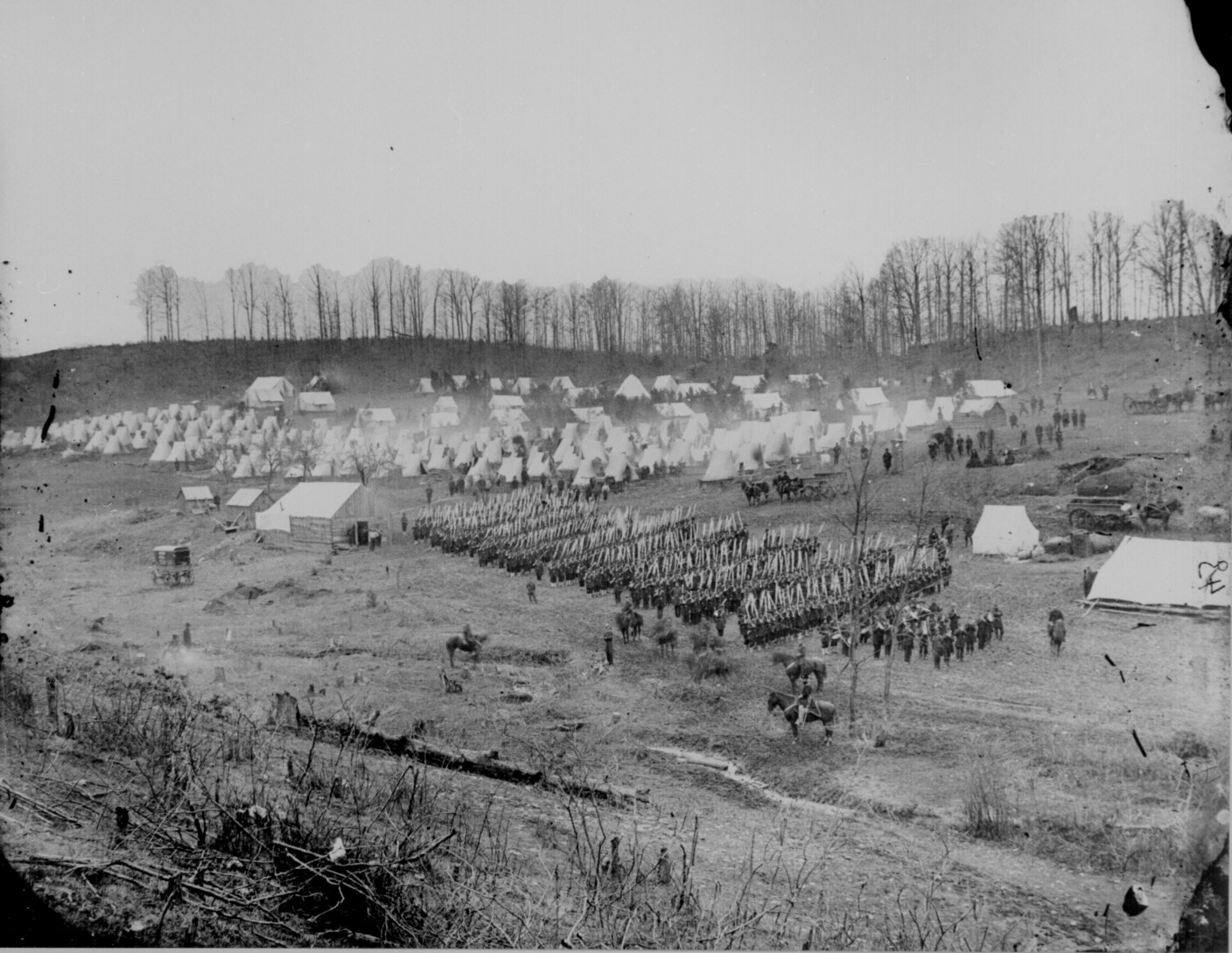
The Army of the Potomac Exits Maryland

150 Years Ago This Week – Berlin, MD

< Noyes speaks frequently in the following segment about “our general” … and is of course talking about Doubleday. >

Tuesday, October 28th. A good sleep and a capital breakfast prepared us for our morning march. As we rode up and through Crampton’s Pass we enjoyed a fine sweep of landscape, and saw the town of Birketsville  < actually spelled Burkittsville > sitting up on its own little knoll, keeping watch and ward over the broad checkerboard of farms and orchards. The general was riding at some distance in front of the troops, and, having joined him, I was ordered to ride on to Berlin, <known since 1890 as Brunswick>  the little town on the Potomac which had been selected as the crossing-place of the army. My ride was, as usual, through a region crowded with troops; the turnpikes were now helped out by roads extemporized through the fields on both sides; mile upon mile stretched the great caravan, pressing slowly forward. It was evident that the Army of the Potomac was at last in motion.

Burkittsville

Berlin was a very interesting place to staff officers about this time, being situated on the railroad which brought up all the army supplies, but ordinarily it has few attractive features. For the next two or three days the village and the region about it became one vast military camp. General McClellan had already established his headquarters in a grove back of the town, and long wagon-trains were at once sent across the river over the pontoon bridge with subsistence stores, which they left in great stacks along the roadside, and then returned for more. Berlin was to be our only depot until we reached Warrenton, and every effort was necessary to provide against contingencies.

Having finished my business, I rode back, to find the division bivouacked about a mile out of town. The evening air was lit up with ten thousand campfires; and when tattoo was sounded by the bugles in every direction, we went to our beds, rejoicing in the belief that the Army of the Potomac was so soon to bid farewell to Maryland.

Exiting Maryland into Virginia – 150 Years Ago 10/30

Thursday, October 30th. Yesterday was a very busy day for me, passed chiefly at Berlin; and to-day, at 1 P.M., we struck tents for the last time in Maryland, and the division moved at once into the town. But so many thousands were now pressing forward over the pontoon bridge that our march was delayed for an hour or two, and we sat with the general on our horses, amused by the evident exhilaration of the troops as they hurried by. The day was beautiful, and every one had quite a touch of the old enthusiasm. At last it was our turn to cross; the men who had been standing at ease along the streets and road fell in, the bands gave us their most exhilarating music, and at the head of his division of eight thousand men the general, with his staff, moved toward the pontoon bridge. All our tedious waiting at Antietam was forgotten; only the pleasant reminiscences of our Maryland campaign were left in our memory, and never have I felt more sanguine of success than on this lovely afternoon.
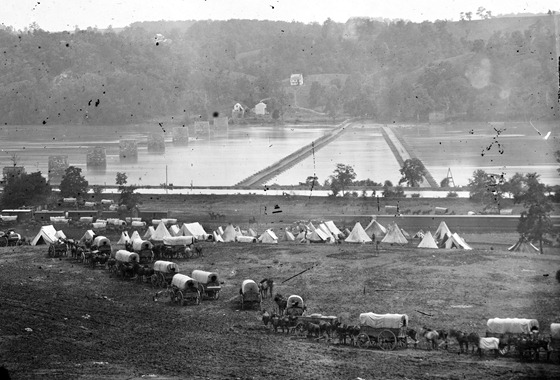
Pontoon Bridge at Berlin, MDJust as we reached the bridge my hand was seized by a strong, two-handed grip, and, turning, I saw the pleasant face of one of our Fredericksburg friends, a good Union farmer of intelligence and thorough loyalty, who had been compelled to fly when our army relinquished that city. His “God bless you!” and fervent hope that we might free his state in this second trial, so that he might once more return home, greatly impressed me. I accepted it as a good omen to be thus cordially welcomed at the threshold of his state by a patriotic and warm-hearted Virginian. <Noyes served with Doubleday’s brigade in the spring of 1862 when it was stuck with McDowell’s troops in Fredericksburg for an extended time. Noyes was quick to make acquaintances with local folks wherever he went.>

While previously in Fredericksburg, Doubleday had caused quite a stir by allowing escaping slaves to pass through lines unhindered. He and staff officers hired some to go with the army and attend to various tasks. One can rightly imagine the fear in these folks at the prospect of retracing their steps to Virginia – the place of their slave confinement. Noyes writes of this:

During this day there was great excitement among our contrabands. The idea of going back to their former homes greatly disturbed them; nor could we blame them for desiring to keep out of the old net. Our cook had no wish to fry any more buckwheats for General Lee, his former master, and my own body-servant came to me with a look so piteous that I had not the heart to say him nay; so we paid them, and sent them back to Berlin rejoicing. Only two were now left of the old set who linked their fortunes with ours at Fredericksburg-Berryman, the old gray-headed darkey, whom I have seen so often sitting in the shadow of the general’s tent, teaching himself to read, the ugliest and apparently least serviceable of the whole party, whom the general took out of mere charity, but who gradually became useful, faithful, and wholly reliable, attending the general with the same solicitude felt by a good nurse for her little charge, and never known to be away from the headquarter wagons on a march; and Charles, a handsome, six-foot, finely-formed native of Maryland, who came nearer to Mrs. Stowe’s Uncle Tom in the simplicity, truthfulness, and deep religiousness of his nature than any I ever met with. The latter, now that my former servant had departed, became attached to the adjutant general and myself jointly, and the whole care of overseeing the pitching of my tent and furnishing it was safely entrusted to his hands.

Moving out of Maryland through Crampton’s Gap

Here is a short excerpt – again from the pen of George F. Noyes in his book “The Bivouac and the Battlefield.” As was evident in the post from yesterday, Noyes stayed behind in Bakersville an extra day. So the events of this writing must have occurred on Monday, October 27th.

This morning the rain had become more reasonable, did not come down so uncompromisingly, and at noon the heavens had gotten over their weeping-fit, and once more smiled on us. Great was the loading of wagons with quarter-master and commissary stores, and the last two tents disappeared from beside the

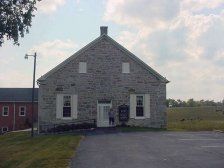
The school house

school-house, my own masked battery being one of them. At breakfast I had achieved a horse-trade. My mess having departed yesterday, I breakfasted at a farmhouse, and there sat at meat with us a stranger, uncouth, unkempt, unclean. < It is interesting how the more things change, the more they stay the same – as such a fellow would not be entirely rare in these parts 150 years later! >  Happening to mention that I should require another horse, my mare being overworked, he of course had just the animal, and after breakfast brought to my tent a beast, large, black, clumsy, and strong, with big feet for wading through the mud. It was my duty to inspect and try him. Now if there was any one quality for which I was noted among the staff, it was my entire ignorance of the good points of a horse; but I mounted the black Bucephalus, rode him a couple of hundred yards, and returned looking very wise and saying nothing. < Bucephalus was the name of the war horse of Alexander the Great, and was a word to describe any animal capable of taking a person into war. > Thus I left it to the horse-dealer to make the first move, and the trade began. As it is the common belief that in a horse-trade the most honest man will try to cheat his own brother, I armed myself at all points with objections, but finally made an offer, which was, after much demur, accepted, and the beast was mine. I never repented of the bargain. Though evidently intended for a truck-horse, he was invaluable for the slow, heavy work of a muddy campaign. On my new black, then, my mare being ridden by my servant, I was soon plunging through the mud out of Bakersville, passing mile after mile of wagons, and reached, about 4 P.M., the head of the column.

The division was just going into bivouac in the fields lying under South Mountain, in the highly picturesque region at the western entrance of Crampton’s Pass. … It was late before the headquarter tents arrived, and as my own was still in the rear, I accepted the invitation of our colonel, a man with very correct ideas as to comfort, to pass the night at the pleasant residence of Mr. Crampton. Colonel Phelps, commanding the 1st brigade, and his staff soon joined us, and with these gentlemen, of whose bravery in battle and openhearted hospitality I had enjoyed abundant evidences, we supped and lodged. Among my many pleasant campaigning memories, that merry evening round Mr. Crampton’s blazing logs, with its mixture of solid conversation and sweet cider, has pleasant prominence. <The Cramptons living in this area were apparently the grandchildren of a Thomas Crampton who first laid out the roads through this area in the 1760s and following. It is my understanding that the Crampton lands were sold off in the 1880s, and doubt that the home of which Noyes speaks is remaining… though here is a map mentioning some Crampton homes:

Regarding Colonel Walter Phelps: He was a brigade commander at South Mountain and Antietam … recording a 43% loss on September 17th.  From research materials that I have recorded from the U.S. Army Military Heritage Institute in Carlisle, PA … in a box of Phelps papers was the following letter from Abner Doubleday…

Camp near White Oak Church

HQ 3rd Divis.  1st A.C.

May 30, 1863

My Dear Colonel:

Now that you are going to leave us I desire to express to you in a few words my high appreciation of the valuable service you have rendered the government while under my immediate command.  Your valor and constancy in the battles of South Mountain, Antietam, and Fredericksburg did much to ensure the success of our Division.  That the splendid body of men commanded by you were able to achieve so much was due in a great measure to the excellent drill and severe discipline inculcated by you.  We all consider your absence a positive loss to the Army and the country.  In bidding you adieu I can only hope that your future life will be as happy as your past has been glorious.

I am, colonel, with much esteem your sincere friend.   .. A. Doubleday, Major Gen of Vol

The Army of the Potomac Finally Moves to Leave Maryland

150 Years Ago – 10/24-10/26:

This will be essentially my last posting in the recent series about the “Antietam Aftermath,” and it will serve also as a hinge to all that is to follow – in terms of my writing to follow the War from the perspective of “this day 150 years ago.”  I’ll again use the written record of George F. Noyes – who talks here about their camp being moved from an area likely just to the southwest of the battlefield toward Shepherdstown, to an area several miles north. But soon after, the narrative turns to speak of their exit from Sharpsburg and Maryland – finally – six weeks after the Battle of Antietam.

Writing with a listed date of October 24thOur division was this day ordered to Bakersville, half a dozen miles up the Potomac, and after breakfast I rode thither with the general <speaking of Abner Doubleday> and our topographical lieutenant, in order to select proper locations for the different brigades. Even so small a change was pleasant; the morning ride very agreeable; wood and water were found in abundance, and long before the brigades arrived their camping-grounds were ready for them. By nightfall they were comfortable; pickets were sent out to line the banks of the river; everybody but the division staff was at home. The general, who now

Bakersville – The red house at the bottom of the hill sits on the crossroads of the village and is the largest house there – looking old enough also.

had his wife with him, had taken rooms in the chief residence of Bakersville, and we had selected a pretty spot close at hand for the headquarter tents. But day glided slowly into night, and our headquarter wagons had not arrived. As it turned out, they had mistaken the road, and gone off upon a reconnaissance in another direction. The night was rainy, and it was after 8 o’clock before they came slowly rumbling along. All ready stood the division guard to unpack and pitch our tents; all ready were our servants to set up our simple housekeeping gear; our cook seized at once his mess-chest, and in half an hour I was sitting comfortably in my tent, everything in its place, hearing the rain patter down upon the roof, and indulging with a friend or two in a late dinner of coffee, bread and butter, and pickled oysters.

Bakersville – Salem Evangelical Lutheran Church – local church people say that Abraham Lincoln visited there during his several days around Sharpsburg.

< For anyone reading this who was at the Antietam sesquicentennial last month, Bakersville is the location where the reenactments took place – certainly on ground where Doubleday’s men camped. >

Bakersville rejoices in one store, with a motley stock of groceries, medicines, and dry goods, consecrate to barter and country gossip, and in some half a dozen residences, so that our staff and attendants doubled its population. Our tents were perched upon an elevation overlooking the little hamlet; our division guard and orderlies encamped in a field on the opposite side of the road, while in the rear our cooks and servants reigned supreme. As the evenings were now cold, a big fire was built at nightfall in front of each tent, the tent-flaps flung back, and a portion of the heat thus penetrated within. Two of our lieutenants had confiscated somewhere a sheet-iron stove with a long piece of pipe, which, when thrust horizontally out of their tent-flaps, looked like a gun protruding from an embrasure. The general now occupied himself in thoroughly exploring the vicinity, while our topographical officer was busy in mapping it out. During our stay here I rode twice to Hagerstown, some twelve miles distant, a pretty town; and as one or two rebel raids around our quiescent army had just stirred up the apprehensions of its citizens, it was overflowing with uniforms.

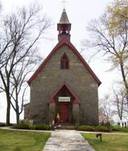
The older church from decades before the Civil War

Our stay here was to be very brief; the usual order to have three days’ cooked rations was issued to the men shortly after our arrival, and at length, on Sunday, October 26th, the order to march actually came. Once more we were to cross the Potomac into Virginia; probably a long and weary march was before us. The wet season was also at hand, and on this day of moving the rain came down in a deluge. But everyone was glad of the expected change. By noon the whole column was in motion; our headquarter tents were all struck save my own and the quartermaster’s, and the wagons moved off, sinking to their hubs in the mud as they rolled slowly along. … There was one good feature about this day’s march. It was not one of those doubtful days when, by picking your way, now here, now there, you can partially protect yourself, for the mud was deep and universal. There was no anxiety about it; your first plunge settled the matter, and you had wet feet and the entire freedom of the road for the rest of the day. … So very slow was the movement of the division that it was after nightfall before the rear brigade marched by, and still poured down the driving rain. Fortunately, the night’s march was not a long one; yet I felt almost a compunction of conscience as I laid down in my camp-bed and thought of the poor fellows bivouacking in the wet fields. < Note that he is saying that he and the quartermaster were not in movement on this day when everyone else was headed off toward Virginia. As can be seen in tomorrow’s post, the division would have been marching toward the southeast from the current location. So Noyes was still somewhat comfortable in his tent on this rainy day, while those marching would have had little such shelter and comfort. As we’ll see, it was cold and raining for a number of days – much unlike this season at the moment that I write of these events! … although a huge hurricane is threatening!>

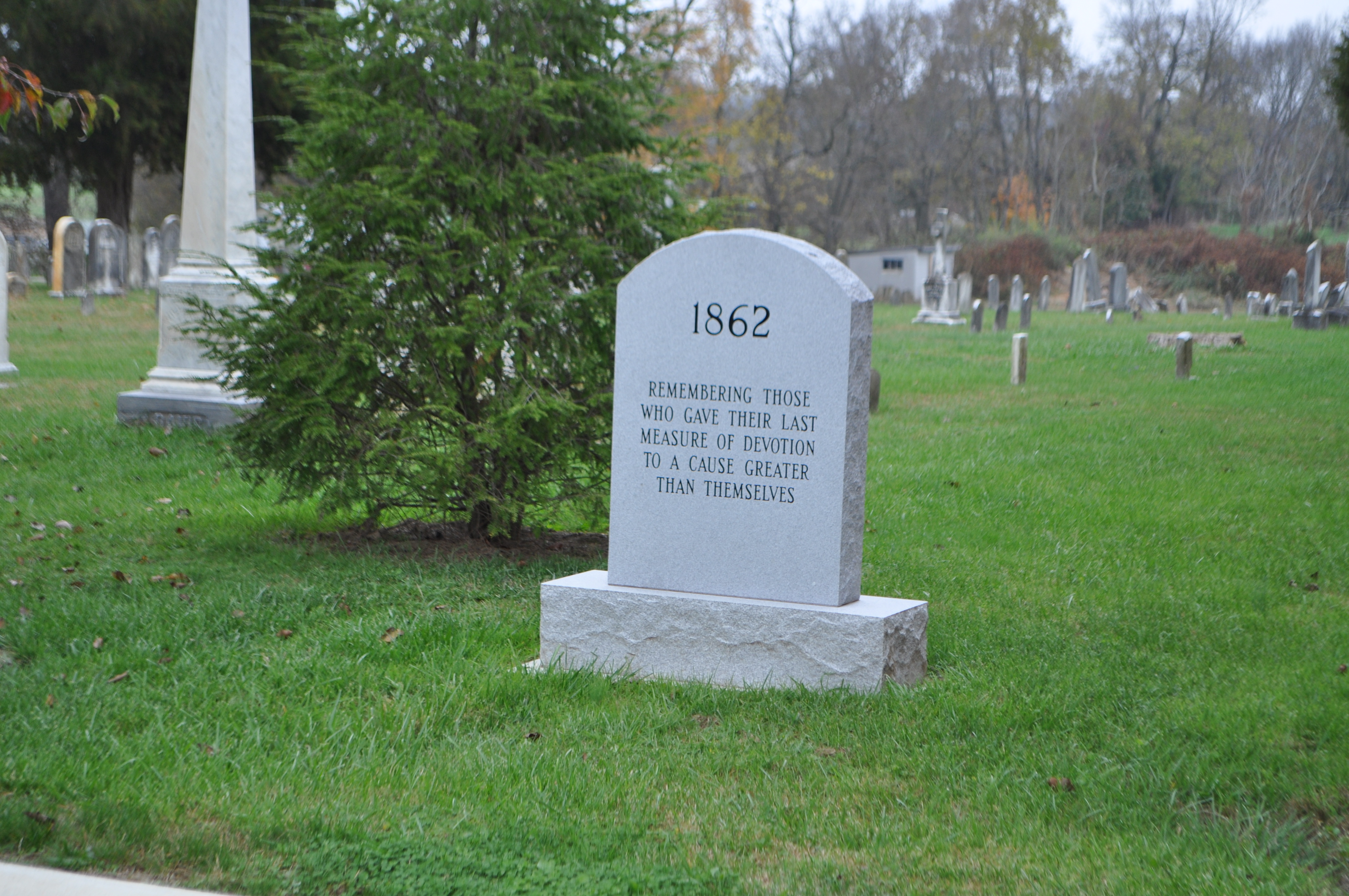
Here is a very recent monument next to the 1850s church


Antietam Area Church Services – October 1862

This is the 11th of a series of posts on the aftermath of Antietam – this one again from the pen of George F. Noyes. This member of Doubleday’s staff writes in this excerpt about his adventure on Sunday, October 19 of 1862 of going to two church service in the Sharpsburg area. I am going to guess the names and locations of the congregations of which he speaks…

Today I resolved to go to church, if such a thing were possible. All the little meeting-houses in the adjacent villages were occupied as Hospitals, but I had heard of an Episcopal chapel some seven miles away, and thither I now proceeded. It was a lovely autumn day, soothing but not melancholy, and a pleasant hour’s ride up the Hagerstown turnpike brought me to the pretty stone chapel just in the mood for a quiet hour within. I was at once courteously welcomed to a seat; the congregation, composed mainly of young ladies, came in; the choir gave us some music; but the minister was not, so that after waiting half an hour I retired.

< I could be entirely wrong, but I am going to guess that he is speaking of St. Mark’s Episcopal Church which is, as he describes, about seven miles north of Sharpsburg. It is very close to the intersection of Lappans Road and Route 65 (the Hagerstown Turnpike). It was known at the time as Jones’ Crossroads. On this very road, Jackson’s command moved from Frederick toward Harpers Ferry – likely passing this church on September 11th of 1862. There are Civil War Trails markers at this location, particularly talking about the retreat from Gettysburg and the presence of the Yankees at this location to the east of Lee’s defensive line outside Williamsport. >

Determined not to be foiled, I now rode off to a Dunker meeting-house, whose locality had been described to me. And a romantic ride that was, through narrow country lanes, beneath the arches of forest aisles, and among some of the finest orchards and thriftiest farms I ever saw. This Dunker settlement would be considered remarkably inviting everywhere; but to a man tired of camps and sick of war, it was positively enchanting. Houses chiefly of stone, large and well-appointed barns and outhouses, fields of the finest corn I ever saw, orchards heavy with fruit … what else could a quiet man desire?

Through this paradise I reached at last the plain brick meeting-house, now surrounded with comfortable family carriages, tied my horse with the rest, and entered the large square room full of worshipers. At a long table extending across the head of the room sat the elders of the community, the males dressed in a semi-Quaker garb, the females wearing plain dresses and pretty white caps by no means injurious to their personal appearance. The body of the house was filled with benches, whereon sat the men on one side and the women on the other. The services consisted of extemporaneous addresses by such of the brethren as were moved to speak, of short prayers, and hymns plaintive and peculiar sung by the whole congregation. To me it was an impressive service, full of earnest religious spirit. At its close the fraternal kiss was exchanged among the brethren, and it was announced that a sort of love-feast would be soon in order. This religious fraternity, which is found in various parts of Pennsylvania especially, is bound together as a sort of community, though each member owns his own farm and enjoys the fruits of his own labor. It is of German parentage, and seems to combine the characteristics of the Methodist and the Quaker. The members own no slaves, and are very strong for the Union, though opposed to war; they greeted me with great cordiality after the service, and I rode back to camp quite satisfied with my morning’s experience.

< Again, I could be wrong, but I am going to speculate that it was at the Manor Church that Noyes made this visit. This would be somewhat near the Episcopal church described above (and a bit between Sharpsburg and the distance to the first church), and it would involve just about the very window of time for horseback travel as he describes. It was to this congregation of friends of faith that the Mumma family fled the Antietam Battlefield – only to return home to find everything in ashes. >

An excellent article (by the Church of the Brethren – COB) on the Dunker Church at Sharpsburg, the Manor Church, and the Brethren beliefs and traditions may be found HERE.

October 1862 Visit to Harpers Ferry

This is the 10th of a series of posts on the aftermath of Antietam – this one again from the pen of George F. Noyes. This member of Doubleday’s staff writes in this excerpt of a trip to Harpers Ferry that he states as occurring on October 10th.

Having some business at Harper’s Ferry, fourteen miles distant from our camp, I rode thither to-day, followed by my sergeant, and accompanied by one of our aids, a smooth-faced son of New York, cool and brave in battle. The ride was one of the pleasantest I ever enjoyed. Through all this portion of its devious course the Potomac has elbowed the Maryland hills out of its way, leaving only space enough at their base for the Chesapeake and Ohio Canal, and a narrow roadway partially scooped out of the side of the mountain. The Virginia bank is more level, less bold and striking, relieving the view with glimpses of green fields and fertile farms. The yet youthful Potomac is not yet far enough from its birthplace among the Alleghenies to be very sedate and quiet—is indeed quite turbulent and frisky at times, only to be cured of these fevers of youth when at Harper’s Ferry it weds the pleasant Shenandoah, after that growing calmer and more dignified every day, as they glide on to the ocean together.

A canal is in general about as commonplace an object as can well be devised, but this section of the Ohio and Chesapeake looked anything but commonplace today. On one side overhung by mountains, cut out, in fact, at some points from their rocky base, on the other fringed with a narrow belt of tall, o’erspreading trees, its waters undisturbed by the nondescript half- vessel, half-box canal boat, its locks all closed and silent, it was actually picturesque in its many windings. The road was so crowded with army wagons, and withal so dusty, that we were glad to quit it for the shaded canal pathway. The little belt of trees between us and the river was picketed by our troops, snugly ensconced in the shade, and ready to give the alarm should the enemy attempt to cross.

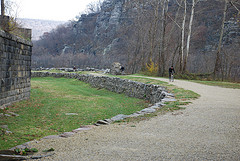
Canal at Harpers Ferry

… and so we found ourselves about noon riding under Maryland Heights, opposite the town of Harper’s Ferry. The shallow, foaming river boiled and bubbled between us and this little elevated angle thrust out at the point of junction of the Potomac and Shenandoah, and frowned upon, buttressed by, absolutely pent in by mountains. On its left Maryland Heights overlook the town, on its right and front are Loudon Heights, with Bolivar Heights in its rear, every one of these now crowned by our batteries and whitened with our camps. It adds to the aggravation caused by the late capture of this spot, with its garrison of ten thousand men, to see how carefully the stable has been locked now that the horse is stolen. It will not do to think of this, however, or we shall lose all pleasure in our visit. < Of course, Noyes is speaking here of the capitulation of the town on 9/15/1862 – largely due to the inept leadership that failed to fortify and secure these very heights. >

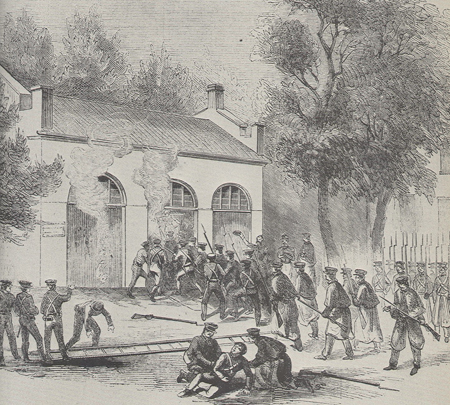
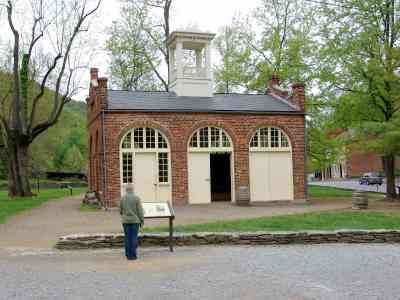
The river is here some five hundred feet wide, and we crossed it at the ford, to enter by a gateway into the government inclosure, with its workshops, arsenals, and storehouses all in ruins and black with fire. Near the main entrance, the engine-house wherein John Brown and his little party defended themselves still stood uninjured, as also the gate which afforded him a temporary barrier. We also paused to take a look at the now ruined bridge, the scene of other impressive incidents in this exciting tragedy.

I have never been able to unite in the wholesale praise or the wholesale denunciation which has surrounded the name of John Brown. He was a compound of the old Puritan of Cromwell’s time and Don Quixote de la Mancha, walking ever in the felt presence of his God, and fighting with his Bible in one hand and his musket in the other, as did the one, and yet imbued with that native chivalry of soul, that self forgetting spirit of knighthood, exaggerated, half-frenzied, regardless of practical consequences, or unable to foresee them, which make the old Spanish knight one of the sweetest and best-beloved of all real or imaginary characters. The old man stood before me in actual bodily presence as I paused at this spot—this spot which is to be hereafter classic ground, as time throws into shadow the more rash and Quixotic features of his undertaking, to bring into the foreground his deeply religious spirit, his wonderful devotion to what he deemed his God-given duty, his real greatness of soul.  < It is interesting to see how Noyes takes a middle of the road evaluation of John Brown – I suppose, understanding and applauding the abolitionist fervor, yet critical of the impractical nature of his actions. But Noyes is certainly correct in anticipating the John Brown “fortress” would become a classic place of interest and visitation in the future. >

Harper’s Ferry is a little, narrow-streeted, dusty, dirty hamlet. There is only room on the little plateau at the apex of the angle for one main street; it was now crowded with sutlers’ shops and with military visitors, and I was glad to mount the heights in rear to be rewarded with a fine view of the Shenandoah and a glance down the Potomac.  < Here is a picture of the angle of view which he describes. I often see this picture as listed as 1865, but have always been skeptical of that – believing the destruction would be worse at that time … therefore thinking the picture is earlier. >

Antietam Aftermath – Hospitals

Antietam Aftermath Series – Post 9

Just about every possible place – homes, schools, churches, barns – were used as hospital locations in the aftermath of the Battle of Antietam. My series of posts describing these days continues with another excerpt from the pen of George F. Noyes:

The little village of Sharpsburg still bore striking evidences of the fearful nature of the late cannonading. At one period in the battle it must have been a target for both armies, and there was hardly a single house in the whole town, no matter how humble, whose roof, walls, or doors were not pierced and torn with shot and shell. And yet quite a number of its residents remained in their cellars during the whole raging of this iron storm. I can imagine few situations more trying to the nerves than to be thus pent up in gloom while that tempest howled and shrieked through the air, or came hurtling in the rooms overhead. < I do not think that there were many, if any, Confederate canon shots landing in Sharpsburg. But the overshot of Union cannonading most surely afflicted the village throughout the entirety of contest. Stories of the local families either hiding in basements – as in this account – or of evacuating to caves along the Potomac, are many. >

A good Union lady, who visited our head-quarters, gave us a description of this season of horror which greatly interested us. How they made their little preparations of food and clothing, and went down, children and all, as soon as the first shell burst over the village; how they listened, expecting every moment to hear some of the shrieking fiends burst through their own walls, perhaps to penetrate into their retreat; how her husband was forced to rush up and put out the fire caught from a shell which exploded in the second story; how hours lengthened out into seeming days of suspense and fear; how they all mutually sustained each other, she narrated as only a woman can. After hearing her story, I felt that a far pleasanter position would have been the very front of the battle. It was pleasant to converse with these true Union women, of whom I met several in this vicinity. Some of them were slaveholders, but declared that they preferred the Constitution of our fathers even to slavery. Well and faithfully did they do their duty also in the hospitals, with which this whole region was now filled.

The army of the wounded, numbering at least ten thousand, occupied more than seventy of these impromptu hospitals, stretching from the Potomac out over the battlefield, through Sharpsburg, Keadysville, and Boonesborough, even to Frederick and Hagerstown, while miles of ambulances bore daily northward their precious freights of patriotic pain. Over the river, also, we could see the red flag waving from many a dwelling, the hospital of the wounded rebels, whom the enemy had carried with them in their late escape. In barns, and sheds, and farm-houses; in churches, halls, and residences; in colonies of hospital marquees; in yards and gardens crowded with shelter-tents; wherever, in a word, there was space for the narrow hospital bed, there lay a soldier chained to his couch by a wound more or less severe. No matter what flag he followed into battle, an equal surgical aid surrounded him, an equal kindness soothed his agony. Once within the hospital, the distinction between the patriot and the rebel was forgotten; and I was touched in noticing that, in some of the little graveyards which sprang up, ah! so rapidly, near the different hospitals, the men of the North and the men of the South slept side by side together.

Most of the rebel wounded lay in the barns and other buildings near the river and inside their former lines, these localities having been selected by their brigade surgeons during the battle. Miserably deficient at first, they gradually put on an air of comparative comfort; every one had in a day or two his own bed and a plentiful supply of food; but the rebel surgeons, who had been left behind in charge, did not, in general, impress me either with their ability or their tenderness. Nor was I particularly impressed with the average appearance of the rebel wounded, the rank and file lacking, to some extent, that look of intelligence and self-reliance which their general want of education and the social despotism of the slaveocracy of the South had not tended to awaken. < How’s that for a sort of elitist Northern perspective? Noyes was indeed a highly educated lawyer, and also obviously, a passionate abolitionist. >

Occasionally, however, an interesting face attracted me, while the fact that they were sufferers invested all of them with a certain dignity. Lying among rough, common-place-looking men, I saw here and there a boy, too young for war, doubtless the darling of some Southern home, lying pale and weak after the loss of a leg or an arm, yet still full of pluck and courage. Some were only lingering for a moment on the shore of the Great Ocean, with hardly a breath of life fluttering through their rent canvas; some moaned despairingly in their agony; some lay still and motionless in the borderland between sleeping and waking; but most of them were not severely wounded, and responded in pleasant terms to every kindly utterance. Had there been any personal repulsion in the atmosphere of those rebel hospitals I should have discovered it; but after these visits I always felt like asking myself what devil it was that had made these men my enemies.

Field Hospital at Smith’s Barn – Keedysville

Antietam Aftermath – Beautiful Words

Antietam Aftermath Series – Post 8

This is the eighth in a series of blog posts past and future that relate the words of various writers about their experiences in the weeks after the Battle of Antietam. Today I return again to George F. Noyes’ remarks from his 1863 book “The Bivouac and the Battlefield.”  A part of Doubleday’s staff, he was quite an accomplished writer and likely a fine orator as well – in an age that especially honored men who could craft words in a moving and compelling fashion.

Noyes continues with descriptions of the scenes during the six to seven week stay in the area after the battle:  During all these weeks I never wandered over the battlefield without meeting parties of visitors, men, women, and children, come to seek out its most famous spots, to glean every little relic, to cut the buried bullets out of the trees, to picnic somewhere under the pleasant shade, and then to drive home with their curiosity fully gratified.

If time permits when hosting a tour at Antietam, I attempt to finish the experience with a walk through the National Cemetery – to view the south end of the field from that high vantage point, to see the line of six World War One African-American soldiers’ graves shoved off to the back corner of the cemetery … and then, while moving toward the grave of Patrick Roy (killed on the USS Cole) I read the following excerpt of Noyes:

One thing quite impressed me, and that was the rapidity with which the more marked traces of the battle disappeared. The roar of the last cannon had not ceased to reverberate among her leafy aisles before Nature, silent but ever active, had commenced to purify herself from the soil and stain of battle, and cover up the bloody footprints of War.  In two weeks’ time, only the broken-down fences, the shattered and ruined buildings, the torn-up cornfields, and the frequent clusters of graves reminded the traveler of the late struggle. A year or two, and even these evidences will disappear. These bullet-marks in the trees will be overgrown with fresh bark, fences, and fields, and farmhouses will resume their wonted appearance, and over the graves and trenches, where lie the buried thousands, will once more wave a thick green mantle of bearded grain. Would that thus might disappear from every Northern and Southern home the sad memories of this battle; that Time the Comforter might thus heal the wounded hearts and dry up the bitter tears in every Northern and Southern family! Would that thus speedily every reminder of this rebellion might disappear from the national memory, every rankle from the national consciousness; that our present national wound might be healed to the central point of difficulty, never to break forth afresh, and leaving no ineffaceable scar!

And my final point to be made to visitors is to say that, though we might appreciate the contemporary words of Noyes who writes during the height of the Civil War, and though we might also be sympathetic to his view that it would be best for this scourge of war to be ever forgotten, the fact is that it should not be forgotten! It should be remembered, and those who fought honored for their sacrifices. It should be preserved for all our posterity to come with generations of our families to reflect upon these Americans who gave the last full measure for those principles that inform our culture and mutual heritage. This is why we must preserve such a national treasure as is this battlefield: Antietam.

Yates County New Yorkers Visit Antietam

A group of folks connected with the Yates County, New York Historical Society came to Antietam on Saturday. It was my privilege to host them and share the story of America’s bloodiest day with them, but even more to learn from them!

To be truthful, I had to look up where Yates County, NY was located! It is in the Finger Lakes region of the state. The closest I’ve ever been to that area is Watkins Glen on several occasions as a child, and I remember well what a beautiful region of the country it is.

The particular interest of these guests centered around two specific regiments from their region: the 33rd and 126th New York.

The latter of these (126th) fought on Maryland Heights overlooking Harpers Ferry, and as a result of terribly poor upper leadership and a series of unfortunate circumstances were among those captured and paroled.

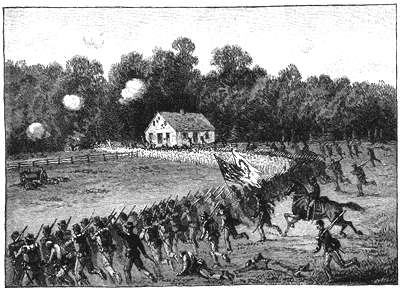
Forbes’ sketch of Irwin’s Brigade at Antietam

However, the 33rd NY was at Antietam as a part of Irwin’s Brigade of Franklin’s 6th Corps. Their action was with an advance toward the West Woods from an area just north of where the Visitor’s Center and the NY State Monument stand today.

An interesting story from the 33rd is that of Medal of Honor recipient John J. Carter, of whom the citation reads:  “While in command of a detached company, seeing his regiment thrown into confusion by a charge of the enemy, without orders made a countercharge upon the attacking column and checked the assault. Penetrated within the enemy’s lines at night and obtained valuable information.”

A typical 2.5-hour tour such as we generally offer at Antietam affords the guest a very good overall view of the battle. We especially feature the three prominent movements of the day: the Cornfield, the Bloody Lane, and the Burnside Bridge. However, there are hundreds of other actions and interesting vignettes occurring all day on September 17, 1862 that get scant recognition. And the actions of the 33rd New York remind me of this.

Among the dozen guests in the group yesterday was Wayne Mahood, author of “Written in Blood: History of the 126th New York Infantry in the Civil War”.  He has also written biographies on James Wadsworth and Alexander Hays, among other works. Also a part of this contingent is George Contant, author of the history of the NY 33rd entitled “Path of Blood.”

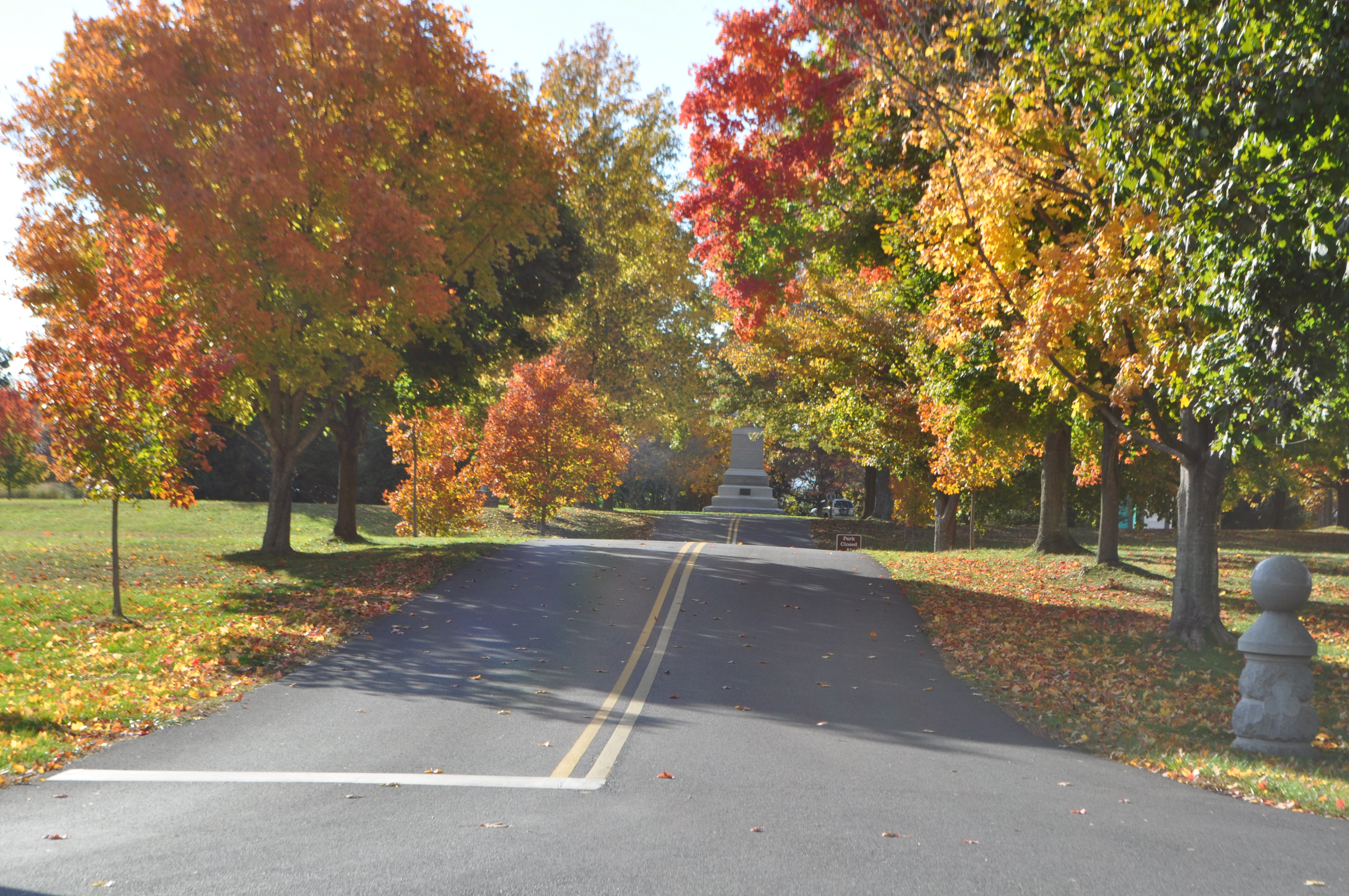
This is a beautiful time of the year at Antietam… here is a view looking into the West Woods and the Philadelphia Brigade Park:


Army Life Near Sharpsburg after the Battle of Antietam

Antietam Aftermath – Post 7

This is the seventh in a series of blog posts past and future that relate the words of various writers about their experiences in the weeks after the Battle of Antietam. Today I return again to George F. Noyes’ remarks from his 1863 book “The Bivouac and the Battlefield.”  I remind the reader that he was a part of the staff of Abner Doubleday and thus a part of Hooker’s 1st Corps … which is relevant to the account shared here today. Noyes wrote:

Our headquarters had thus become in itself quite a village, located nearly at the extreme southwestern corner of the battle-field. A few hundred feet in front was the headquarter camp of General Meade, now in command of the corps, and our division was encamped by brigades through the woods directly west of us. < If Noyes is accurate in his description, this would put their camp south of Sharpsburg and along the path that A.P. Hill’s men took on the 17th when arriving at the field in the late afternoon. >

The problems of being idle

A basic sort of Civil War camp


A game of cards is well enough in its way as an occasional pastime; but, if this be the only resort, it is apt to degenerate into gambling, out of which grow quarrels and the acquisition of bad habits not easily overcome. I have very seldom seen our troops playing base ball or indulging in any athletic sports; hidden away in the woods, with no companions of that sex without whose influence man becomes rough and brutal, they are exposed to the enervating influence of many idle hours. If you wish to demoralize a man, to dilute his manliness, corrode his patriotism, steal away his cheerfulness, destroy his enthusiasm, and impair his health, pen him up in an isolated camp with little to do, no books to read, no resource against idleness; if you wish to demoralize an army, march it off from a severely-contested battle-field into the woods, and condemn it to a month or two of listless do-nothingism. < I cannot let the mention of “base ball” pass without commenting that

A Doubleday bobblehead given away at a local Hagerstown minor league baseball game in 2009

this is Abner Doubleday’s staffer writing; and we should note that he did not say something like “that wonderful new sport of base ball that our general invented back in New York State!” And of course, that is because Doubleday did not have anything to do with it. My summary statement on the matter has always been to say that Doubleday was more of a boy scout than a little leaguer, and baseball was more about evolution over time than the creation of any one person at any one time. >

Every day now witnessed about our headquarters a levee of officers from the different brigades, and there was always straying in, to take a seat at our mess-table or sit around the evening camp-fire, some good fellow with a fresh atmosphere of thought and experience, to keep the social currents ever in motion, and prevent any mental stagnation. This evening camp-fire, built every night in front of the general’s tent, had become our usual place of assemblage after supper, and here any man who could talk was especially welcome; then were our old stories brought out once more, refurbished and newly decorated, as fair barter for his novelties; the old battle-scenes were re-enacted; fresh bits of humor sparkled around the circle, struck out, like fire from flint, by the concussion of wit and fancy. Our general, < this is the way Noyes always wrote about Doubleday > from his extensive repertoire of Mexican and Florida experiences, his personal acquaintance at West Point and elsewhere with most of the leaders in the rebel army, and his budget of entertaining anecdote, led the campfire congress, delighting us constantly with something fresh and new.  < Having read extensive amounts of material by Doubleday and about him, this last sentence really does capture the character of the man. He loved stories and recounting them over and over. Of course, many of them were filled with opinions and attitudes – leading either to extra enjoyment or extra contempt, depending upon the viewpoint of the observer. Among stories that Doubleday had written included being sold a defective horse by Stonewall Jackson and a host of others about the antics of John Magruder. I can certainly imagine this scene that Noyes describes. >

Antietam Aftermath (part 6) – Early Visitors to the Battlefield

I again continue with this post by sharing some more of the writing of George F. Noyes – a lawyer from Maine who was a part of Abner Doubleday’s staff – and who wrote the following excerpt in his 1863 book The Bivouac and the Battlefield.

As throughout this series, the excerpt will be given in italics, whereas my remarks will be contained <in this fashion>.

Our next day was a quiet one. At our mess-table in the morning it was generally thought that we might move before night, and every moment was therefore occupied in bringing up arrears of staff business. <This is now several days after the battle. I would take from the total description of his writings at this point that they are camped to the west edge of the battlefield – perhaps on the Nicodemus farm, or somewhere roughly to the west of the modern Route 65 bypass.>

Late in the afternoon, however, I rode out to visit a portion of the battlefield I had not yet seen, once more to have a partial return of yesterday’s impressions. The van of that immense army of visitors, which for several weeks came pouring in to visit Antietam, had already arrived, and many citizens were now picking up relics of the battle, and exploring every part of the field.  Hither came the father or the brother from New England searching for his dead; here, also, the distracted wife sought out the grave of her heroic husband. The Hagerstown turnpike for weeks saw every afternoon almost one continuous funeral procession, bearing away to the North the bruised bodies of the North’s bravest sons. More than a thousand, perhaps, were thus carried home to sleep among their kindred, to repose beneath commemorative stones, to which all of their name and family shall point hereafter with natural and patriotic pride. At first it had seemed to me better to permit our brave boys to rest undisturbed under the bullet-scarred trees, in the little glens, or out in the fields, where they died for the good cause, and where they had been laid to rest by their comrades; but when I saw the gratification with which their graves were discovered by relatives who had come hundreds of miles to claim their own, and the affectionate tenderness, not unmixed with pride, with which they lifted the beloved forms, shrouded only in uniforms of blue, into their coffins, and the evident relief with which they commenced their journey home, I had reason to change my mind.  < From time to time I refer readers and guests to my friend John Banks’ Civil War Blog. Here you may read story after story of Connecticut soldiers who fought and died at Antitetam, along with the frequent accounts of their being brought home to a final resting place. As a recent example of this, check out his blog entry from 9/22/12 which may be found HERE. >

Stretching in front of the fields adjoining our camping-ground was one of the long fence-rail barricades of the enemy, and behind it a continuous pile of straw indicated their sleeping-spot at night. They had left behind them some fifteen thousand muskets, and details of men were engaged in collecting them. The burial-parties were still busily engaged; it seemed, indeed, that their sad work was hardly half accomplished. As we rode on, we met a friend guiding a couple of ambulances; as he was not a surgeon, we inquired his destination, when he told us that during his afternoon ride he had discovered, in a barn on the edge of the battlefield, some twenty rebels so desperately wounded that they had been unable to help themselves, and had therefore remained untended and without food ever since the battle. He was now going with the ambulances to bring the poor fellows into one of our hospitals.