150 Years Ago Today: First Battle of Ironclads

Deck of the Monitor

On the 8th of March of 1862 (150 years ago yesterday), the Confederate ironclad CSS Virginia had successfully assaulted a Union squadron at Hampton Roads, sinking the USS Cumberland and the USS Congress.

On this date, the Union Ironclad – the USS Monitor – arrives upon the scene and engages the Virginia. For several hours they circle and fire at each other with little damage inflicted. An attempt by the Monitor to ram the Virginia fails, and the Confederate vessel retreats to the Elizabeth River.

History is made; though both the English and French have been attempting to build such vessels, this is the first they are used in battle.

CSS Virginia

Innovations included (for the Monitor) not only the hull being completely under water, the gun turret also rotated a complete 360-degrees.

150 Years Ago Today: The Battle of Pea Ridge

An outnumbered Union army gained a victory in northwest Arkansas on this date of March 7th (and 8th) in 1862 at the Battle of Pea Ridge – also known as the Battle of Elkhorn Tavern.

The Elkhorn Tavern at Pea Ridge

General Samuel P. Curtis

The Confederates had previously been driven out of Missouri, and the Union Army of the Southwest (about 11,000 men) under Gen. Samuel R. Curtis had pushed into Arkansas and established a defensive position on the bluffs overlooking Little Sugar Creek.

For the Confederates, a force of about 16,000 under General Earl Van Dorn was determined to defeat this Union army – now extended some 250 miles from its base.

Van Dorn’s strategy was to flank and cut off the Northern forces, but his own army was split by Pea Ridge – essentially turning the battle into two contests. Pushing his men too hard during the hours leading up to the battle and advancing with insufficient supplies for a major fight, Van Dorn lost an

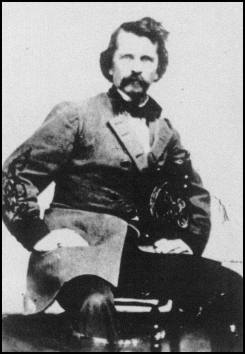
General Earl Van Dorn

General Earl Van Dorn

opportunity for a major victory. Additionally, his command and control structure deteriorated, and toward the middle of the second day, his supplies wagons were found to have been mistakenly ordered far away from the scene.

The Confederates superior numbers largely carried the first day of battle. But Union reinforcement and redeployment of lines overnight (on a bitter cold evening) strengthened the Federal line significantly. Union artillery under Franz Sigel softened the Rebel line and facilitated a successful infantry attack. Short on supplies, the Confederates were forced to retreat from the field. The Union victory at Pea Ridge solidified Federal control over Missouri for the next two years.

Miscellaneous Interesting Details:

Pea Ridge was the only major Civil War battle in which Indian troops participated. About 800- 1,000 Cherokee comprised two Confederate regiments. Some wounded Iowans were scalped, and a number of mutilated bodies were found after the battle.

Union troops hailed primarily from Iowa, Indiana, Illinois, Missouri, and Ohio. Over half of the Federal

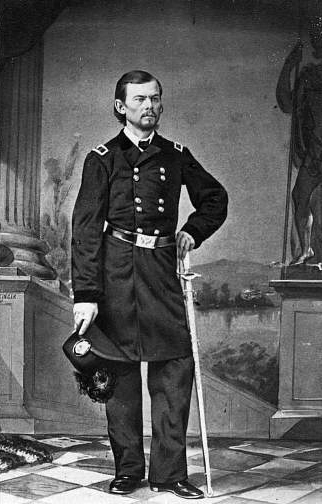
General Franz Sigel

soldiers were German immigrants.

It was possibly the only time during the war an entire army (Union on the 8th) was visibly deployed in one continuous line of battle from flank to flank. <Shea, William, and Earl Hess, Pea Ridge: Civil War Campaign in the West. University of North Carolina Press, 1992, p. 239.>

It was one of the few times in the Civil War when a preparatory artillery barrage effectively softened up an enemy position and paved the way for an infantry assault.  <ibid, p.236>

This area gets its name from the wild peas that grow there, especially abundant when settlers first arrived.

The 4,300 acre National Park also contains a 2.5-mile portion of the Trail of Tears.

Casualties: 1,400 Union / 3,000+ Confederate

Quote – from Isaac Smith, of the 1st Missouri Brigade (CSA)

Pea Ridge - artist's rendering

“It was a very cold night and it was pitiful to hear the wounded calling all through that night in the woods and alone for some water or something to keep them warm. I hope I never will hear such pleadings and witness such suffering again. Such cruelty and barbarity ought not to be tolerated by civilized nations. Young men, the flower of the country in the bloom of youth to be shot down and left on the field of battle to suffer untold agony, and die the death of the brave, to be forgotten by their countrymen and all that can be said of him is ‘He was a brave man and died for the cause he thought was right.’”

The 1st Minnesota Regiment at Antietam

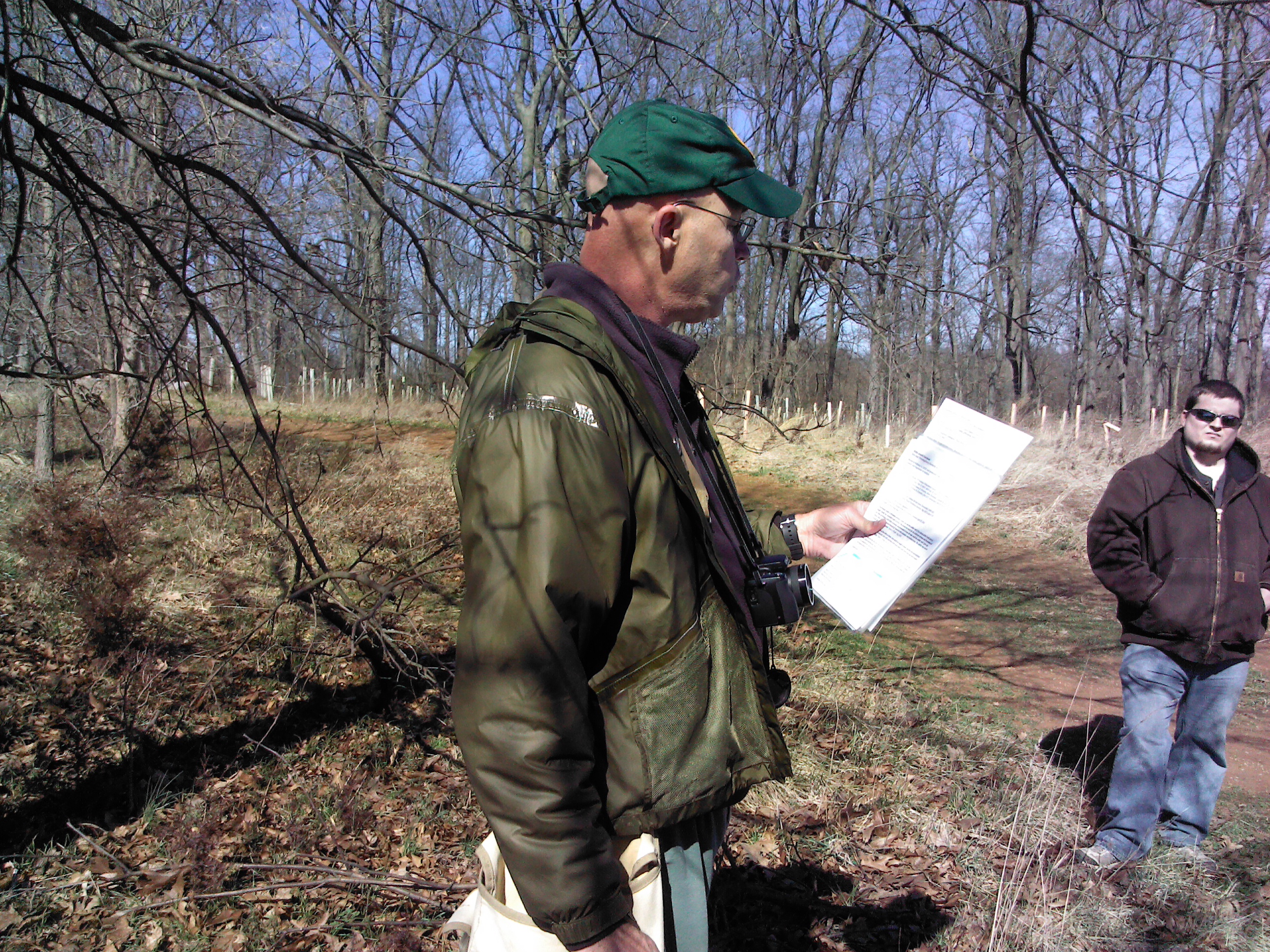
This past Saturday (3/3/12) I joined with our chief battlefield guide Jim Rosebrock for a special walk across the field following the path of the 1st Minnesota Regiment.

We have been challenged as Antietam Guides to develop some focused tours and topics to add to our basic overall macro-tour of the Battlefield, and this effort by Jim was presented in that vein.

I attempted to take some video of the excursion to put on our Facebook / Web Page (www.antietamguides.com), but the wind was simply too severe to make the audio sufficiently clear. But a group of 10 guides and enthusiasts walked the path of this regiment from the East Woods, crossing the Cornfield and Hagerstown Turnpike, into the West Woods and beyond, while also following their path of retreat toward the Poffenberger Farm.

There is nothing quite like actually walking the ground to gain a fuller appreciation of the circumstances of the battle. Getting out of the car and covering the terrain adds a new dimension of appreciation for the contours of the entire landscape. The varied moments of the conflict are also vividly captured by occasional readings of original sources at the actual spot being referenced, and there is an abundance of good materials to quote.

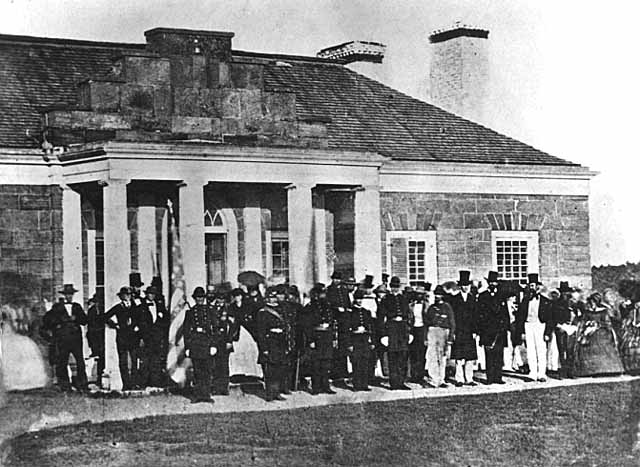
The 1st Minn officers at Fort Snelling, MN

The 1st Minnesota was the very first unit of troops offered to fight for the Union upon the shelling of Fort Sumter. Minnesota Governor Alexander Ramsey was in Washington at this time, and promised Lincoln that his state would raise a 1,000-man regiment. Fort Snelling, MN was the location for the rendezvous and training of these new recruits.

The Minnesota boys were on the extreme right of the first of the three lines that entered into and through the West Woods – only to be ultimately flanked by Rebels arriving from the south, behind the Dunker Church. Actually walking into the West Woods gave us an appreciation and understanding as to how they faced fire from the right (Nicodemus Heights), the front (Houser’s Ridge), the left (the enfilade of McLaws’ troops), and even the rear – as the Confederate tidal wave flowed into a gap behind them.

I have long believed that these sorts of special interest excursions could be a wonderful supplement to the current offerings of the Guides program, and I look forward to the development of others – having suggested offering a Doubleday walk looping from the North Woods and across the Cornfield and back. I actually have done this with a group in the past, as I have also presented a Frederick Hitchcock walk from the Visitor’s Center, past the Mumma and Roulette farms, and ultimately “attacking” Bloody Lane along the path of the 132nd PA. (I will add that neither of these were quite as micro-focused as Jim’s walk, as I included overview materials of the entire battle – probably still a value for all but the most conversant with battle details.)

A final lesson from the Saturday walk was to learn what shoes NOT to wear the next time. It was wet and we were walking through mud and woods, so I wore work boots – and am still paying for that decision! But a lot of the soldiers there almost 150 years ago would have loved to have had my clodhoppers!

150 Years Ago: Burial of Willie Lincoln

Imagine if one of the Obama daughters were to contract some dreadful disease and die. It would be all over the news, cameras would follow the family, and there would be (rightly so) a sort of national outpouring of grief for the family – all political issues set aside.

Willie Lincoln

It was 150 years ago this past week that Abraham and Mary Lincoln lost their second surviving son, Willie, at age 11 to Typhoid Fever. (The same year Willie was born, they lost their second birth son.) Younger brother Tad was sick at the same time with the same disease, and oldest son Robert was a student at Harvard.

It was on this date that the news of the burial was reported briefly in the New York Times. The death had occurred on the 21st, with the funeral on the 24th.  The funeral was in the Green Room of the White House, and attended by a private gathering. He was buried in Oak Hill Cemetery in Georgetown. A Doctor Charles Brown – noted for his perfecting of the embalming process – did the preservation work on the body. Certainly the following seems strange to us, but the Lincolns actually had the body disinterred twice to view it!  Yes, odd … but it speaks to the depth of grief suffered by the First Family.

Of that grief, Lincoln is quoted as standing at the foot of bed where the boy had just passed, and saying, “My poor boy, he was too good for this earth. God has called him home. I know that he is much better off in heaven, but then we loved him so. It is hard, hard to have him die!”  Mary Lincoln was nearly completely inconsolable, and did not attend the funeral or burial. Apparently, as the funeral was progressing, a storm of violent proportion was raging on the other side of the windows. This engendered more than a few comments upon the convulsive emotions of the moment and occasion.

After Lincoln’s assassination, Willie’s casket was exhumed and he accompanied his father on the funeral train back to Springfield, Illinois.

I am sure Lincoln felt the need to not make a public spectacle of his grief, knowing that there where thousands upon thousands of homes having lost sons in the fratricidal conflict engulfing the nation. Of course, the 19th century was an age where the loss of children before maturation to adulthood was more the norm than the exception.

We tend to sometimes romanticize certain eras of the past … moved by the grandeur of an age where occurred gigantic events affecting the global structure of that present day and many decades to follow.  But really? Would we want to live with our families in a time preceding modern medicine and all the benefits of public health?

I’ve always been moved by the circumstances of the Lincoln family and their boys … perhaps because I have five boys myself. My heart is moved by their losses. Beyond that, as compared to the President, I don’t have to deal with a rather crazy and bizarre wife!  We have had a couple of life-threatening situations with our sons, but by God’s grace, we’ve seen them survive. Only one of the Lincoln’s four sons would survive both parents (Tad died at age 18 in 1871).

Abner Doubleday’s Winter of 1861-62

(As I have written in the page you may reference at the top of the blog, I have a special research interest in Abner Doubleday. This material is from that body of work.)

Background

Abner Doubleday

Abner Doubleday was one of the major figures involved with the onset of the war, being stationed in Charleston, S.C. as a Captain of artillery. He sighted the cannon firing the first shot from Fort Sumter in response to the Rebel attack upon that installation in April of 1861.

After returning to New York, Doubleday was soon connected with the movements of Banks and Patterson through the Cumberland Valley, Washington County Maryland, and into northern Virginia and Harpers Ferry. These troops were not involved in the Battle of First Manassas/First Bull Run.

The Defenses of Washington

At the end of August of 1861, Doubleday’s artillery command of heavy guns was ordered moved to the defenses of Washington. On August 30th came special orders from McClellan charging Doubleday with commanding the heavy artillery defenses from the Long Bridge to Fort Corcoran. In the event of an attack, it was stated he was “to command the whole.”[1]  Doubleday found this command puzzling, in that he was a mere Major, and these forts were under the command of Lieutenant-colonels, Colonels and general officers. He wrote: I construed the order there to mean, not that I was to assume actual command over my senior in rank, but that I was to arm and equip the forts properly, and have them ready for defense as soon as possible.  Upon presenting my orders to General McDowell, he bowed very low in burlesque manner, and intimated to me that he considered the order an absurdity. [2]

Arlington House During the Civil War

However, Doubleday went to work on the project, making his headquarters in Arlington House—the former plantation home of Robert E. Lee. With a single orderly from the 14th Brooklyn Regiment working for him, he began to make the necessary requisitions of supplies and ordnance to place the forts’ artillery in working order. At the time of his commencement upon this task, the forts were in a very incomplete state, with ammunition in two magazines quite some distance from the actual fort locations. The entire project consumed Doubleday’s efforts for the remainder of 1861 and into the early months of 1862. The army engineers had also laid out a series of new forts from Albany to Alexandria—thus encircling the city. Doubleday was ordered to also deal with the armaments for these installations. All of this fortification involved a considerable expense.  The total perimeter was about 35 miles and involved an armament of some 480 guns manned by 7200 men. By the end of the year, the Brigadier General and Chief Engineer of the Defenses of Washington, J.G. Barnard was able to write to Secretary of War Stanton that “there has been but one other system of field works that I know of that is analogous to this in extent and character–the famous lines of Torres Vedras. These frustrated the design of Napoleon of driving the English from the Peninsula [in Portugal]. They consisted of a greater number of works, but the works were smaller, and much less expensive in workmanship …” [3]

Testimony before The Joint Committee on the Conduct of the War

Doubleday was not nearly so impressed with the condition of the forts, according to his testimony before “The Joint Committee on the Conduct of the War” on January 3rdof 1862. This committee had been established only a month previously (in the wake of the Army’s embarrassing disaster at Ball’s Bluff), and was chaired by the Radical Republican Benjamin Wade of Ohio. With Republicans in control of the Congress, the “War Committee,” as it was commonly known, was comprised of five Republicans and only two Democrats. Throughout the war, the Committee expressed criticism of tactics lacking aggressive initiative, and of military commanders like McClellan and Meade—whom they lobbied to see replaced. The members of the War Committee questioned Doubleday on the condition of the forts defending Washington, to which he answered that they were insufficiently manned and garrisoned with artillerists. When prodded to answer why this condition existed, Doubleday replied that he could not

Benjamin Wade

understand why it had not been specifically addressed. He reported of his repeated efforts toward seeing this accomplished, but such had not come to fruition. Doubleday answered in the affirmative that there seemed to be many greater efforts applied to infantry over artillery, even though there were many regiments interested in becoming heavy artillerists. Though men could be trained to load and fire within a few days, it would require two to three months for them to gain a skilled level of proficiency. When asked specifically if General McClellan knew of this lack of sufficient manpower, Doubleday replied that the situation had been made known repeatedly to his Adjutant General and to his Chief of Artillery. But Doubleday frankly stated: “I do not see anything being done to remedy it.” The line of questioning turned to address the broader issues of the war effort, and Doubleday was asked his opinion upon these matters as a military man. Regarding the wisdom of a movement of the Army of the Potomac at that season versus at a later date, Doubleday opined that a movement ought not to be delayed, in that hesitation allowed the enemy to fortify. When queried as to what he would suggest as an appropriate movement of the Army of the Potomac, Doubleday spoke of the viable strategy of advancing the force into Virginia at Leesburg in an effort to attack the left flank of the Confederate forces. Such testimony, though appealing to the leading members of the War Committee, surely did not endear Doubleday with the predominant culture of Democrats in the Army. [4]

Commission as Brigadier General

On February 3rd of 1862, Doubleday was commissioned as Brigadier General of Volunteers. At the end of the month, General McClellan assigned him to duty as inspector of all the military defenses of Washington, with particular command of those to the north and east of the Potomac. Among a number of men from New York whom Doubleday chose to serve on his staff was his brother Ulysses, a Major of the Fourth New York Heavy Artillery. The new General assigned him the position of ordnance officer. Another significant addition to his staff was an eloquent lawyer from Portland, Maine named George F. Noyes, who at Doubleday’s request was appointed a captain in the Commissary Department. Noyes would eventually serve with Doubleday for some time, and would write an 1863 memoir of their experiences together entitled The Bivouac and the Battlefield; or, Campaign Sketches in Virginia and Maryland. Noyes’ skill with words is most evident in this picturesque writing. It begins with a dedication page “to Major General Abner Doubleday, U.S. Vols., and his first staff, this record of our common experiences is affectionately inscribed by the author.”  Doubleday’s name never again appears in the narrative, but he is always warmly spoken of rather as “the general” or “our general.”

Abner Doubleday was busily occupied through the middle of May, inspecting all the forts surrounding Washington, and in drilling and disciplining the troops of the forts to the north and east of the city. [5]

(Check back again in early April for a compelling story on Doubleday’s views on dealing graciously with former slaves.)

  1. Addendum, vol. 5, pp. 352-353.
  2. Abner Doubleday Journal – “My Record During the Rebellion” – p. 30
  3. The Civil War Defenses of Washington
    Parts I and II – from Appendix D, part 1 (letter of Barnard to Stanton, 12/30/1861) – web page – http://www.cr.nps.gov/history/onlinebooks/civilwar/index.htm
  4. U.S. Congress, Senate, Report of the Joint Committee on the Conduct of the War, 37th Congress, 3rd session, 1863, Senate Report 108, part 1, pp. 209-213.
  5. Doubleday Journal, p. 54; supplement, p. 678

150 Years Ago Today: Jefferson Davis Inaugurated

Jefferson Davis – from Mississippi – resigned from the United States Senate in January 1861 and was chosen President of the Confederacy by

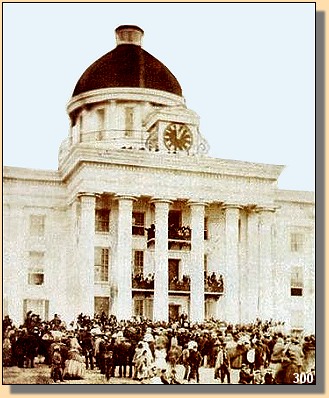
First Inauguration in 1861 in Alabama

the Provisional Congress and inaugurated in Montgomery, Alabama on February 18, 1861 (see picture).  He was then officially elected President of the Confederacy in November of that year for a term of six years. His inauguration was in Richmond, Virginia, February 22, 1862 – that is 150 years ago today.

It is interesting to read through his speech and note some of the themes. One cannot help but immediately ponder that the inauguration was on the date of George Washington’s birthday. It was common for the Confederates to assert an affinity with the Founders’ generation and efforts, and that is exactly how Davis began his speech:

Fellow Citizens: On this, the birthday of the man most identified with the establishment of American independence, and beneath the monument erected to commemorate his heroic virtues and those of his compatriots, we have assembled to usher into existence the permanent government of the Confederate States. Through this instrumentality, and under the favor of a benign Providence, we hope to perpetuate the principles of our revolutionary fathers.

It is with difficulty that some folks today struggle to understand what in the world would make the Southern cause seem so just in their minds – to have such a passionate allegiance to principles that, by modern standards, seem odious and riddled with injustice. This was not at all how the Confederates viewed their situation – feeling genuinely that they stood in line with principles of justice and rightful constitutional government. Davis summarizes some of these thoughts:

Portrait of Jefferson DavisThe experiment instituted by our revolutionary fathers, of a voluntary union of sovereign States, for purposes specified in solemn compact, had been prevented by those who, feeling they had the power and forgetting the right, were determined to respect no law but their own will. The government had ceased to answer the ends for which it was ordained and established. To save ourselves from a revolution which, in its silent but rapid progress, was about to place us under a despotism of numbers, and to preserve, in the spirit as well as the form, the system of government we believed to be peculiarly fitted to our condition and full of promise for mankind, we determined to make a new association, composed of States homogenous in interest, policy and feeling.

Of special interest and notice was to see my state of Maryland especially spoken of in the address. Resident within these words is the context for the feelings of the Army of Northern Virginia marching into Maryland in September of this year of 1862 – coming as friends to liberate fellow Southern kinfolk from Union oppression.

Our Confederacy has grown from six to thirteen States, and Maryland, already united to us by hallowed memories and material interests, will, I believe, when able to speak with united voice, connect her destiny with the South.

Davis addresses both the successes of the early War, and yet also inferentially the recent setbacks at Forts Henry and Donelson – defeats that opened the interior to Union control.

After a series of successes and victories which covered our arms with glory, we have recently met with serious disasters; but in the heart of this people, who are resolved to be free, these disasters tend but to stimulate to increased resistance. … Battles have been fought and sieges conducted, and although the contest has not ended, and did for the moment go against us, the final result in our favor is not doubtful.

It is a wonderful speech – yet another evidence of the many extraordinary examples of writing and speaking from a period where some of the most gloriously-constructed documents and speeches in the English language have come. And Jefferson Davis ends on a breath-taking note of dependence upon divine providence. As I read this, I think of the great words of Lincoln at his 2nd inaugural, where he spoke of the irony as to how the North and South “Both read the same Bible and pray to the same God, and each invokes His aid against the other … The prayers of both could not be answered.”

Davis concludes:  “… fully realizing the inadequacy of human power to guide and sustain, my hope is reverently fixed on Him whose favor is vouchsafed to the cause which is just. With humble gratitude and adoration, acknowledging the Providence which has so visibly protected the Confederacy during its brief but eventful career, to Thee, O God, I trustingly commit myself, and prayerfully invoke Thy blessing on my country and its cause.”


General Mansfield’s Final Hours, by Captain Dyer

The transcript below is the third of three documents found in the Antietam Battlefield file concerning General Joseph Mansfield and his mortal wounding and death. The first – by attending physician Patrick Flood – is in a blog post here on January 6th (with varied responses thereafter). The second – a handwritten account by John Mead Gould – was posted on January 25th.  Both of those first two documents are referenced as a part of the Mansfield Papers at the Middlesex County Historical Society – housed in the former Mansfield home in Middletown, Connecticut.

This third document – a copy of a handwritten report by Captain Dyer – has no reference as to where the original may be housed. It is dated at the end as having been written on October 10, 1862 – therefore 23 days after the Battle of Antietam.

Clarence Hopkins Dyer was born in Harwinton, CT in 1832 and was appointed Captain and Assistant Adjutant General, U.S.V. in the fall of 1861. He was with General Mansfield in Virginia at the time of the fight between the Monitor and the Merrimac, and after Antietam served in similar capacity throughout the war for Generals Banks, Carr, Canby, and Merritt – the last service of which was with cavalry in the southwest.

Various written reports of Mansfield taking command of the 12th Corps in the days before Antietam speak of the General travelling west from Washington accompanied by his aide, Captain Dyer.

Here then is a transcription of the document, stated as from Captain Dyer, though he speaks of himself as if someone else was writing:

General Mansfield’s Last Hours – Capt. Dyer’s report

General Mansfield left Washington accompanied by his Aid Capt Dyer and body servant on Saturday the 13th Sept 1862 at about 4 o’clock P.M. on Horseback, arrived at Middletown Md. on Monday the 15th at 9 o’clock A.M. and reported there to Genl. McClellan as ordered and was there assigned to the Command of Gen. Bank’s Corps of about 11,000 men   The two Divisions of Genl’s Williams and Sterns[1]   and on the morning of Wednesday the 17th he lead them forth to action at about 7 o’clock and had been but an hour or so engaged when at the head of his troops urging on one of the new or ‘raw’ regiments which needed some encouragement, as they were timid being under their first fire   and tho firing of the enemy was very heavy of both Infantry and Artillery. He was shot by a minie ball through the right lung passing clear through him, so that he literally bled to death.  His horse was shot dead at the same time   three balls passing through him.

The General lived 24 hours and conversed freely most of the time.   was under the influence of opiates some of the time.

He was constantly inquiring how the action was going on, and after the other officers as to their safety, etc. Having it reported to him at one time that Generals Burnside and Hooker both were killed he lifted up his hand and escclaimed[2] “Too bad.” “Too bad.” “Poor fellows.” “Poor fellows”!

Being afterwards told it was not so he seemed much gratified and relieved. Enquired several times how the Battle was going, and when told in our favor was much pleased.

He gradually grew weaker and weaker and sent love to all his friends   wished to be remembered to all and to have his remains taken home.  Wanted Captain Dyer to stay by him all the time until his death.

Doctor Anselum[3] Surgeon of the Corps and Doct’s Porter and Weeks (The latter of the Navy) were all very attentive to him. He had the best of care and attention and went off quietly as one going to sleep.

He escpired on Thursday morning at 8 o’clock and 10 minutes. His remains were immediately taken by Capt. Dyer and put into a rough bosc and carried in an ambulance from the place which was between Cadysville and Sharpsburgh to Monocacy Station, near Frederick, where they took the cars for Baltimore.

He seemed impressed with the idea that he should be killed, as he had escpressed to several persons that he should never come out of the fight alive. He told Hon Ely Thayer[4] in Washington just as he was leaving there, that he was going into the field and did not escpect to come back alive and desired him to have his body recovered and sent home to his friends in Middletown Ct.

Capt Dyer was not with the General at the moment he fell, he having been ordered back by the General to bring on Genl Gordon’s Brigade to their support.

The General was at the time he fell at the head of Genl Crawford’s Brigade. As he fell he was immediately caught up in the arms of five of the privates (from one of our regiments nesct to him) also by the Surgeon of one of the Pennsylvania regiments and carried back about ¼ of a mile to the rear, where he was put into an ambulance and carried back about 1 ¼ mile further to a hospital (made of an old farm house) where he was attended to by the Chief Surgeon of the Corps and had the best of care. Capt Dyer his aid was with him in about 20 minutes after he fell and remained over him constantly until he escpired. Opiates were used to quiet his pains.

His last moments after he could no longer talk audibly from loss of blood, seemed spent in prayer, as occasional escpressions could be understood, such as: “My Lord”  “Father in Heaven”  “into thy hands”  he seeming perfectly resigned to God’s will. He was conscious from near the first, that he could not live. But as he escpressed it when told by his Surgeon he could not survive, “It is God’s will it is all right”

                                                October 10th 1862

[1] My best guess of the handwriting was “Sterns” … however the other Division of the 12th Corps was led by George Greene, though there is no way the handwriting is saying Greene.

[2] A unique feature of his writing was to not use the letter “x” but rather “sc” … even later when the word “box” is spelled “bosc”

[3] This name is quite illegible, and will take some further research to seek to establish of whom he speaks

[4] This must refer to Eli Thayer – a Massachusetts Republican congressman from 1857-1861 – who was an ardent anti-slavery man

324 Years Ago Today: The Germantown Protest Against Slavery

Once in a while at Antietam while doing tours – like maybe once a year – I meet someone who has a very strong and passionate feeling that the Civil War had very little to do with slavery … that the concepts we have as moderns have been blown massively out of proportion relative to the significance of the issue at the time.

I also remember one day (about 1981) in a religious history class at my conservative evangelical seminary I attended in Dallas, the professor was making a point that those of us educated in Northern schools were taught that the Civil War was ONLY about slavery to the exclusion of understanding pertinent economic issues and the Southern values of state’s rights. There was a very annoying Southern fellow seated near me who was “amen-ing” the presentation in a rather provocative fashion, and being a good Yankee, I told him to “shut his rebel mouth.” So there we were – a couple of future church pastors – about ready to come to blows in a seminary class, over the causation factors of the Civil War.

Certainly this is a topic not lacking for debate over the past century.5!  But to deny a very substantial and significant role of slavery passions North vs. South is to deny a tremendous bulk of the literature from the period.

In the 1850s and 1860s, the issue was not a new one in America of course. We know that the debate was smoldering for decades … even noting some few comments dating back to the Founders.

Among early abolitionists in America were many (though not all) Quakers. A reading of James Michener novels like Chesapeake depicts the early role of this group against the injustice of this forced servitude.

On this date in 1688 in Germantown, Pennsylvania (now a portion of Philadelphia), four Quaker men stepped forward to register their official disdain in what was known as the Germantown Protest Against Slavery. This was the first American protestation against slavery made by a religious body.  Their arguments formed the following outline:

1.  The Golden Rule – They argued that if Turks were to enslave Whites, they would certainly expect and honor Whites fighting for their freedom … so why should it be different for Blacks?

2.  A Biblical Injunction Against Theft – Blacks were stolen from their homes and forced into slavery. So many of those who were reading the Protest were people who had recently themselves escaped a large measure of intolerance in Europe – so why would they not be offended by inflicting even worse upon others?

3.  A Biblical Injunction Against Adultery – Slavers forced adultery on men and women by breaking up marriages when they resold husbands and wives to different owners. How could such actions be condoned by Christians? The bad report of American slavery shocked even the conscience of Europe.

The Protest was lost for many years until being rediscovered and printed in 1844 during the controversial era leading up to the Civil War. Surely the country would have been better to have listened to the protestation of these men so many years before the War and even the actual founding the nation.

150 Years Ago Today: The Capture of Fort Donelson

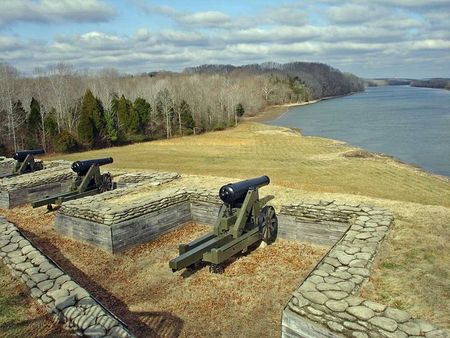
The first really significant major Union victory of the Civil War occurred 150 years ago today with the Confederate surrender of Fort Donelson on the Cumberland River in Tennessee. This is the occasion of the utterance of Ulysses S. Grant that “no terms except an unconditional and immediate surrender can be accepted” … which became one of the famous quotes of the war and led to the name “Unconditional Surrender Grant.”  With over 12,000 Southern troops surrendered, Grant had actually captured more soldiers than all American generals before him combined!

Fort Donelson Lower River Battery

The several days leading up to the surrender saw both naval engagements – largely a Confederate success in defense – and infantry battle. Seeing that the Fort was likely to be surrounded, Confederate Generals John B. Floyd and Gideon Pillow escaped on the evening of the 15th with their approximate 2,000 troops, leaving the Fort to be surrendered by General Simon Buckner.

The news of the victory led to great rejoicing throughout the North and created a new war hero. The central heartland of the Confederacy was opened, as the Tennessee and Cumberland Rivers and nearby railroads made the area a supply depot for the War effort. The South had to surrender southern Kentucky and much of middle and western Tennessee.

150 Years Ago Today: The Williamsport Ladies Grand Concert

The collection of letters of John B. Noyes at the Houghton Library of Harvard University contains one written on 2/22/1862 that speaks of a concert held in Williamsport – presented on the back-to-back evenings of February 14th and 15th.

As written previously, the 13th Massachusetts Regiment spent the winter of 1861-1862 in Williamsport, MD. The picket duty was rather boring and mundane, the conditions cold, and the overall experience a rather tedious one. The mostly well-educated and more sophisticated New Englanders from the environs of Boston oft found Williamsport residents to be quite simple folks, though remarks also of pleasant interchange were not rare in these writings.

The Glee Club of the 13th Mass

The 13th Massachusetts had put together a glee club that sang at some events in the Hagerstown area with good success, and so it was determined to arrange and host a concert, along with the regimental band, of varied musical entertainments, and invite the townsfolk. The concert was called “The Williamsport Ladies Grand Concert” – though apparently the participation of ladies was a bit scant. It was held in the Presbyterian Church, and caused great excitement in the camp and town.

Noyes wrote a paragraph about another denominational local clergyman that, as a pastor myself, caught my attention. Here is what he thought of the Lutheran churchman:

The Rev. Mr. Lepley discourses to the Lutherans. Of late the most spirited, if not the most telling portion of his discourses has been devoted to drumming his congregation. Now it so happens that Lepley, rather a dull preacher, not young, somewhat straitened in means, was a Unionist from the start. This alienated from him the richest portion of his congregation who were secession sympathizers.

Maybe I don’t really have many church problems compared to this one!