General “Burnslide”

Some people wonder how it is possible to do even hundreds of tour groups at Antietam and not get bored with the narrative. Well, even though there is a fair amount of repetition of the actual battle material, the people who come are very diverse, and interesting things happen along the way that never happened before.IMG_0596

Today, for the 2nd consecutive day, I had a busload of teenagers – this time from Ohio. It is sometimes a challenge to get them engaged, as there is clearly a wide range of natural interest in a historical site. I’ve learned that if I can get the girls interested, I’m likely to get most of the group – so I’ll often speak right at the girls, ask questions of them and fuss over them a bit, and then I’ve got the whole group tracking with me. It was going great today – until the end at the Burnside Bridge.

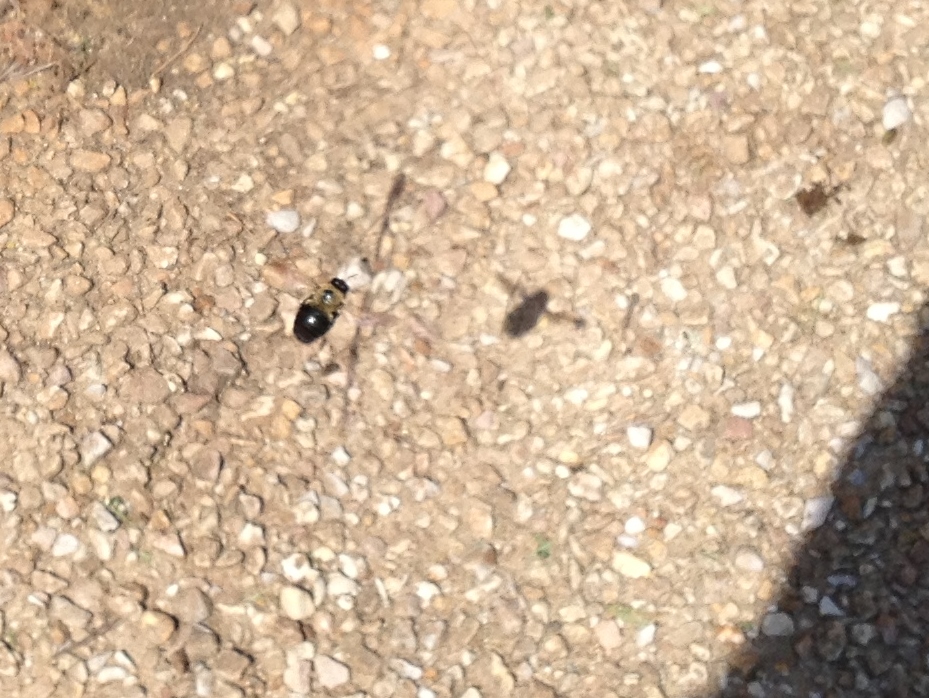
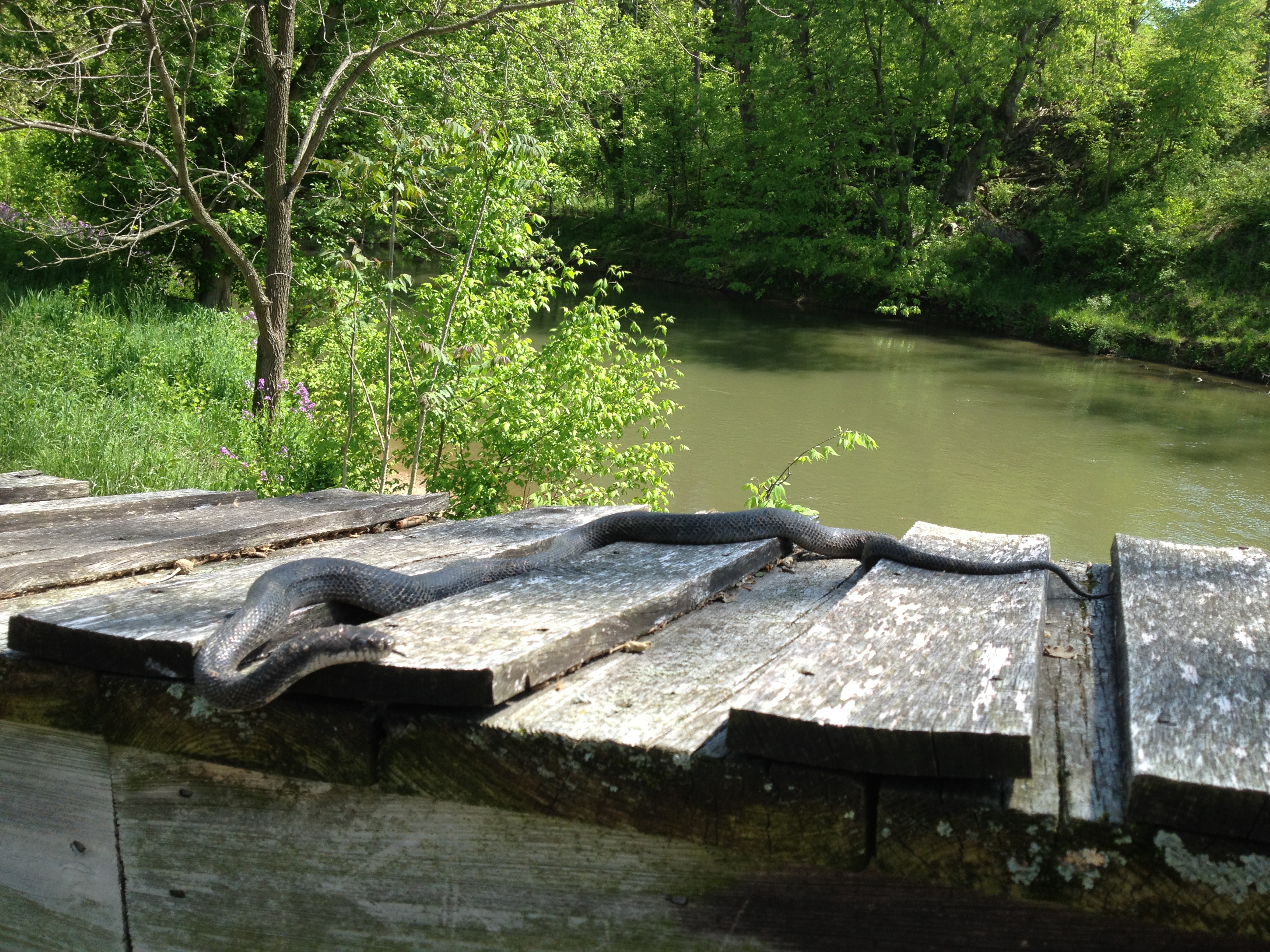
IMG_0600After some recent cool and damp weather, this afternoon was brightly sunny and warm. That is probably what brought a lot of “nature” to life. Before even reaching the bridge we were assaulted by thousands of gnats. And then, when crossing, the bumble bees were flying around us as thick as the missiles from the 2nd and 20th Georgia regiments 150 years ago – I caught one of them in flight – see the picture with its shadow cast upon the bridge surface. But finally, there was the real narrative killer – the appearance of a guy I’ll call General Burnslide – getting a spring tan on the sides of the bridge. He was not alone, as his cousin Captain Griswold of Company A was curled up about five feet away.

This sent my busload of kids headed for their transportation at the double quick. The tour was essentially done!

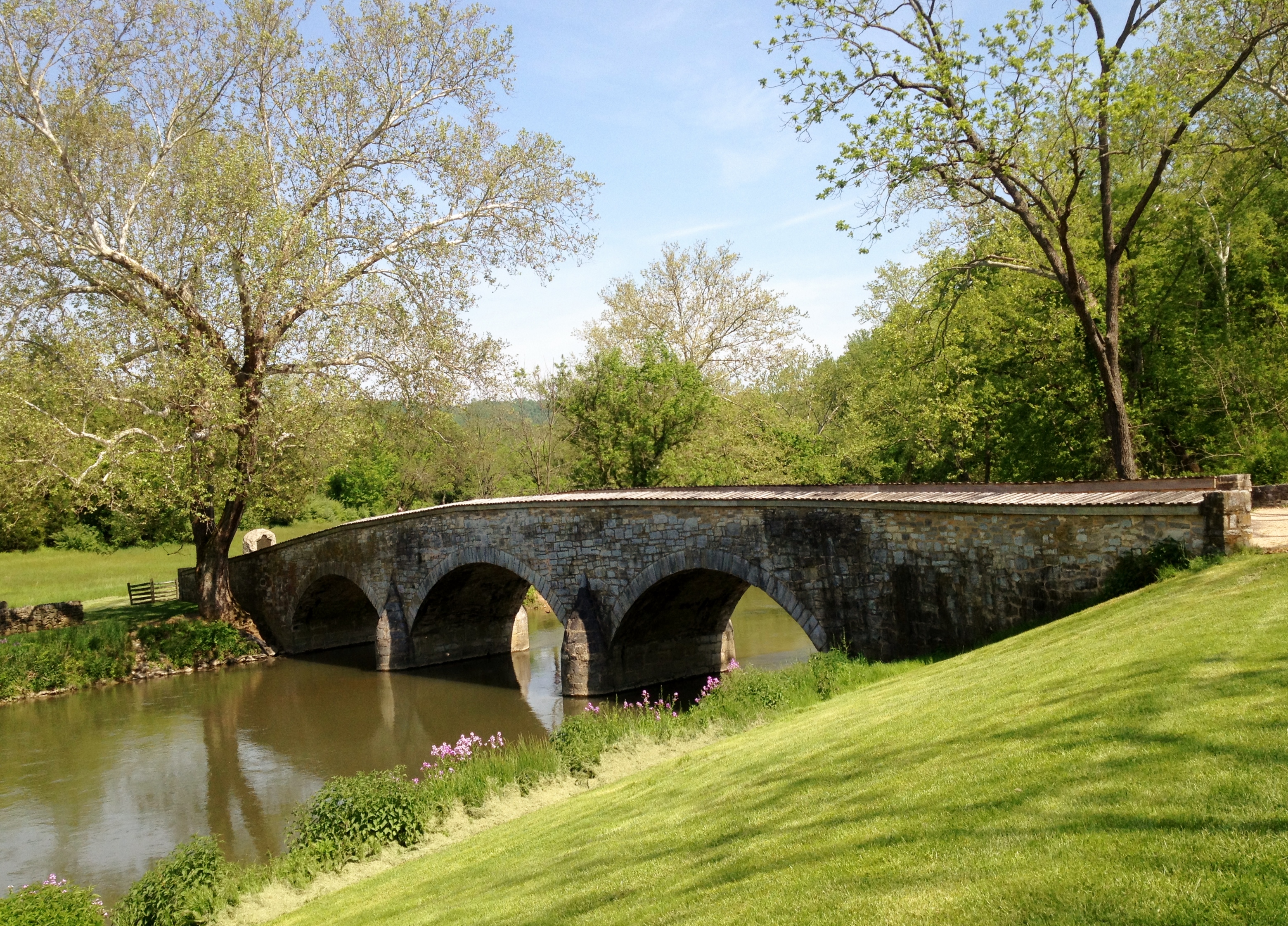
Even with what I believe to be the most despicable creatures on the planet hanging out at the Burnside Bridge, it has to be about the most beautiful spot on earth.

IMG_0603

Vicksburg Campaign – Battle of Jackson

The Battle of Jackson, Mississippi occurred on this date of May 14, 1863, and should not be confused with the Battle of Jackson, Tennessee – which was on December 19, 1862.

Confederate General Joseph Johnston – wounded at the Battle of Seven Pines in May, 1862 – arrived on the 13th in the state capital of Jackson, Mississippi. He was now commanding the Department of the West, having been ordered to Mississippi to address the growing threat in that region. He quickly surveyed the situation and seeing inadequate defenses and numbers of troops, he ordered the city evacuated.

Bowman house hotel in Jackson MS

The Bowman House Hotel

On the 14th, John Gregg’s men fought to delay the Union attacks of the 15th Corps of Sherman and the 17th Corps of James B. McPherson, and buy time for the city to be abandoned. The fighting began in late morning and intensified into the mid afternoon. The city having by this time been evacuated, Johnston ordered Gregg to break off the action and follow.

The Union occupied the town with Grant himself hosting a victory party at the Bowman house (hotel). Sherman was ordered to destroy railroad connections with Vicksburg and anything else in the city that could contribute to the war effort. This was done over the next two days. Properties were pillaged as well. Many of Jackson’s inhabitants also suffered the loss of personal property. A minister in the town remarked: “My thresholds, it is true, were spared the stain of blood; but theft and ravage, and wanton destruction marked every room in the house and every article on the premises. . . . May God forgive them for all the evil they did during the two memorable days which they spent amongst us.”

This Union victory not only brought down morale in the South, it isolated Pemberton’s troops in Vicksburg from reinforcement and supply.

Today begins a series of quick posts that look back 150 years ago to a number of conflicts surrounding the Vicksburg Campaign, with the ultimate surrender on July 4th. There have already been two articles on this campaign in the Enfilading Lines Blog:

1.  The Running of the Vicksburg Batteries (April 16) and may be found by looking HERE.

2.  The American Normandy: Grant Crosses the Mississippi / Battle of Port Gibson (April 30) and may be found by looking HERE.

The remaining posts will be:

3.  Today, May 12: The Battle of Raymond

General John Gregg

General John Gregg

4.  May 14: The Battle of Jackson

5.  May 16: The Battle of Champion Hill

6.  May 17: The Battle of Big Black River Bridge

7.  May 19: The First Assault on Vicksburg

8.  May 22: The Second Assault on Vicksburg

9.  May 26: The Siege of Vicksburg

10.  July 4: The Surrender of Vicksburg

The Battle of Raymond – May 12, 1863

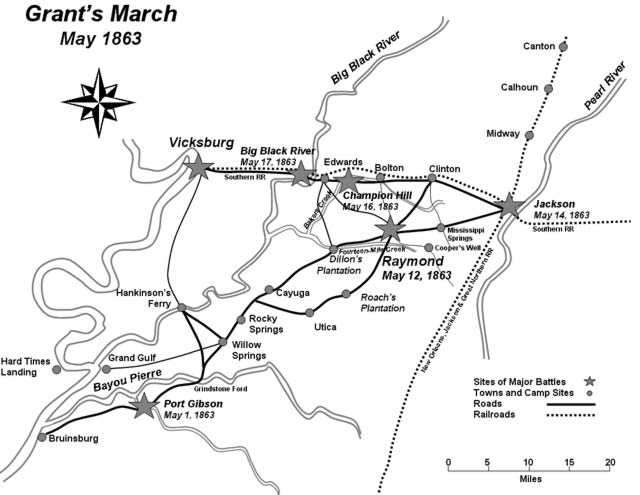
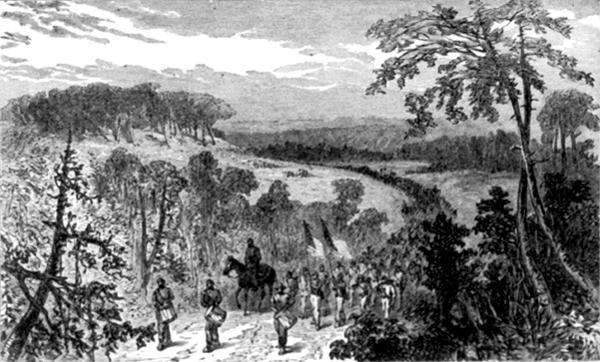
The forces of Grant’s Army of the Tennessee marched northeast in Mississippi from their river crossing point at Bruinsburg (rather than an expected straight north – see the map), pushing inland from the river over a period of 10-12 days. On this date of May 12, 150 years ago, the Battle of Raymond was fought.

Confederate Brigadier General John Gregg was ordered by commanding general John Pemberton at Vicksburg to intercept advancing Union troops, but to not bring on a general conflict against a larger force. Gregg sought to set a trap at a bridge crossing the 14-Mile Creek, believing the Union force to be some sort of advance raiding party. But the blast of artillery upon the bridge signaled the presence of more infantry (a division under John Alexander Logan). Though the Confederates had the numerical advantage early in the day, the arrival of the Union XVII Corps under the command of Maj. Gen. James B. McPherson turned a 2-1 Confederate advantage into a 3-1 deficit. After six hours of fighting, the superior numbers prevailed and Gregg was forced to retreat from the field.

The result of the battle was that Confederate forces under Pemberton and Gregg (soon to be in command of Johnston) were unable to combine, and the Southern Railroad supply for Vicksburg was cut. Total losses were roughly in the 400-500 range for the Union, and about double that for the Confederates.

gmarch

Death of Stonewall Jackson – 150 Years Ago Today

One of the great losses to the Confederate cause happened on this date of May 10, 1863 in the death of General Stonewall Jackson. This was, of course, due to his accidental shooting by his own forces in the grand confusion of that dark evening of eight days prior at the Battle of Chancellorsville. His left arm was amputated, and infections and pneumonia followed. General Lee is reported to have sent word to Jackson with some version of “you have lost your left arm, but I my right.” On the day of his passing which was a Sunday, Jackson said, “It is the Lord’s Day; my wish is fulfilled. I have always desired to die on Sunday.”  And his final words were “Let us cross over the river, and rest under the shade of the trees.”

The room at Guinea Station where Jackson died.

The room at Guinea Station where Jackson died.

Probably everyone who ever spent any time with Stonewall Jackson had interesting stories and anecdotes to tell about him. My guy Abner Doubleday was no exception to this. So I thought I would include here an excerpt from my Doubleday biography that I’ll likely never finish (so might as well use it). This is from a time in the couple of years immediately after the Mexican War – so about 1848-1850 – when Doubleday was assigned duty in the old army at Forts Columbus and Hamilton in New York.

< Actual Doubleday quotes are the words italicized >

 The most interesting and unusual person to enter into Doubleday’s association at this time was a gloomy, strict, awkward, and poorly dressed First Lieutenant named Thomas Jackson—later to be known as Stonewall Jackson. Like many others who knew Jackson, Doubleday penned remarks concerning a number of his most prominent eccentricities. Jackson fretted much about his health, as Doubleday wrote: When we met, he either was in poor health, or thought himself to be so, which amounted to pretty much the same thing. Jackson believed that all of his food ran down into his right leg, thus making his left leg weak. He was therefore very strict in his exercises, and also exhibited a fear of drinking surface water—pumping for long moments to get the deeper water of a well. Before a deep religious experience, he had quite some temper and was fond of the honors involved with dueling and the strict rules connected with it. Doubleday wrote of A.P. Hill commenting to him that “Jackson is the last man I should wish to have as a second in an affair of honor—for if he thought I infringed the code, ever so little, he would shoot me himself.” It was a triumph of grace, a proof of deep and sincere piety, when after his conversion, he gave up his belief in this way of settling disputes.   

Jackson owned a fine-looking horse that Doubleday negotiated to possibly purchase. Jackson hesitatingly informed Doubleday it was a fine horse that formerly had some bad habits, which he had solved. They agreed upon a price, and Doubleday took it out for several “test rides” before buying it. It struck Doubleday as odd that a group of people gathered around to see him mount and ride the horse for the first time. I was rather astonished to find that so simple a performance drew a crowd of spectators. Afterward I knew that they wanted to see which would come off best—myself, or the stubborn beast.

But the initial ride of a steady half-mile proved agreeable. On the next occasion, the same onlookers gathered as Doubleday took the horse out on a military exercise. The first occasion when Doubleday halted, the horse threw out his forelegs and refused to be moved. After much prodding, the horse cut some pretty shines and took Doubleday wildly through a ravine and into some brambles. When Doubleday related the experience to Jackson, the latter intimated it was Doubleday’s fault for stopping—that if he had kept him going, the horse would have been just fine!  The deal was not consummated.

Many people feel that the Confederate disaster at the third day at Gettysburg would not have happened if Jackson had survived to be present there. I don’t have a lot of patience for alternative history and speculations about “what ifs” … but there is no doubt that Jackson’s death was a major blow to the Southern cause.

Summary and Final Chancellorsville Thoughts

On this rainy day of May 5th, 150 years ago, the Army of the Potomac was retreating to the north across the Rappahannock River at the United States Ford. Though a midnight council of war had met to consider the matter and had voted 3-2 to stay and continue the fight, Hooker had decided to pull back … and that is what happened throughout this day and into the morning of the 6th.

But to quickly summarize the 3rd and 4th (since the last post of 3 days ago on the 2nd) … Relentless and bold Confederate attacks pounded the Union lines on the 3rd, using the advantage of the recently captured high ground called Hazel Grove. Hooker issued few orders this morning, while watching and standing on the veranda of the Chancellor house. A Confederate round shot split the wooden pillar on which he was leaning, leaving him stunned for 30 minutes. Though he mounted his horse and attempted to take charge, varied symptoms consistent with a traumatic brain injury overcame his efforts. He ordered a pullback, which stunned Couch and Meade, though they implemented his command by establishing a bridgehead around the U.S. Ford.

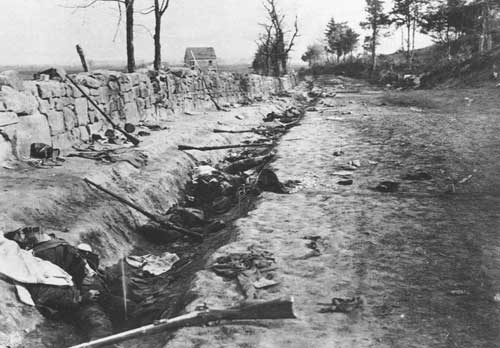
Confederate dead at Marye's Heights

Confederate dead at Marye’s Heights

Over at Fredericksburg, Sedgwick was assaulting Marye’s Heights – being repulsed on the first two attempts. A third more audacious advance with orders to simply rush the hill without pausing to load and fire proved successful, as General John Newton’s division seized the hill and scattered the rebel defenders. Sedgwick quickly gathered his men into columns and pushed them westward toward Hooker at Chancellorsville, leaving John Gibbon’s division of the 2nd Corps to garrison Fredericksburg. Sedgwick’s men encountered opposition at Salem Church – just about 5-6 miles east of Chancellorsville. Lee correctly surmised that Hooker would not come out from behind his trenches near the U.S. Ford, and Sedgwick correctly surmised that Lee was going to bring his heaviest force against him – therefore Sedgwick dug in. The time required for Lee to make these dispositions delayed his attack until late on the 4th, with Sedgwick successfully defending his lines. Sedgwick was told to also retreat north across the Rappahannock, which he too accomplished on the 5th via pontoon bridges downstream from the Banks Ford.

When Lincoln heard of these retreats he exclaimed, “My God, my God, what will the country say? What will the country say?”  Likewise in similar terms, Horace Greeley of the New York Tribune wrote, “My God, it is horrible—horrible; and to think of it, 130,000 magnificent soldiers so cut to pieces by less than 60,000 half-starved ragamuffins!”

So what are we to make of Hooker’s curious behavior? It really is such a mixed bag of good and bad. He had done a wonderful job of resuscitating the army after the Fredericksburg disaster. His battle plan was excellent, and he maneuvered his forces into place on a fine schedule. But when it came time to actually fight the battle, he mysteriously changed personality into a passive person not previously seen. Some blamed his reputation for drinking, while others said it was his cessation from drinking that changed him. And still others said it was a righteous retribution for his arrogant and bombastic speech. Whatever, it was a mess.

John Gibbon wrote of this in his Recollections of the Civil War, “There was a bad influence pervading Hooker’s Headquarters whilst he was in command and this began to crop out immediately after the battle of Chancellorsville. An idea gained ground in the army that by insinuations, innuendoes and intrigues, Hooker and those about him were seeking some “scape-goat” on whom to saddle the responsibility of his failure, a course not without precedent in the army in front of Washington, and when such an impression gets abroad, confidence is soon lost in the officer who attempts it, for no one can ever feel safe in following the dictates of his judgment.”

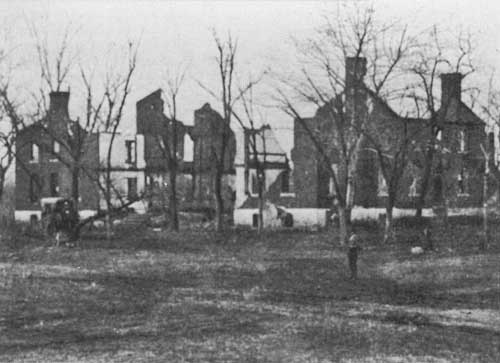
Ruins of the Chancellor house

Ruins of the Chancellor house

A Day of Disasters at Chancellorsville

On this date of May 2nd of 1863, the second day of the Battle of Chancellorsville featured disasters for each side. The Union’s right flank would be crushed by a surprise attack, while the Confederates would mistakenly mortally wound Lee’s right arm – General Stonewall Jackson.

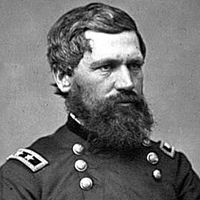
Confederate forces were spotted moving south of Chancellorsville, perceived by Hooker as a withdrawal. In fact, though moving south, before long they took a road to the west and thus were in a position to attack the exposed right flank of the Union Army – that of the 11th Corps of O.O. Howard. Though numerous warnings and reports were received by Howard throughout the day, for unknown reasons he did not take them seriously. Some of his lieutenants took matters into their own hands to make what preparations they could, but it was insufficient to withstand the weight of Stonewall Jackson’s entire corps rolling them over. As the 11th Corps was washed from the field, Hooker became aware of it by the flight of the men streaming past his headquarters. The action being taken late in the day made it impractical for the Confederates to follow up on it, and darkness ensconced men from both sides in utter confusion – seeking to find safety among their own. As Stonewall Jackson returned from a reconnaissance, he was mistakenly fired upon by his own men – dying eight days later.

Of this disaster of the 11th Corps, I’ll share here some excerpts from Doubleday’s book on the battle. Howard and Doubleday were certainly not pals. Howard had reported Doubleday’s well-ordered retreat at the first day of Gettysburg as a rout – contributing to Newton (Doubleday’s junior) being given a corps assignment over him. Doubleday was terribly bitter about this, and actually never fought again after Gettysburg. I believe this attitude is but scantly beneath the surface in his writing as seen in these excerpts – though Howard did (or didn’t do) plenty to earn such verbal castigations……..

O.O. Howard

O.O. Howard

Notwithstanding Hooker’s order of 9:30 a.m., calling Howard’s attention to the weakness of his right flank, and the probability that Jackson was marching to attack it, no precautions were taken against the impending danger. … So far as I can ascertain, only two companies were thrown out on picket, and they were unsupported by grand guards, so that they did not detain the enemy a moment, and the rebels and our pickets all came in together. … There was no reason other than Howard’s utter want of appreciation of the gravity of the situation to prevent him from forming a strong line of defense to protect his right flank.

The Germans were bitterly denounced for this catastrophe, I think very unjustly, for in the first place less than one-half of the Eleventh Corps were Germans, and  in the second place the troops that did form line and temporarily stop Jackson’s advance were Germans; principally Colonel Adolph Buschbeck’s brigade of Steinwehr’s division, aided by a few regiments of Schurr’s division, who gave a volley or two.

In reference to this surprise, Couch remarks that no troops could have stood under such circumstances, and I fully agree with him.

The subsequent investigation of this sad business by the Congressional Committee on the Conduct of the War was very much of a farce, and necessarily unreliable; for so long as both Hooker and Howard were left in high command, it was absurd to suppose their subordinates would testify against them. Any officer that did so would have soon found his military career brought to a close.

Howard was in one or two instances mildly censured for not keeping a better lookout, but as a general thing the whole blame was thrown on the Germans. Hooker himself attributed the trouble to the fact that Howard did not follow up Jackson’s movements, and allowed his men to stray from their arms.

A great French military writer has said, “It is permissible for an officer to be defeated; but never to be surprised.”

First Day at Chancellorsville – 150 Years Ago Today

The huge Battle of Chancellorsville kicked off in earnest on this date of May 1st in 1863. In the last post of several days ago, I finished with this quote of a note to the Army of the Potomac from General Hooker – a note that EVERYONE who writes about Chancellorsville includes in their comments: “It is with heartfelt satisfaction the commanding general announces to the army that the operations of the last three days have determined that our enemy must either ingloriously fly or come out from behind his defenses and give us battle on our own ground, when certain destruction awaits him.”  It is reported that Hooker also said within the hearing of a newspaper reporter that “The rebel army is now the legitimate property of the Army of the Potomac. They may as well pack up their haversacks and make for Richmond. I shall be after them.”

On the beautiful morning of this 1st day of May in 1863, Hooker ordered his men in a three-pronged attack to the east of Chancellorsville, exiting the thicket of the wilderness. The idea was to secure the high ground near Zoan Church and press any Confederates toward Fredericksburg.

At the ridge at Zoan Church were Richard Anderson’s command and the units that had retreated back from the United States Ford … along with the 5/1 morning arrival of McLaws and Jackson’s infantry and artillery. Rather than merely dig in for a defensive stand, the Confederates moved west in an offensive – therefore moving directly into the attack coming toward them. Pressed forward by the audacity of Jackson and Lee, the Union forces ran into a bee’s nest of fire.

Henry Slocum

Henry Slocum

Back at Chancellorsville, the heretofore confidant Joe Hooker completely lost his nerve – ordering a retreat back into the wilderness area to entrench. Hooker’s subordinates were flabbergasted by this. Slocum’s 12th Corps was actually gaining ground at this juncture with but few losses. Meade grudgingly complied with orders but exclaimed, “My God, if we can’t hold the top of a hill, we certainly can’t hold the bottom of it!”

Hooker tried to make the best of it with continued verbal bravado, “Lee is just where I want him; he must fight me on my own ground.”  But Darius Couch could see that he was in the presence of a defeated commander, writing later that “…the retrograde movement had prepared me for something of the kind, but to hear form his own lips that the advantages gained by the successful marches of his lieutenants were to culminate in fighting a defensive battle in that nest of thickets was too much.”  Lee had gained the momentum, and it would not be relinquished … nor would Hooker revive.

My guy (of particular study) Abner Doubleday wrote a volume in the series called Campaigns of the Civil War, writing a combined work on Chancellorsville and Gettysburg. It is not considered a particularly great piece of analysis. As something of a friend of Hooker, Doubleday was not particularly harsh; in fact he may even have something of an apologetic tone of support at times. Among his remarks:

Regarding Hooker’s plans for May 1st movements:  Hooker, who was a very sanguine man, expected to be able to form line of battle by 2 P.M., with his right resting near Tabernacle Church, and his left covering Banks’ Ford. It did not seem to occur to him that the enemy might be there before him and prevent the formation, or that he would have any difficulty in moving and deploying his troops; but he soon found himself hampered in every direction by dense and almost impenetrable thickets, which had a tendency to break up every organization that tried to pass through them into mere crowds of men without order or alignment. Under these circumstances concert of action became exceedingly difficult, and when attempts were made to communicate orders off of the roads, aids wandered hopelessly through the woods, struggling in the thick undergrowth, without being able to find anyone. It was worse than fighting in a dense fog.

Regarding the order to retreat:  To retreat without making any adequate effort to carry out his plans made the General appear timid, and had a bad effect on the morale of the army. It would have been time enough to fall back in case of defeat; and if such a result was anticipated, the engineers with their 4,000 men, aided by Sickles’ corps, could easily have laid out a strong line in the rear for the troops to fall back upon. … After the order came to retire, Couch sent to obtain permission to remain, but it was peremptorily refused. Hooker soon afterward changed his mind and countermanded his first order, but it was then too late; our troops had left the ridge and the enemy were in possession of it. There was too much vacillation at headquarters. Slocum, who was pressing the enemy back, was very much vexed when he received the order, but obeyed it, and retreated without being molested.  …

Here is where a tone of apology is heard: Chancellorsville being a great centre of communication with the plank road and turnpike leading east and west, and less important roads to the south, and southeast, Hooker desired above all things to retain it; for if it should once fall into the hands of the enemy, our army would be unable to move in any direction except to the rear.

Regarding the situation at the end of the day:  The prospect for Lee as darkness closed over the scene was far from encouraging. He had examined the position of the Union army carefully, and had satisfied himself that as regards its centre and left, it was unassailable. Let any man with a musket on his shoulder, encumbered with a cartridge-box, haversack, canteen, etc., attempt to climb over a body of felled timber to get at an enemy who is coolly shooting at him from behind a log breastwork, and he will realize the difficulty of forcing a way through such obstacles. Our artillery, too, swept every avenue of approach, so that the line might be considered as almost impregnable. Before giving up the attack, however, Stuart was directed to cautiously reconnoiter on the right, where Howard was posted, and see if there was not a vulnerable point there.

Yep, there was … and that is much of the story for tomorrow!
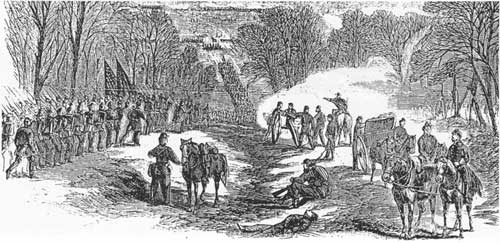
Zoan church

The American Normandy: Grant Crosses the Mississippi / Battle of Port Gibson

150 years ago on this date of April 30, 1863, Ulysses Grant was accomplishing the largest American military amphibious operation prior to Normandy. The location desired for the crossing at Grand Gulf was pounded by the navy for five hours on the 29th – to no avail, as the bombardment fleet suffered more than it inflicted. Admiral Porter declared, “Grand Gulf is the strongest place on the Mississippi.”

Grand Gulf Attack

Grand Gulf Attack

Instead, Grant and his army crossed farther south at Bruinsburg where there was a decent road ascending the cliffs. They crossed the river from Louisiana to Mississippi beginning in the early hours of April 30th. The first troops to come ashore were the 24th and 4th Indiana Regiments. The cliffs were secured, and by the end of the day 17,000 had crossed.

Advance on Port Gibson

Advance on Port Gibson

A quick march to Port Gibson was ordered in hopes of surprising the Confederates there. Taking the less obvious of roads (the Rodney Road), a forced march through the night brought them upon Confederate outposts and into a skirmish in the wee hours of the morning. A hotly contested battle ensued throughout the day on May 1st.  The Southern forces performed as best they could with the numbers at hand (about 8,000), but the weight of Grant’s roughly 23,000 infantry would carry the day. The Union victory at Port Gibson forced the Confederate evacuation of Grand Gulf, and beyond that contributed significantly toward the ultimate fall of Vicksburg. The win established Grant’s position in Mississippi and his base of operation for a successful campaign.

gmarch

Chancellorsville Campaign Underway – 150 Years Ago

On this date of April 28th, 1863, the Army of the Potomac was in motion to catch Lee with movements like unto a hammer pounding against an anvil. To understand this post today, if you are unfamiliar with these army movements, I would reference you to the remarks in this blog posted three days ago.

Let me begin today with some excerpts from Frederick Hitchcock’s War from the Inside – an account written of the activities of the 132nd Pennsylvania Regiment. As a part of the 2nd Corps of Darius Couch, they were moving to the west and crossing the Rappahannock at the U.S. Ford in order to join with the larger forces sweeping more widely to west.

Hitchcock wrote: On April 28 our corps broke camp and joined the column northward. The winter’s rest had brought some accessions to our ranks from the sick and wounded, though the severe picket duty and the excessively damp weather had given us a large sick list. We had, to start with, upward of three hundred and seventy-five men, to which was added some twenty-five or thirty from the sick list, who came up to us on the march. … We marched about six miles the first day, much of our route being through a wooded country, some of it so wet and spongy that corduroy roads had to be built for the wagons and artillery. The army can, as a rule, move as rapidly as it can move its artillery and supply trains, and no faster. Of course, for short distances and special expeditions, where circumstances require, both cavalry and infantry move very rapidly, ignoring the wagon trains and artillery; but on a general campaign this is impossible, and so where the ground is bad these must be helped along. In a wooded country the usual method is by corduroy road. Extra details are made to assist the pioneer corps, who cut down young saplings three to six inches in diameter and about six feet in length and lay them side by side on the ground, which is roughly leveled to receive them. They do not make a handsome road to speed over, but they bear up the artillery and army schooners, and that is all that is wanted of them.

The second day we crossed the Rappahannock at United States ford on a pontoon bridge. There had been a sharp skirmish here when the first troops crossed a couple of days before, and a battery of artillery was still in position guarding the crossing. We now began to experience once more the unmistakable symptoms of approaching battle, –sharp spurts of cannonading at irregular intervals some distance to the south and west of us, with the hurry of marching troops, ambulances and stretcher corps towards the front; more or less of army debris scattered about, and the nervous bustle everywhere apparent. We reached the famous Chancellorsville House shortly after midnight. This was an old-time hostelry, situated on what was called the Culpeper plank-road. It stood with two or three smaller houses in a cleared square space containing some twenty or thirty acres, in the midst of the densest forest of trees and undergrowth I ever saw.

chancellorsville house site

Chancellorsville House Site

Hitchcock goes on at this point to talk about some preliminary fighting that I believe would be associated with May 1st … which makes me think his earlier dating of his writing was off by a day … but nonetheless, he continues:

In view of the events of the next two days, it will be interesting to recall the somewhat windy order published to the army by General Hooker on the morning on the 1st of May … <written and dated the 30th>  … “It is with heartfelt satisfaction the commanding general announces to the army that the operations of the last three days have determined that our enemy must either ingloriously fly or come out from behind his defences and give us battle on our own ground, when certain destruction awaits him.”

My recollection recalls a phrase in this order reading something like this: “We have got the enemy where God Almighty can’t save him, and he must either ingloriously … etc…” I have been surprised not to find it in the records, and my memory is not alone in this respect …

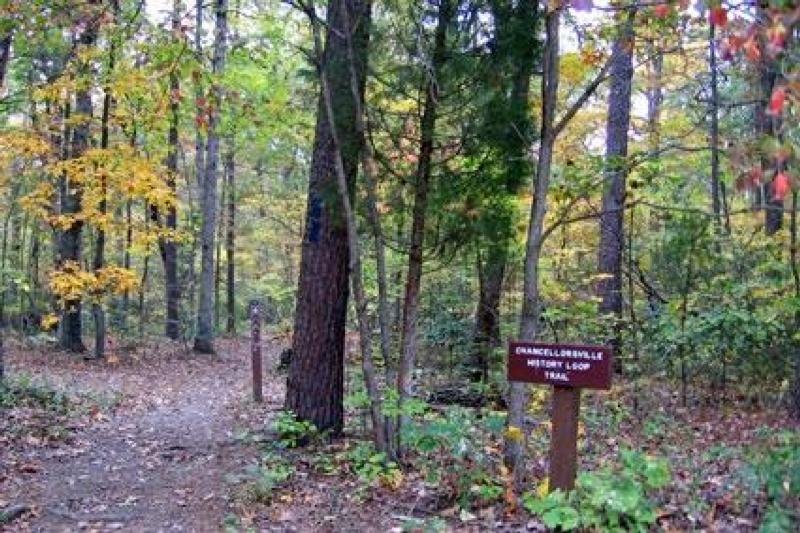
Chancellorsville History Trail

Chancellorsville History Trail

The purpose of this order was to encourage the men and inspire them with the enthusiasm of forthcoming victory. But when we consider that the portion of the army operating around Chancellorsville was at that very moment apparently as thoroughly caged up in a wilderness of almost impenetrable undergrowth, which made it impossible to move troops, and into which one could not see a dozen feet, as though they were actually behind iron bars, it will be seen how little ground there was for encouragement. I can think of no better comparison of the situation than to liken it o a fleet of ships enveloped in a dense fog endeavoring to operate against another having the advantage of the open.

This excerpt sets up the situation well for the opening of the Battle of Chancellorsville – to be continued in the next blog. It has been a number of years since I visited Chancellorsville, and not knowing I would someday write a blog, I did not take pictures. There is actually not a great deal to see, though the visitor’s center is very good. But my main memory is the sight of this dense vegetation, even to this day – an unbelievable tangle.

Wilderness near Chancellorsville

Wilderness near Chancellorsville

The Upcoming Chancellorsville Campaign

After a winter and spring of starring at each other across the Rappahannock River at Fredericksburg, the time had come for some real major action of the Army of the Potomac and the Army of Northern Virginia. General Hooker had devised a plan that, on paper, certainly appeared to be one of excellent construction. Even some of his doubters and critics found significant merit in it.

The Chancellorsville Campaign is rather complicated, but at the same time quite fascinating when studied in detail. In but a few posts, I will attempt to simplify it, while also bringing to it a few of the original sources I particularly enjoy.

The movements of the Army of the Potomac begin in earnest on the 27th of April. Actually, it was two weeks earlier on the 13th that Stoneman’s Cavalry was sent northwest to cross the Rappahannock and drive in Lee’s left flank toward Fredericksburg and ultimately a retreat toward Richmond. Running into terrible wet weather and flooded conditions, this vision would not be realized, though the cavalry would continue on to threaten and harass Confederate supply behind the lines.

Simply stated, Hooker’s plan to use his 130,000-man army to (#1) retain a visual presence (25,000 men) immediately opposite Fredericksburg at Falmouth, (#2) send 40,000 downstream to cross below the city to engage Lee’s right flank and hold the Confederates in that position, while (#3) the primary movement would quickly traverse some miles upstream with three corps of 42,000 – crossing the Rappahannock and Rapidan, driving east through the “wilderness” past Chancellorsville, thereby catching Lee in a vise grip between two major forces. Honestly, it is a good plan.

Making the long journey to the northwest (beginning on the 27th) were the 5th, 11th, and 12th corps of Meade, Howard, and Slocum respectively. The first two major fords to the west and northwest of Fredericksburg – well-defended by Confederates – would be skipped, as this force would march much farther upstream to cross at Kelly’s Ford. The 11th and 12th would make a wider sweep to the west and southwest, turning back toward the east by crossing the Rapidan at the Germanna Ford. The 5th Corps of Meade would turn more sharply against the Rappahannock, crossing the Rapidan at Ely’s Ford. The Confederates at the U.S. Ford would have to pull back to meet this threat, allowing an additional 10,000 troops of two divisions of Couch’s 2nd Corps to bolster the numbers of Federal forces moving from west to east toward Fredericksburg. The other division of the 2nd Corps and all of Sickles 3rd Corps would comprise the 25,000 at the center, while the operations to the east of Fredericksburg would be under the command of John Sedgwick – with his own 6th Corps and the 1st Corps of John Reynolds.

The key elements for success would be for the wide-ranging 52,000 men coming in from the west/northwest to successfully break through a 70-square-mile thicket of “wilderness” to the east of Chancellorsville, while also trusting that Lee would hold the bulk of his force at Fredericksburg.

Sketch of the Chancellorsville House

Sketch of the Chancellorsville House

The word “wilderness” is an apt description of the areas surrounding the Chancellorsville Mansion house and clearing, along with land to the west of it, including those areas south of the rivers in that direction. A dense thicket of scrubby wasteland, choking vines, blackjack and hickory … it was no place for a battle. Traversed by a couple of roads, an army would not want to be entrapped in such a place.

Lee again did what would not be expected. He possessed knowledge through JEB Stuart of the crossing of a large force to the northwest. One would expect that he would pull back toward Richmond and establish a new fortified position. Rather, he kept one-quarter of this forces under Jubal Early to meet the threat at Fredericksburg, while the rest would move west – establishing a line at Zoan Church in the open ground to the east of Chancellorsville and the wilderness region.

I will pick up the story in three days – talking about these troop movements leading up to the opening of battle on May 1st, using some interesting original source materials.