150 Years Ago Today – The First Battle of Murfreesboro

On this date of July 13, 1862 occurred the FIRST Battle of Murfreeboro, Tennessee. In the South, the Battle of Murfreesboro is what the North called “Stones River” – a major conflict that transpired on December 31 of 1862 to January 2, 1863.

Here is a write-up of the July 1862 battle as taken from tennesseeencyclopedia.net …

After U.S. Brigadier General James Negley’s June 7-8 attacks on the Confederate forces at Chattanooga, U.S. Major General Don Carlos Buell moved his Army of the Ohio from Corinth, Mississippi, toward Chattanooga to reinforce Negley. The Confederate response was to divert the reinforcements and to draw Union troops away from Chattanooga. To that purpose, Confederate Colonel Nathan Bedford Forrest was dispatched from Chattanooga with two of his cavalry units to retake Murfreesboro, while Colonel John Hunt Morgan launched a cavalry offensive against Union stations in Kentucky. At that time, Murfreesboro, a strategic supply depot on the Nashville and Chattanooga Railroad, was held by a small Union force camped in and around the town.
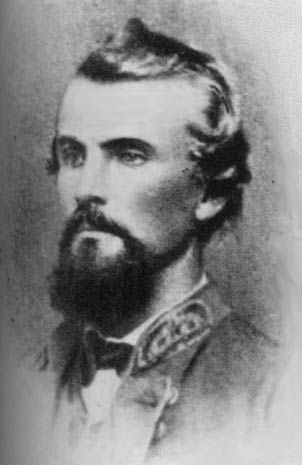
Two more cavalry units joined Forrest on his way to Murfreesboro, bringing the total of Confederate troops to about 1,400. While Forrest camped at McMinnville on the night of July 12, a detachment of the Eighth Texas captured the Union pickets without a shot fired. From the captured pickets, Forrest learned of the uncoordinated Union troop emplacements at Murfreesboro. The Ninth Michigan, along with a unit from the Fourth Kentucky cavalry, was camped at Maney’s Spring. The Third Minnesota and part of the First Kentucky battery, who had originally camped near the Michigan troops, but relocated due to inadequate water supply and ill will between regimental leaders, were now a mile and a half northwest of town. The Ninth Michigan’s Company B, commanded by Captain Oliver C. Rounds, provost marshal of Murfreesboro, was holding several local citizens prisoner in the courthouse to be executed by order of Major General Thomas L. Crittenden. Crittenden had arrived from Alabama on July 12 and was completely unsuspecting of any Confederate activity in the area.

Just before dawn on July 13, his birthday, Forrest and his men approached from the east on Woodbury Pike, capturing a Union hospital and the Ninth Pennsylvania. Forrest divided his troops into three forces to address the three remaining Union concentrations. The Ninth Michigan at Maney’s Spring defended its position forcefully, though its commanding officer, Colonel William Duffield, was wounded and taken to the Maney house at Oaklands. The Third Minnesota, to the west of the Michigan troops, held its position through sporadic Confederate attacks. Though relatively unengaged, the Minnesotan commanding officer, Colonel Henry C. Lester, refused to come to the aid of the hard-pressed Michigan troops, thus forcing the latter to surrender. Under a flag of truce, Forrest led him past the same Confederate units repeatedly, causing Lester to overestimate the number of opposition forces. Once assured of the other units’ surrender, Lester then gave up his own troops, as well as the attached Kentucky battery. He was later court-martialed for cowardice.

Meanwhile, the Confederates who attacked the Federal garrison at the courthouse were exposed to Union sharpshooter fire from the cupola, and the assault to free the prisoners soon became uncoordinated and ineffectual. After several Confederate casualties, the courthouse door was finally breached and a fire kindled in the building to force the Federals to surrender.

By evening, Forrest’s cavalry had captured between 800 and 1,200 Union prisoners, including Major General Crittenden and Captain Rounds, and set free the condemned citizens in the courthouse, all to the joy of the loyalist townspeople. Owing to the large number of prisoners, however, Forrest had to retreat to McMinnville, leaving Murfreesboro open again to Federal occupation. The Confederates also captured a large cache of supplies, including four pieces of artillery, all amounting to about a quarter of a million dollars. The greatest damage was the destruction to the railroad–the depot, a substantial length of tracks, and the bridge south of town were torn up or burned down. Confederate casualties numbered only about 150.

The raid, also referred to as the First Battle of Murfreesboro, was the first significant operation behind Federal lines in the western theater. As Forrest’s first independent raid, its success catapulted Forrest to great renown and a promotion to brigadier general. Strategically, the raid succeeded in diverting Union regiments from reinforcing Negley’s troops at Chattanooga and disrupted Union control of Middle Tennessee by destroying communications and stores at Murfreesboro. Because the Union officers mistakenly estimated that Forrest had as many as 3,500 troops, local garrisons were called in from the Army of the Ohio to protect Nashville and Middle Tennessee. This allowed Confederate General Braxton Bragg to concentrate his forces for an August campaign into Kentucky, ultimately leading to the Battle of Perryville in October.
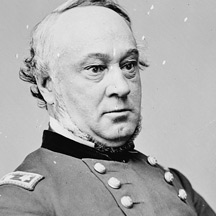
150 Years Ago Today – Halleck Appointed General-In-Chief

On this date of July 11, 1862 President Lincoln had returned to Washington from his visit with McClellan and the Army of the Potomac at Harrison’s Landing. As further evidence that the President was not impressed with McClellan’s unsolicited letter, he appointed Henry Halleck as General-In-Chief – a position originally held by Little Mac, but taken from him when he departed for the Peninsula.

Halleck had always been Winfield Scott’s preferred replacement when old “Fuss and Feathers” had retired from this same post. But at that time, McClellan was on the crest of a wave of popular support that included Lincoln’s confidence.

Halleck came to the position from service in the West. He was far from an inspiring character – either by looks or personality. But he was a smart fellow, having written an acclaimed book on military science called “Elements of Military Art and Strategy.”  For his wonkish book smarts, he was known in the army as “Old Brains.”

An 1839 graduate of West Point (3rd in the class), the native New Yorker passed the Mexican War in California in non combat roles of military governance and adminstration. He became a lawyer in the Golden State and, like most former military men, joined the war effort as the nation divided. His successes in the west were frankly more attributable to subordinates, as his hands-on command demonstrated a propensity for slow, deliberative movements. Yet Lincoln perceived him to be the possessor of necessary qualities for the execution of the War from Washington.

McClellan was predictably disturbed upon hearing of this appointment some days later (reportedly by reading it in a newspaper!). To his wife Nellie he wrote: “It is grating to have to serve under the orders of a man whom I know by experience to be my inferior.”

(I sometimes wonder why Nellie didn’t throw these letters into the fire!)

McClellan’s Advice to Lincoln – 150 Years Ago Today

As was communicated in yesterday’s post, President Lincoln made a visit to the Army of the Potomac at Harrison’s Landing on these dates 150 years ago. His purpose was to gain a first-hand assessment of the Army with a view toward discussions and decisions relative to future objectives.

General McClellan handed Lincoln a letter containing thoughts that were unsolicited and that were beyond the scope of his duties. The letter is extraordinarily well-written and details clearly the variant views the General possessed of the broader issues of the War, such as political matters. In fact, Lincoln’s secretaries Nicolay and Hay called this “the beginning of General McClellan’s distinctively political career.”

Lincoln and McClellan at Antietam, October, 1862

The major points to take away from the communication involve McClellan’s view of the purpose and aims of the war. His desire was to see the Union restored as it had been – without touching the institution of slavery. As well, it is clear that he did not want to see the South punished or persecuted by the confiscation of property and prosecution of the war in all-out fashion.

The President read the letter in McClellan’s presence and put it in his pocket without comment. Dated July 7th, the letter writes:

Mr. President:

          You have been fully informed that [the] rebel army is in [our] front, with the purpose of overwhelming us by attacking our positions or reducing us by blocking our river communications. I cannot but regard our condition as critical, and I earnestly desire, in view of possible contingencies, to lay before your excellency, for your private consideration, my general views concerning the existing state of the rebellion, although they do not strictly relate to the situation of this army or strictly come within the scope of my official duties. These views amount to convictions, and are deeply impressed upon my mind and heart. Our cause must never be abandoned; it is the cause of free institutions and self-government. The Constitution and the Union must be preserved, whatever may be the cost in time, treasure, and blood. If secession is successful other dissolutions are clearly to be seen in the future. Let neither military disaster, political faction, nor foreign war shake your settled purpose to enforce the equal operation of the laws of the United States upon the people of every state.

          The time has come when the government must determine upon a civil and military policy covering the whole ground of our national trouble.

          The responsibility of determining, declaring, and supporting such civil and military policy, and of directing the whole course of national affairs in regard to the rebellion, must now be assumed and exercised by you, or our cause will be lost. The Constitution gives you power sufficient even for the present terrible exigency.

          This rebellion has assumed the character of war; as such it should be regarded, and it should be conducted upon the highest principles known to Christian civilization. It should not be a war looking to the subjugation of the people of any State in any event. It should not be at all a war upon population, but against armed forces and political organization. Neither confiscation of property, political executions of persons, territorial organization of States, or forcible abolition of slavery should be contemplated for a moment. In prosecuting the war all private property and unarmed persons should be strictly protected, subject only to the necessity of military operations. All private property taken for military use should be paid or receipted for; pillage and waste should be treated as high crimes; all unnecessary trespass sternly prohibited, and offensive demeanor by the military towards citizens promptly rebuked. Military arrests should not be tolerated, except in places where active hostilities exist, and oaths not required by enactments constitutionally made should be neither demanded nor received. Military government should be confined to the preservation of public order and the protection of political rights. Military power should not be allowed to interfere with the relations of servitude, either by supporting or impairing the authority of the master, except for repressing disorder, as in other cases. Slave contraband under the act of Congress, seeking military protection, should receive it. The right of the Government to appropriate permanently to its own service claims to slave labor should be asserted, and the right of the owner to compensation therefor should be recognized.

          This principle might be extended, upon grounds of military necessity and security, to all the slaves within a particular State, thus working manumission in such State; and in Missouri, perhaps in Western Virginia also, and possibly even in Maryland, the expediency of such a measure is only a question of time.

          A system of policy thus constitutional and conservative, and pervaded by the influences of Christianity and freedom, would receive the support of almost all truly loyal men, would deeply impress the rebel masses and all foreign nations, and it might be humbly hoped that it would commend itself to the favor of the Almighty.

          Unless the principles governing the future conduct of our struggle shall be made known and approved, the effort to obtain requisite forces will be almost hopeless. A declaration of radical views, especially upon slavery, will rapidly disintegrate our present armies. The policy of the government must be supported by concentration of military power. The national forces should not be dispersed in expeditions, posts of occupation, and numerous armies, but should be mainly collected into masses and brought to bear upon the armies of the Confederate States. Those armies thoroughly defeated, the political structure which they support would soon cease to exist.

          In carrying out any system of policy which you may form you will require a commander-in-chief of the army, one who possesses your confidence, understands your views and who is competent to execute your orders by directing the military forces of the nation to the accomplishment of the objects by you proposed. I do not ask that place for myself. I am willing to serve you in such position as you may assign me, and I will do as faithfully as ever subordinate served superior.

          I may be on the brink of eternity; and as I hope forgiveness from my Master, I have written this letter with sincerity towards you and from love of my country.

Very respectfully, your obedient servant,
Geo. B. McClellan,
Maj.-Gen. Commanding.

Harrison’s Landing on the James

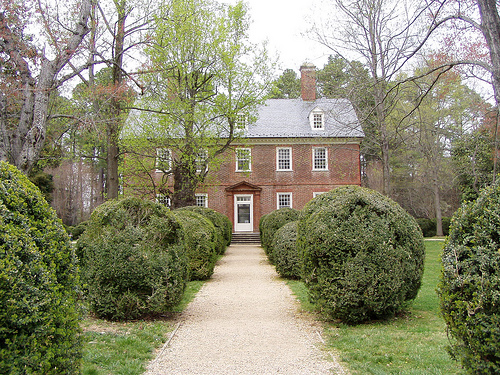
The site of the Berkeley Plantation – the ancestral home of William Henry Harrison, 9th US President – was the location for the Army of the Potomac during July and August after the retreat from in front of Richmond. On this date of July 8, 1862, President Lincoln made a visit.

Lincoln came to assess the condition of the army and found them to be in surprisingly good morale. On the 9th, he visited with General McClellan and five of his corps commanders. Lincoln raised the question about the withdrawal of the army from the Peninsula, but the majority (including McClellan) believed it would be devastating for the broader purposes of the war.

Lincoln, as was often the case, covered any hint of what action or direction he was leaning in terms of any decisions. But upon return to Washington, he appointed Henry Halleck as general-in-chief (more on this in a coming blog post on the 11th).

Naturally, none of this pleased McClellan – who reserved his greatest wrath for Stanton, saying to his wife Ellen in a letter on the 13th that if Stanton “had lived in the time of the Savior, Judas Iscariot would have remained a respected member of the fraternity of Apostles.”

Another minor note: It was here at Berkeley that General Daniel Butterfield composed the familiar tune” Taps”, fist played by his bugler, O.W. Norton.

July 4th – 150 Years Ago Today

<The following three paragraphs are from my Doubleday research and book project … with other materials included below as well.>

Washington is where Doubleday was during the latter part of June of 1862, being called there on business about which he does not specify in his diary. But surely this business was connected to the creation of a new Union army—the Army of Virginia, which was birthed on June 26th. Bringing together the departments of Banks, Fremont, and McDowell, along with the troops in Washington under General Samuel Sturgis, this new force of up to 50,000 was placed under the command of Major General John Pope. Organized into three corps, McDowell was in charge of the 3rd Corps, which would include Doubleday’s Brigade.

Preparations for active campaigning now began in earnest for Doubleday and his command. During this period of approximately six weeks, Doubleday recorded a number of interesting incidents and details in his journal.

(July 4th Celebration)

There was quite a grand celebration of Independence Day, and Doubleday recorded that Captain George Noyes, my brigade commissary, delivered a very eloquent address to the troops and we had a very pleasant celebration.1  The day consisted of an

Camp Recreation – from Harpers

artillery salute, a reading of the Declaration of Independence to the gathered troops, accompanied by music from the band of the 56th Pennsylvania Volunteers. The afternoon involved great merriment of horse races between the various regiments, and the humor of races with donkeys. Regarding the speech of Noyes, the Maine lawyer wrote anonymously of his own oration: “Truly the penates [household gods – a word from Roman times] of the Phillips mansion, and the spirits of earth and air who, as the poets tell us, flit on invisible wings about these groves and hillsides, must have heard sentiments uttered on this occasion by the parlous Yankee orator which had for them at least, the charm of novelty. As for Virginians of mortal mould, we had but few of them, and these mainly contraband of war, who made up, however, for their lack of numbers by their open-mouthed enthusiasm. To them it was Independence Day indeed.”2  The historian of the 76th New York also wrote of the address as eloquent and patriotic, praising it for speaking openly of truths not usually heard in such a region oppressed by “the dark pall of slavery.” He reported that the address was heartily received by the volunteers who had come to suppress the rebellion, and rendered the opinion that they “consecrated themselves anew to their holy mission.”3

– – – –

July 4th, 1862 around the USA

With the news of the change of base and Seven Days Battles being reported to the northern population, what were they to make of it?  Was this a victory or a defeat or something else? The mixed emotions may have been best expressed by a correspondent of “Vanity Fair” who wrote: Yes, my boy, we have had a great victory. Now we want to know who is to blame for it!4

The troops on both sides were being commended by their leadership. To the Army of the Potomac, McClellan wrote:  Your achievements of the past 10 days have illustrated the valor and endurance of the American soldier. Attacked by vastly superior forces, and without hope of reinforcements, you succeeded in changing your base of operations by a flank movement, always regarded as the most hazardous of military expedients … Your conduct ranks you among the celebrated armies of history.  No one will now question that each of you may say with pride, “I belonged to the Army of the Potomac.”

The Army of Northern Virginia was also receiving accolades from Jefferson Davis. Speaking anthropomorphically of the Union  Army, he wrote:  You marched to attack the enemy in his intrenchments with well-directed movements and death-defying valor; you charged upon him in his strong positions, drove him from field to field, over a distance of more than 35 miles, and despite his re-enforcements, compelled him to seek safety under cover of his gunboats, where he now lies cowering before the army so lately divided and threatened with entire subjugation.

If I could write half as well as any of these people in this blog post, I could make a living off it!  But hopefully I write more accurately and honestly and with some less hyperbole!!!  But it sure is fun to read!

1.  Doubleday Journal – HFC: My Record During the Rebellion, p. 63.

2.  Noyes, George – The Bivouac and the Battlefield, pp. 50-51,

3.  Smith – The History of the Seventy-Sixth Regiment New York Volunteers, pp. 88-89.

4.  Seward – Reminiscences of a War-Time Statesman and Diplomat, p. 205.

The 53rd Virginia of Pickett’s Charge

In the early Spring of this year I was driving through south-central Virginia on Route 29 and saw a sign speaking of visiting “historic Chatham,” so I exited the highway and drove into town to see what was historic about it. A town web site says: “Chatham was established as a town in 1777 during the turbulent years of the American Revolution. Chatham has been affectionately called the ‘Prettiest Little Town in Southside Virginia.’ It has also been called the hub of American architecture by some, as she boasts a fine representation of pre-Revolution, Federal, Victorian, and post-Victorian architecture.”  (I wrote another post on this town which may be seen on April 21 of this year in this blog.)

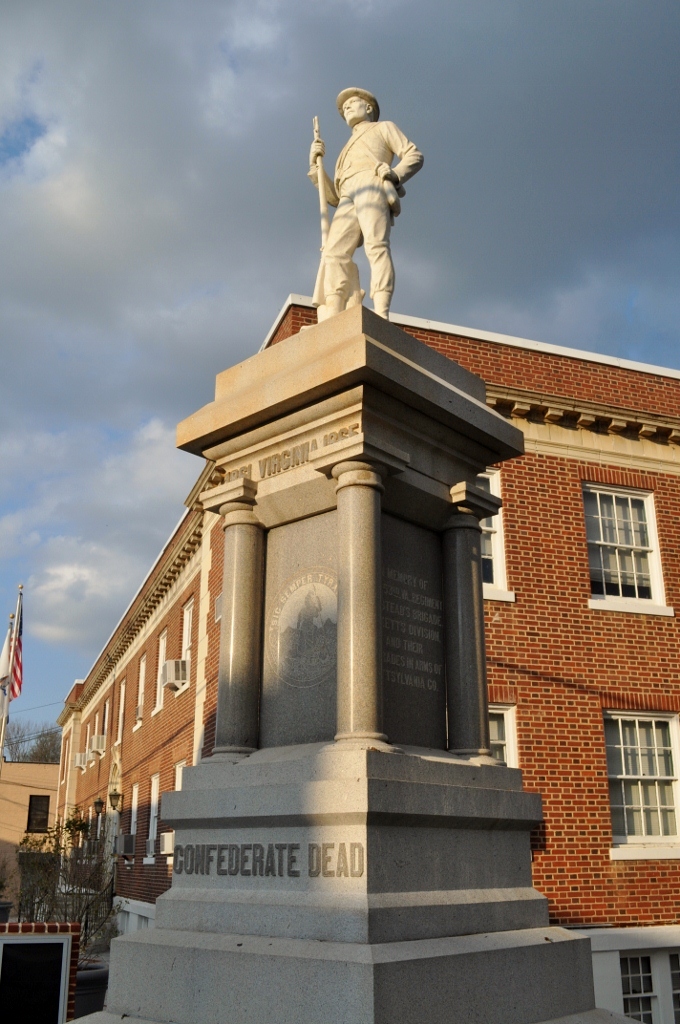
In the center of town is a monument (see pictures below) to the 53rd Virginia regiment – composed of men from this county of Pittsylvania. The 53d Virginia was the middle of five regiments in Armistead’s Brigade in the middle of Pickett’s Charge upon the Federal position at Gettysburg. Of course, this fatal attack was made on this date 149 years ago today. (I’m sure I’ll have more to say about this a year from today!)

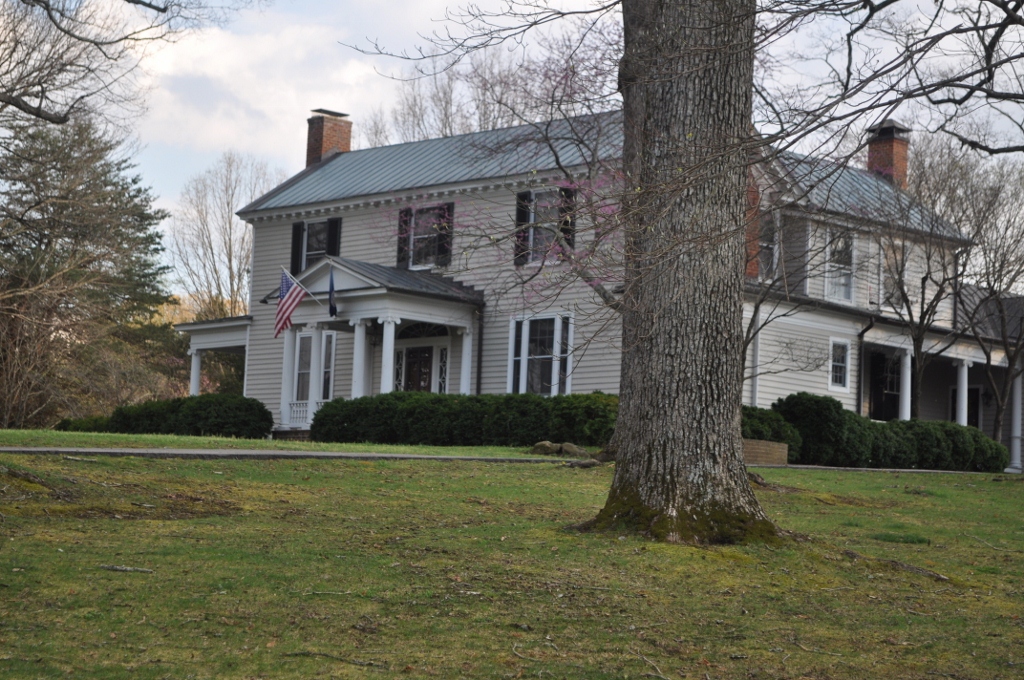
Leading the charge of the 53rd VA was Lt. Col. Rawley W. Martin.  There is a home on the main street in Chatham with a historical marker speaking of this future physician in the town (see pictures below).

Young Clara Barton Scholar

Texas Girls at Antietam

With the Antietam Battlefield Guides, we get to see all sorts of individuals, families, and groups. Earlier this year I wrote about a group of 300 Marines who were our guests to examine the battlefield and discuss leadership and tactics. We meet with educational groups, and especially this year there have been busloads of history teachers from public schools around the country – I’ve meet with two groups from Missouri and South Dakota. We connect with Civil War enthusiasts who are often quite well-read, along with every variety of family imaginable.

Today I met with a family from East Texas with a history loving, cheerleader, teenage daughter!!  So much for stereotypes. Dad was definitely a Civil War buff and his daughter was very interested in all aspects of the battle. Gotta love a girl like that (pictured at the Texas monument).

This past Saturday, I met with a rather young scholar on Clara Barton – a young lady from Frisco, Texas who will be going into 4th grade in September (she is no longer a 3rd-grader!). She wrote a school paper on Clara Barton, and her mom brought her (and her younger sister) to see the Antietam Battlefield and the very location where the future founder of the American Red Cross would become renowned for her work.

Clara Barton had a real heart for the suffering of the soldiers. She would load up extra medical supplies from wherever she could gather them and head out to the battlefield to assist wherever she would be welcomed. At first, she was seen as overstepping certain bounds of propriety, but she would eventually be known as “the angel of the battlefield.”

It was at Antietam that she told the story of a stray bullet passing through the sleeve of her dress into a wounded soldier whom she was assisting. She labored for six weeks with the army around Sharpsburg after the Battle of Antietam, came down with Typhoid Fever, recovered for a month in Washington, and resumed her efforts with the army by the Battle of Fredericksburg in December of 1862.

Beyond showing her the Poffenberger Farm, there was not much I could tell my young scholar friend that she did not know and have as a part of her report. I gave her a 10-page biography on Clara Barton copied from an online source, and she had it read before we even got to the Burnside Bridge!

I have met some pretty amazing children over the past 5-6 years!

Clara Barton scholar in front of the monument of her heroine!

Here is a Clara Barton quote that I share with most visitors who come to Antietam. At this point I have it pretty much memorized!

“If I were to speak of war it would not to show you the glories of conquering armies but of the mischief and misery they strew in their tracks; and how, while they marched on with tread of iron and plumes proudly tossing in the breeze, someone must follow closely in their steps, crouching to the earth, toiling in the rain and darkness, shelterless themselves, with no thought of pride or glory, fame or praise, or reward; hearts breaking with pity, faces bathed in tears and hands in blood. This is the side which history never shows.”

Seven Days Battles – Malvern Hill

Battle of Malvern Hill

<<Today is the sixth and final of a series of posts on the Seven Days Battles near Richmond, Virginia that occurred 150 years ago this week.>>

On this date 150 years ago, July 1 would feature the final and most deadly of the Seven Days Battles in front of Richmond. Malvern Hill was a high ground bluff overlooking Harrison’s Landing on the James with a gentle northern slope. Here the Union was strongly established in its “change of base” retreat to the James River.

Yet again, the Confederates attacked a difficult position with insufficient support and bad orders. None of the assaults approached any measure of success for breaking through. The Rebels especially suffered from the deadly accurate fire of 250 Union guns under Henry Hunt – McClellan’s chief of artillery.

Total losses for the day would be about 5,300 Confederate and 3,200 Union. For the entire week, the South lost about 20,000 of the 85-90,000 and the North about 16,000 of the 115,000 or more engaged.

In the final analysis, Lee is hailed for the strategic victory of driving McClellan away from Richmond; yet, the week was filled with tactical flaws and losses galore!! On four occasions, the Union carried the day, and slipped away at night. The loss for the Union, and the nearly three years until Richmond would be taken, would guarantee that the country would be massively reconstructed from the pre-1860s era.

As a review and summary of the past seven days … (from: http://www.encyclopediavirginia.org/Seven_Days_Battles)

June 25, 1862 – Union general George B. McClellan’s forces advance on Oak Grove south of the Chickahominy River in the first of the Seven Days’ Battles. The fighting ends with little tangible result.

June 26, 1862 – Confederate general Robert E. Lee attacks Union general Fitz-John Porter’s lines north of the Chickahominy River near Mechanicsville but is repulsed. Confederate forces under Thomas J. “Stonewall” Jackson arrive in the afternoon but are too late to affect the battle’s outcome.

June 27, 1862 – After a series of assaults during the afternoon, Confederate forces under Robert E. Lee finally defeat Fitz-John Porter near Gaines’s Mill. Porter crosses the Chickahominy River that night, and Union general George B. McClellan starts his retreat to the James River.

June 29, 1862 – After a day of confusion, Confederate general John B. Magruder attacks Union general George B. McClellan’s rear guard at Savage’s Station but is stopped.

June 30, 1862 – Confederate general Robert E. Lee’s best chance to severely hurt Union general George B. McClellan is thwarted at Glendale by a combination of hard Union fighting and Confederate failures of command.

July 1, 1862 – Several assaults on the Union position at Malvern Hill are bloodily repulsed because of Confederate command failures. Nevertheless, Union general George B. McClellan begins his final retreat to the James River during the night.

July 2, 1862 – The Army of the Potomac arrives at its new base at Harrison’s Landing.

150 Years Ago Today – The Battle of Frayser’s Farm

<<Today is the fifth of a series of posts on the Seven Days Battles near Richmond, Virginia that occurred 150 years ago this week.>>

The best opportunity for Lee to cut off McClellan’s retreating army was on this date of June 30, 1862. McClellan had about half of his army near the Glendale crossroads (Frayser’s Farm) – a junction of roads from the Richmond area toward the James River destination of Harrison’s Landing.

The Confederate plan was to have the forces of D.H. Hill, Jackson, and Huger occupy the Union Army north of Glendale, while A.P. Hill and Longstreet would maneuver to cut them off. Again, the plan was not executed as envisioned, and again, Jackson failed to carry out Lee’s desires. Also again, it was Longstreet and A.P. Hill who advanced unsupported against the Federals – finding early successes, but ultimately unable to sustain them.

The Army of the Potomac would successfully retreat in the darkness to the good high ground position of Malvern Hill, where 150 years ago tomorrow, the dreadful battle of that name would transpire.

150 Years Ago Today – Battle of Savage’s Station

<<Today is the fourth of a series of posts on the Seven Days Battles near Richmond, Virginia that occurred 150 years ago this week.>>

The fourth of the significant conflicts of the Seven Days Battles occurred on this date of June 29, 1862. As McClellan continued his “change of base” (retreat) to the James River, Lee attempted to aggressively pursue, with hopes that on this day perhaps a large chunk of the Army of the Potomac could be cut off.

But when darkness fell, few commanders on either side would score high grades in leadership. Lee’s own circle of command forwarded confusing and garbled directives; Jackson was not aggressive in typical fashion; Magruder’s main attack on the Union rearguard of Summer’s Second Corps would elicit a reprimand from Lee; McClellan was far south of the action with no orders for the retreat; and Heintzelman decided on his own that Sumner’s two divisions and Franklin’s one division were sufficient, and so he retreated without informing the others.

In fact, the three divisions were sufficient as a rear guard; and despite some initial Confederate successes of Magruder’s troops, the Union was ultimately able to hold off the attacks. Rebel attempts to flank and circumvent the AOP’s withdrawal were insufficient and late.

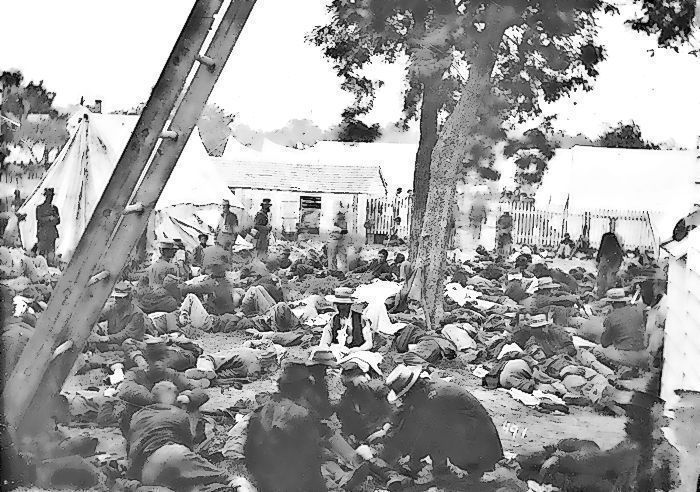
The Federals were ordered to burn whatever they could not carry in their retreat across the White Oak Swamp. And unfortunately, about 2,500 Union wounded were left behind in a field hospital at Savage’s Station.

Total losses on the day (beyond the 2,500 wounded) were over 1,000 for the Yankees and close to 500 for the Rebels. The most significant losses were suffered by the Vermont Brigade of Colonel Brooks – of Baldy Smith’s division. Brigade losses totaled 439, with the 5th Vermont losing nearly half its number – 209 out of 428 total.

Field Hospital at Savage’s Station