The Bridge is THE BRIDGE

What more iconic image of the American Civil War is there than the Burnside Bridge at Antietam? The structure itself – nestled in a bucolic valley – traversing a gentle stream under the canopy of trees and hillsides … it just screams “Civil War History!”

Having taken hundreds of guests on tours of the scene of America’s bloodiest day, most often the highlight is the arrival at the hillside overlooking the bridge. As we park at the top of the hill where the Georgian Brigade held off thousands of Union troops on the opposing shore, people cannot help but verbalize their awe at the site of this compelling location with its poignant story.

It is so perfect; it is so enchanting, that people often ask, “Is that real? Was that bridge really here?”  People jump out of the car to take pictures – even people who took no photos at all up to that point will pull out their iPhone to get a shot of this object!

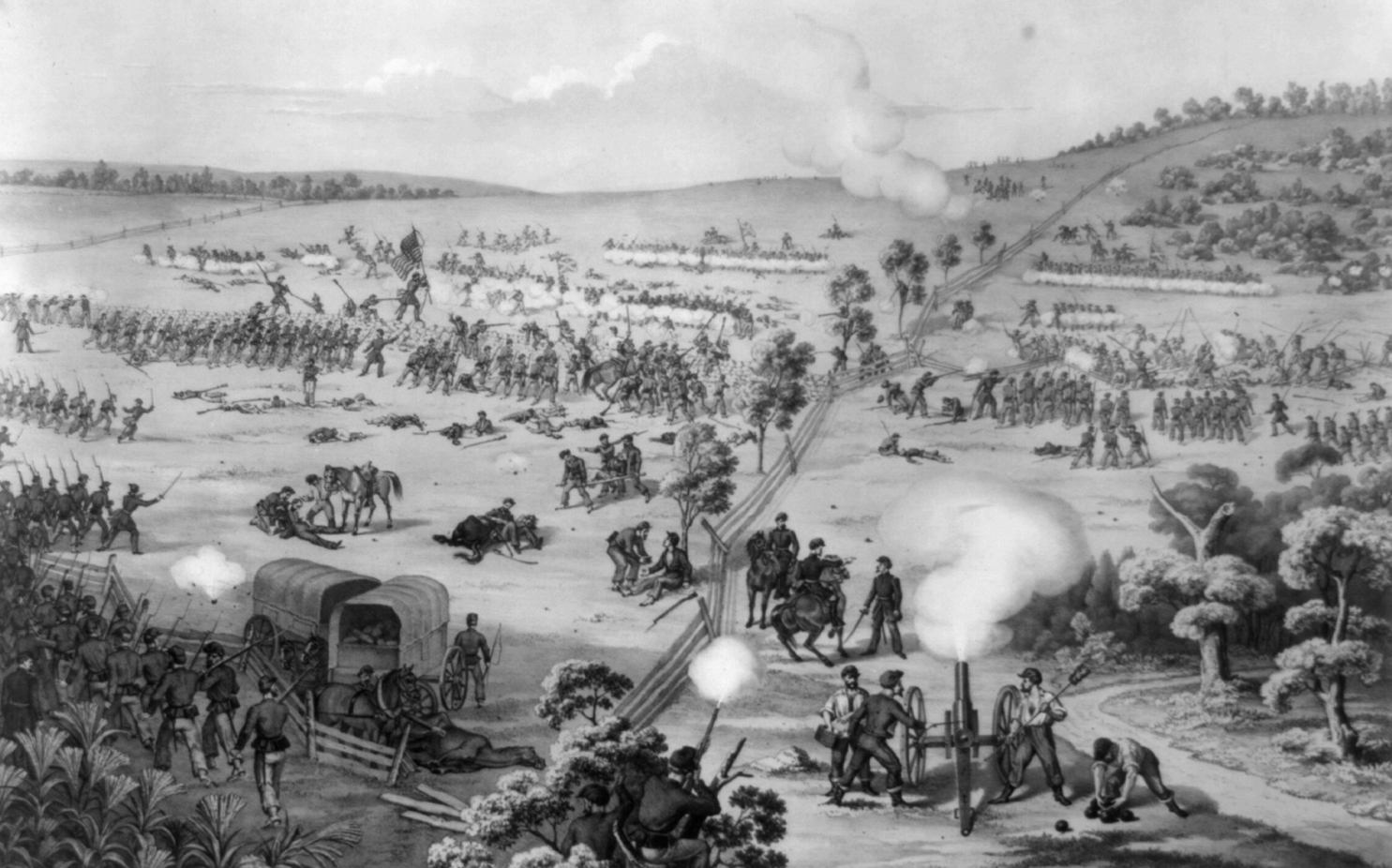
The bridge has captured varied artists of pen, brush, and shutter ever since that incredible day 150 years ago. An original sketch (pictured here) was made by Edwin Forbes – a landscape painter and etcher who gained fame during the American Civil War for his detailed and dramatic sketches of military subjects.

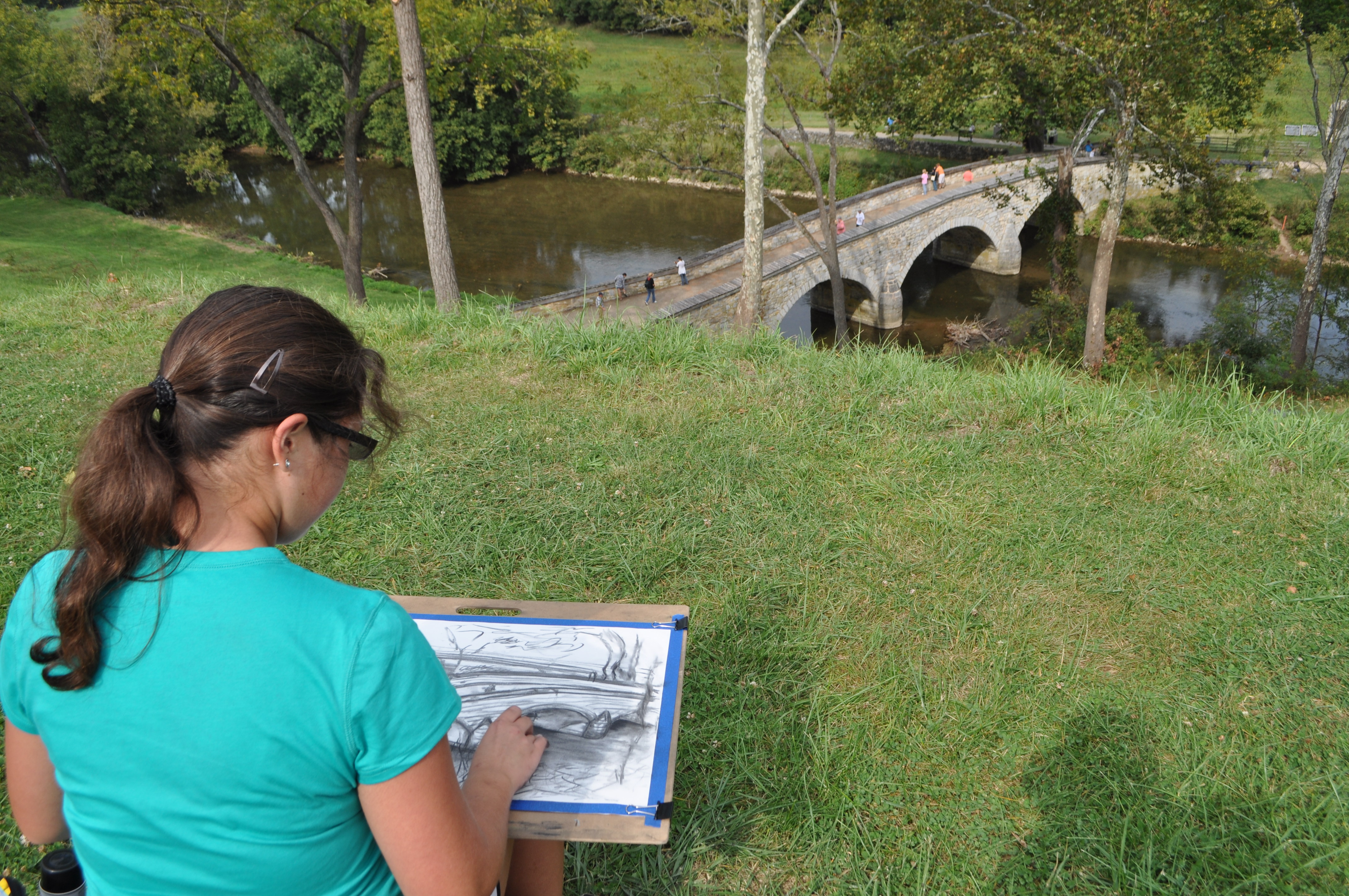
As I wrote in an earlier blog, on the day of the sesquicentennial, I drew an assignment to be at the bridge for the afternoon. While there, I was drawn to engage a young woman in conversation who was sketching the bridge from the opposite side as did Mr. Forbes 150 years earlier. I gave a business card with this blog address and email to her father standing nearby, and she recently sent me a note with her charcoal sketch of the bridge attached. I’m amazed that anyone can do anything like this! Her name is Katherine Bobby, and she attends Anne Arundel Community College where she is majoring in the Fine Arts. I think this is very cool …

150 Years Ago Today – Emancipation Announced

It was on this date of September 22, 1862 that Lincoln issued publically a preliminary proclamation of emancipation of slaves in states in rebellion against the United States. The official order, signed on January 1st of 1863 took effect in areas where the Union forces had gained control. The Thirteenth Amendment – December 1865 – made slavery illegal everywhere in the United States.

On tours at Antietam, I make certain at the beginning orientation talk to speak about a Cabinet meeting on July 22, 1862 where Lincoln made it clear that he was intent upon this action. He did yield to what he construed as wise advice to wait for a battlefield victory to issue it. Of course, that victory is Antietam/Sharpsburg … and so, the bookends for my presentation involves ending with the facts surrounding the results of this proclamation, namely: the War had an additional moral purpose, that purpose made it untenable for European support of the Confederacy, and left on their own – outnumbered North to South by a ratio of 22 million to 9 million – it was ultimately impossible for the Confederacy to gain their goal of independence.

Several years ago I had a very, very prominent African-American person appear as a guest on a tour. I figured out who he was about 30 minutes into that time together. He is a well-known figure to millions of Americans … particularly of my own admitted conservative political persuasion. But when I came to the end of my talk – speaking of the items in the paragraph above , he very ungenerously (in my humble opinion) exclaimed that “it was a proclamation that didn’t free a single slave!”

Lincoln was a great man – one who had to wisely walk a delicate line between very divergent political factions. He could not dare lose the Border States loyal to the North where slavery still existed, yet felt compelled by conscience and practical political exigencies to do as he did. I think his leadership and decision process during this time was simply masterful.

The analyses of this period of our history never end, and I suppose that is what makes this time of our history so interesting and compelling. Yet I also often find contemporary passions surrounding it to be more that a bit overboard!

Battle of Shepherdstown – September 19 and 20 of 1862

Today marks 150years since the Battle of Shepherdstown. Located on the Potomac River in (then) Virginia, it is approximately three miles from the Antietam Battlefield. Lee had led the Army of Northern Virginia on a retreat overnight from the 18th to the 19th. McClellan pursued, and a significant artillery duel began across the river – to be followed by infantry crossing later. The result would be a Confederate victory in making possible a successful retreat deeper into Virginia.

An excellent book detailing this battle is one of rather recent publication entitled “Shepherdstown: Last Clash of the Antietam Campaign” by Thomas McGrath. (There is a foreword by my fellow Antietam Battlefield Guide Thomas Clemens.)  Particularly standing out in my memory of reading this account was the author’s inclusion of several Shepherdstown residences’ remembrances of September 17th.  Not only could they hear the roar of cannon fire, they also all reported clearly discerning the rattle of musketry AND the voices of the combatants as they made attacks and counter-attacks!!  I think that is amazing.

Shepherdstown was one giant hospital – already functioning as such from the nearby fighting in Harpers Ferry. Now in the wake of Antietam, every building in town was full of the wounded and dying. The largest of these was the Shepherdstown Presbyterian Church – which stands to this day

Other history was being made on this date by the arrival in Sharpsburg of Alexander Gardner and James Gibson – photographers who had arrived from Washington to capture the aftermath of battle. Over four days they photographed images that, when put on display some weeks later, completely shocked the northern population by bringing home to them the reality of war. When sharing this information and these photos with guests, I use this analogy:  I ask if they have been to the Holocaust Museum in Washington. Most people have been there, but even those who have not visited are able to relate to the following words. After 2-3 hours of viewing displays of those atrocities, one leaves mentally wiped out and emotionally exhausted from the experience. Though the Antietam pictures are rather innocuous by modern standards, the visceral experience of those who lined up for blocks in NYC to see “The Dead at Antietam” caused them to exit the display with a similar emotional reaction.

Reflections on Antietam, Then and Now

Today is 150 years since “the day after.” It was a day with scenes that were a shocking experience to even the most hardened veterans. The great historian Joseph Harsh wrote of this morning, “A dull, gray dawn spread sullenly over the blasted, blood-drenched fields of Antietam. Smoke drifted from campfires and the cooling ashes of house and barns to thicken the leaden air of the somber morning.”  (Taken at the Flood, p. 430)

Lee could do nothing but defend, and though McClellan had plans for the 18th to resume the attack by an attempt on Nicodemus Heights, a series of circumstances would delay the plans for 24 hours – by then, Lee had crossed the Potomac. Again, it is Harsh who summarizes the situation thus:  “In a career filled with controversy, McClellan’s decision not to attack on September 18 would become one of his most fiercely criticized actions. It provides a curious counterpoint to the fact that Lee’s decision to remain on the 18th is one of but a handful of actions taken by the Confederate commander that even his veterans would second guess. In truth, both may have erred in the light of hindsight. But it is difficult to conclude that either can be seriously faulted for their decisions in light of what they knew at the time and of how each interpreted his responsibility as commander of the major army of his nation. Lee believed he was compelled to take unreasonable risks. McClellan believed he was prohibited from doing so. Each may have been correct.”  (Taken at the Flood, p. 440)

Reflections on the Sesquicentennial at Antietam

As I have written here of the contending commanding generals, I noted from guests over this past weekend a heightened tendency to discuss and dispute their actions and non actions. A few folks standing around became even a bit contentious with one another (as the War goes on!). I am neither commending nor criticizing … am simply noting that the average person attending this past weekend was a bit more CW “hard-core” than the guests I’ve met over my six years of giving private tours.

I spent yesterday afternoon in the area of the Burnside Bridge – giving one talk in the shadows of the “witness tree” just after 1:00 – a very cool experience to be talking of events that happened under our feet 150 years ago to the minute! And I also gave two talks from the Confederate overlook of the Bridge.

An interesting feature of the day was to talk to a number of people who were making the pilgrimage to this spot because of ancestors who contended at this very location on the afternoon of September 17th.  One man in particular said he would send me some descriptive letters of a great, great grandfather in the 35th Mass. I’ll hope to share some of that with my readers. Another man was especially interested to see where exactly his forebear from the 103rd NY had fought. And yet another intensely desired directions to walk out to the 16th CT monument to honor an ancestor.

I’ll close with this picture of a young woman who did a beautiful chalk sketch of the Bridge. From Crofton, MD, she is an art major at Anne Arundel Community College.


150 Years Ago Today: The Battle of Antietam

The focus of this “Enfilading Lines” blog is ultimately upon the Battle of Antietam that occurred 150 years ago today – September 17, 1862. Though I write often about the entire Civil War and other general themes, my heart is most primarily on the ridge of hills and the fields outside Sharpsburg, Maryland. It has been this way for the past 45 years, since as a 7th grader I wrote a paper about this bloodiest day in American history and visited it for the first time. I was hooked, and still am!

So now that this special day is here, what to write about? I hope to be writing in this blog about this place for years to come! But for this sesquicentennial day, I’ll do something very general and very “macro.”

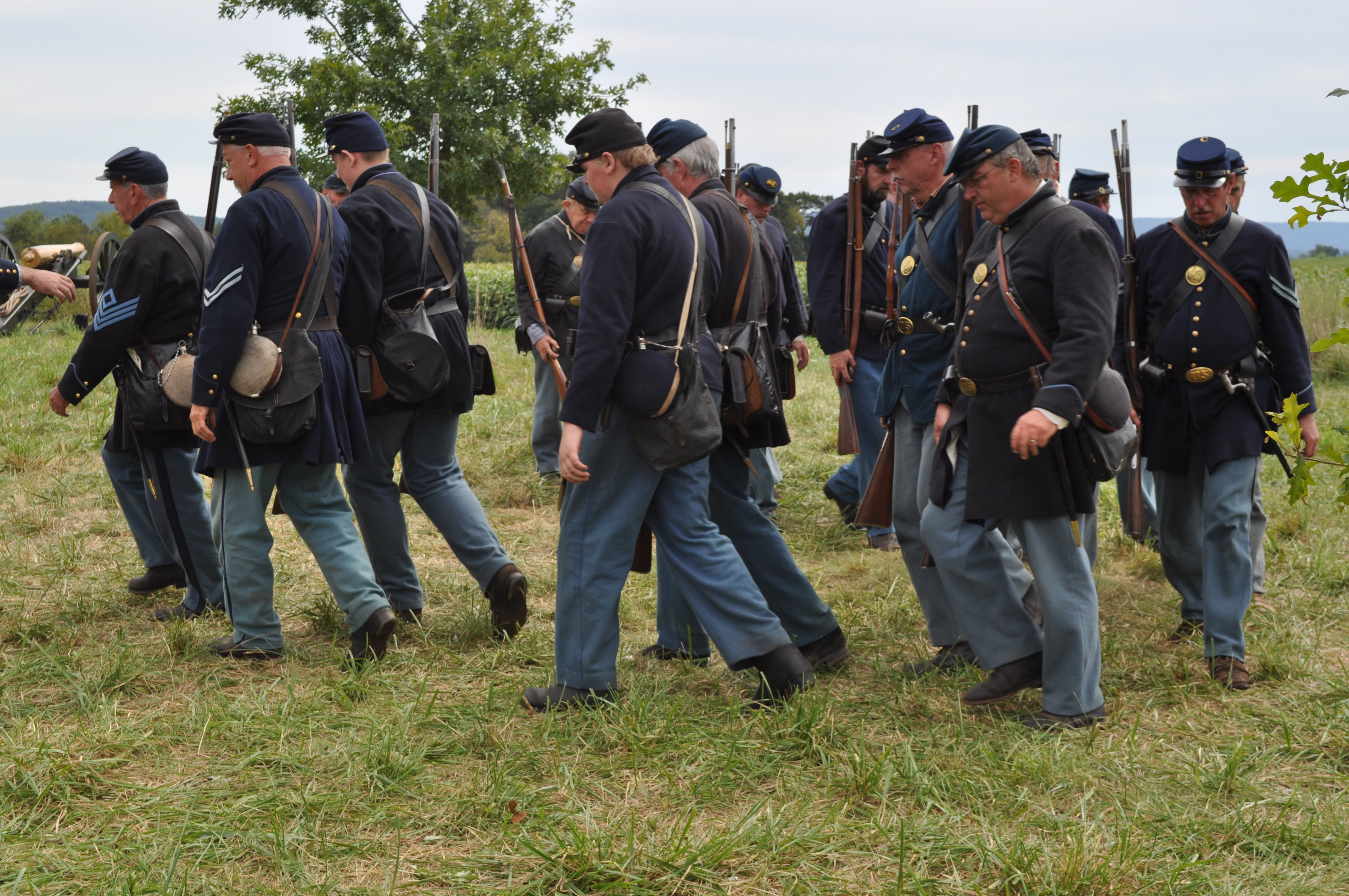
Infantry display at Antietam 150th – 9/16/12

As a part of the Antietam Battlefield Guides organization, we are committed to include within our tours and interpretive communications a list of themes. The National Park Service has established four primary themes and nine sub themes that rather inclusively present the take-away ideas of this incredible event in our country’s history. Anyone who knows and remembers these themes, knows and understands Antietam in the context of the War and all that makes us who we are as Americans.

Here are the themes and sub themes:

  • PRIMARY THEME:  The Maryland Campaign which culminated in the Battle of Antietam was a major turning point of the Civil War, and indeed in American history.
    • SUB THEME:  The Battle of Antietam led directly to the issuance of the preliminary Emancipation Proclamation.
    • SUB THEME:  Major personalities on both sides defined the progression of the campaign, the nature of the concluding battle, and the character of its outcome.
  • PRIMARY THEME:  The level of carnage, suffering, and human drama during and after the Battle of Antietam has accorded it a unique place in American history.
    • SUB THEME:  The experiences of the individual soldiers of all ranks were significant and provided meaningful insight into the battle.
    • SUBTHEME:  The Battle of Antietam reflects dramatic improvements in the field medical services of the Civil War. The efforts of Dr. Jonathan Letterman – a professional, and Clara Barton – a volunteer, reflect this.
    • SUB THEME:  The battlefield and the National Cemetery served, and continue to serve, as the setting for reunions and ceremonies that commemorate the sacrifices of those who served in America’s wars.
    • SUBTHEME:  Through photographic images of Antietam Battlefield, the horror of war was relayed to the world at large in a new way.
  • PRIMARY THEME:  The battle was affected by the state of available technology and landscape on which it was fought.
    • SUB THEME:  Topographical features played a major role in defining the nature, tactics, and flow of the battle.
    • SUB THEME:  Artillery played a major role in the outcome of the battle.
  • PRIMARY THEME:  The battle had a major impact on the town of Sharpsburg, surrounding farms, and the area’s residents.
    • SUB THEME:  The campaign was waged among a divided population that took differing moral and political views on the war and those reactions to the presence of the Confederate Army affected the outcome of the campaign.

Concluding word>>  If you’ve never been to Antietam, you’ve got to come see it. It is an amazing place.

Antietam Sesquicentennial Kicks Off

Today was the opening session for the long weekend commemoration of the 150th anniversary of America’s Bloodiest Day. Already quite a number of guests were at the Battlefield, but clearly the Park is fully prepared with a plan for every parking contingency or whatever else is needed.

I spent the morning with a great three-generation family from California and Pennsylvania. They arranged to meet together at this place at this time – having had an ancestor fight across the Cornfield with the 3rd Wisconsin regiment of the Union Army’s 12th Corps. Due to parking considerations and the visual difficulties of seeing much around the Cornfield with the crop so high, I did something I’ve not done before – taking the family to the “courtyard” of the Indiana State Monument. This gave enough elevation to see over the corn and gain a good perspective of this area of the field.

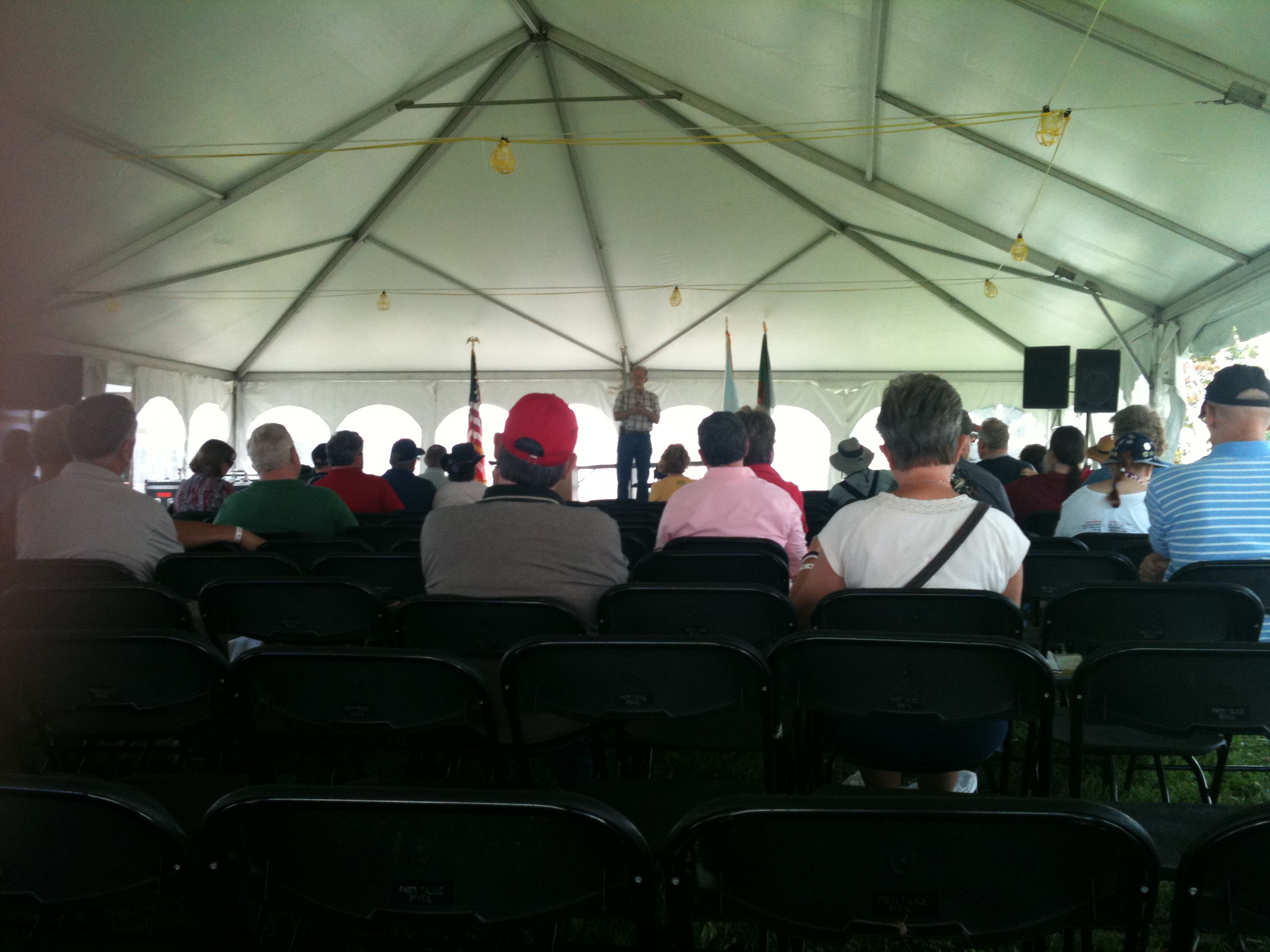
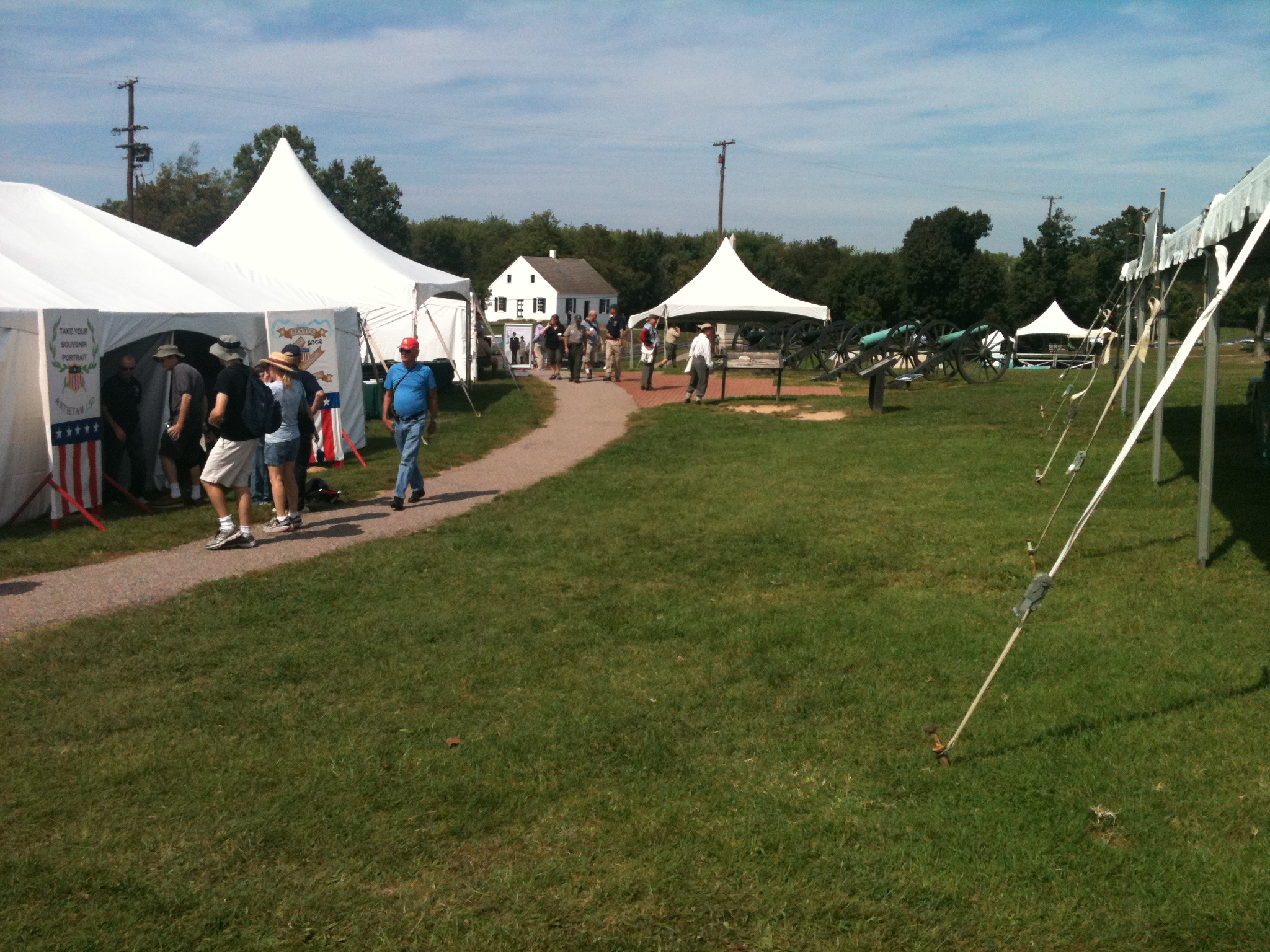
Here are a few pictures of the setup around the visitor’s center. There is plenty to see and do beyond just exploring the battlefield itself.


150 Years Ago Today – The Battle of South Mountain

September 14, 1862 … including Doubleday journal entries and anecdotes …

Again I’ve run out of time in this busiest season of my life to write as much as I’d like to, but I figure I have years of blog writing to pen all the thoughts and research details I might wish to include! I’m writing this here in the wee hours of the morning of the 14th, and I am looking forward to the late morning hours where I will be meeting with a small group to tour Antietam – though on this date I feel I will almost insist to these people that we need to drive over South Mountain.
When I take people for a quick view of South Mountain (which is probably only on about maybe 1 out of every 25 tours I’d estimate), I take them to Boonsboro and turn south at the base of the mountain and travel several miles through Pleasant Valley. I then turn left to ascend the hill and cut to the east through Fox’s Gap – where the heaviest fighting occurred and where the Reno Monument stands. Then, going east toward Frederick where one can look into the Middle Valley and see the village of Middletown, I cut across a road to go the short distance north to the National Turnpike. A left turn onto Alternate 40 takes us back over the mountain through Turner’s Gap – following the assault of the Iron Brigade, past the Mountain House (now the South Mountain Inn) and down again to Boonsboro. While headed back to the Antietam Battlefield, I’ll take my guests through the winding main street of Keedysville, and ultimately back to the Battlefield by the country roads crossing the upper bridge used by the 1st and 12th Corps.

I’ll again, for this blog entry, talk just a bit about the Battle of South Mountain through the eyes and pen of Abner Doubleday. He and his brigade fought to the right flank of the action at Turner’s Gap, assaulting the Confederates on the mountain by moving parallel to the National Turnpike.

So here is Doubleday’s account from his journal. It is a bit long but is very interesting reading.

While Meade was assailing the Rebel right, and Reno the left, our division under Hatch attacked the center. Hatch directed Patrick’s Brigade to advance and develop the enemy’s line. For this purpose, two of the regiments were deployed as skirmishers—Colonel Rogers’ 21st NY on the right, and the 35th NY under Colonel. Lord on the left—with the remaining two regiments of the 20th NY (Colonel Gates) and the 23rd NY (Colonel Hoffman) as supports respectively. As soon as the Rebel position was ascertained, Phelps’ Brigade was ordered to charge them, and my brigade to act as a supporting force in reserve. Patrick went forward until he found the enemy in strong force lying behind a fence near the summit of the mountain—fronted by woods and backed by a cornfield full of low rocky ledges. Constituting a perfect natural fortification, Phelps’ Brigade charged the woods and General Hatch in person rode through the lines urging the men forward. They went in with a cheer, drove the enemy back into the cornfield after a sharp and severe struggle, and took possession of the boundary fence—which being on top of a low swell of ground, served as a slight breastwork and gave some protection to the men. Phelps held his ground for about half an hour, but he did so with some difficulty, as he was greatly outnumbered by D.H. Hill’s command with which he was contending, having been heavily reinforced by Longstreet.

When he could hold out no longer, I relieved him with my brigade, and he fell back to the stone church from which he had started. Immediately after this, I assumed command of the division, as I learned that General Hatch had been seriously wounded while leading a charge made by Phelps’ men. As Patrick’s Brigade was still deployed over a wide extent of country, and as Phelps had retired and Gibbon was detached, the fighting part of the division at this point merely amounted to my own little brigade of about 1,000 men. The enemy had from 4,000 to 5,000 in front of me under Longstreet in person, and these forces were securely sheltered behind the low rocky ledges referred to. Our lines were only 40 yards apart.

The enemy pressed heavily upon me, and there seemed no prospect of success in charging them across the open space through the corn, as they were superior in number and strongly posted. Finding they were reserving their fire and that most of our shot was wasted against an unseen foe behind the rocks, I ordered a temporary cessation of our fire. This induced them to suppose that we had given up the contest and were about to retire. They at once made a great charge upon our position, headed by Colonel  <???> of Virginia. It was now getting quite dark. As I was on horseback in the front line, I saw the charge coming before our men (who were lying down behind the fence) perceived it. I at once gave the command, in a loud tone, to commence firing. The troops sprang to their feet and poured in such a destructive volley that the charging line gave way and retreated, leaving a large number of dead and wounded behind them—some five or six yards in our front.

Their frontal attack having failed, a strong column was organized to assail my left flank. I had anticipated something of the kind, and had thrown out small outposts to give me due warning. At the same time as my ammunition was reduced to four or five rounds per man, I sent to request that General Ricketts, who was in reserve, would reinforce me. He came up promptly with Colonel Lyles’s Brigade and relieved my men. I would not consent however to leave the field, and directed my command to fall back eight or ten paces only behind Ricketts, in order that we might sustain him with the bayonet if necessary. A young officer acting as staff officer misunderstood my order, and directed the left of my line to join Phelps’ Brigade in rear at the stone church—at the foot of the mountain. The left referred to consisted of the 76th NY regiment under Colonel Wm. P. Wainwright and the 7th Indiana under Major Grover. They both filed off by the left flank in obedience to the last order. This movement brought their line perpendicular to that of the main body, and covered our left flank. Colonel Wainwright had gone but a short distance when he became satisfied that there was a movement in progress against my left flank. He took command of both regiments, halted them, and quietly awaited the enemy’s advance. The sound of the Rebels stumbling over the rocks in the dark now became plainly audible to him. He ordered perfect silence until they were very close upon him. He then poured in such a destructive volley at short range that they gave up the contest and fled from the field leaving their dead and wounded behind, and even abandoning their position opposite to us on the crest. It was no longer possible for them to hold it, for while the battle had been going on in our front, two regiments of Colonel Patrick’s command under Colonel Rogers of the 21st NY and Colonel Gates of the 20th NYS volunteers arrived and seized a fence which bounded the cornfield on the northeast. As this position flanked the enemy and endangered one of their batteries, they made a furious attempt to dislodge Rogers and Gates, but without success.

General Gibbon held an independent command on this occasion. He advanced up the national road towards Turner’s Gap, and pressed the enemy back on their main body. As they occupied a strong position behind a stone fence, and were in heavy force, he could not dislodge them.

We remained all night on the field of battle after sending the wounded to the rear.

At the very end of this journal entry about South Mountain, Doubleday recorded a number of miscellaneous stories from the event – which he simply entitled “South Mountain Anecdotes.”


Color Sergeant Charles E. Stamp of the 76th N.Y. moved out in advance of his regiment beyond the woods into the cornfield, and planting the staff in the ground he called out to the men, “come up to this.”  His position—being very much exposed and close on the enemy—he fell dead at once with a bullet through his forehead.

A soldier named Weaver came from Canada to enlist to defend the Union, out of sympathy for the Northern cause.  He fell in this battle mortally wounded, and gave his dying message to Captain Halstead of my staff.

A number of deserters from the enemy rushed over to join us during the firing, holding up their hands to prevent us from shooting them.  Several of them were unfortunately badly wounded.  They were Union men who had been drafted by the enemy and forced into the ranks.

The men of the 7th Indiana fought differently from the Eastern men.  Instead of loading and firing in silence, they constantly encouraged each other by calling out, “Give it to them, Issac” . . . “Stand up to them, Bill” . . . “ Don’t give way, John”, etc.

When it became evident that our shots were being wasted on the rocks while the Rebels were crouched down in safety saving their ammunition, orders were given to stop firing. One Western man who was fighting with great fury, with his hat off and long hair falling over his neck, could not be induced to stop for some time.  At last he called out angrily, “Who says stop firing?” “Gen. Doubleday says so, as says the staff officers.”  “Then let him make those big boys over there stop shooting at me . . . they began it!”

9/11 – Lincoln’s Worst Day

Dennis Frye Lecture in Hagerstown

We here in the Washington County area these days prior to the 150th Anniversary of Antietam and the Maryland Campaign are much in anticipation of this pending event. Every day the local paper contains articles about events both then and now.

Among these events was a presentation at my local Hagerstown Rotary Club by Harpers Ferry Park Historian Dennis Frye, speaking about all that is anticipated, along with his new book entitled “September Surprise: Lincoln’s Union in Peril.”

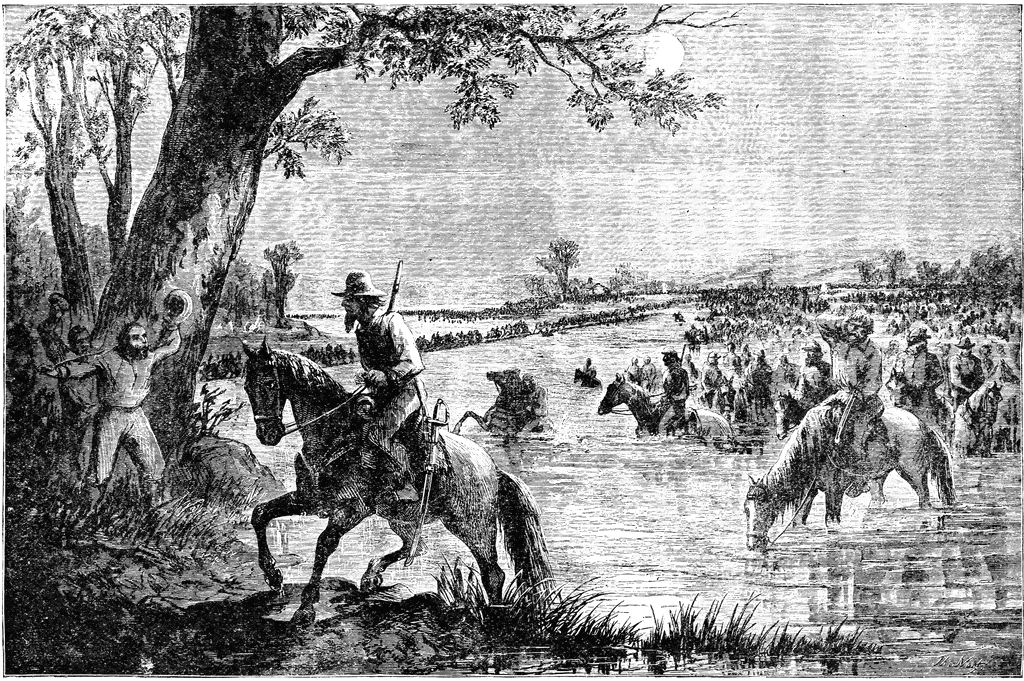
Dennis Frye spoke to our Club on Wednesday of last week – so that was on September 5th. He began by holding up a rock and asking if anyone knew what it was. It was a river stone that he had picked up that very morning from White’s Ford on the Potomac at the very spot and time when Robert E. Lee crossed into Maryland, with the bands playing the song “Maryland, My Maryland.”

Frye said, “Lee is proving that Lincoln and the Republicans don’t know how to execute this war – a conflict that was supposed to last but 90 days.  Lee knows that the mid-term elections will result in the Congress likely going to the Democrats.  The key to winning the Civil War was not going to happen on the battlefield; it was going to be decided in an election. On this week in 1862 in Maine, voting has already started.  November was the LAST day one could vote.  The Democrats would control appropriations in the House, cut off war spending, etc.”

“So this was Lincoln’s most difficult time. Lincoln would probably say his worst day – apart from letting his wife drag him to the theatre on 4/14/1865 – was 9/11/1862.  Lee’s arrival in Hagerstown made our city became prominent in the halls of the White House and in the mind of Abraham Lincoln. The worst was about to happen. Lee had arrived with an invading army … they are not stopping here, but going to PA… using Hagerstown as a launch pad to end the Union.  Lee is undefeated; he is poised to pounce over the Mason-Dixon line. Lincoln has no troops to stop Lee. There are none in PA.”

“The Governor of Pennsylvania would send this message to Lincoln on 9/11 … ‘I have information this evening of a private character, which I deem entirely reliable, that the whole of the rebel army has been moved from Frederick, and their destination is Harrisburg and Philadelphia. You should order a strong guard placed upon the railway lines from Washington to Harrisburg to-night, and send here not less than 80,000 disciplined forces … It is our only hope to save the North and crush the rebel army. Do not suppose for one instant that I am unnecessarily alarmed … The enemy will bring against us not less than 120,000, with large amount of artillery. The time for decided action by the National Government has arrived. What may we expect?’”

“So this was another 9/11 full of emotion. We FEEL this date, and they then FELT the same sorts of emotions.”

“Hagerstown is the focus not only of the nation, but of the world (England and France) … We were unwilling hosts … We did not ask 135,000 to come … They did not bring economic benefit … They brought us death and graves.”

Frye spoke of his book, saying that having lived here he wanted to write something very different … and that he did so using the last great untapped source for Civil War research – newspapers.

If you ever have a chance to hear Frye speak – do it, as he is very engaging and presents material in a passionate style.

Marching West from Washington – September 1862

September 10, 1862 – Lee leaves Frederick

When speaking with guests at Antietam, I attempt to bring a balanced view toward the interpretation of events from 150 years ago. It is difficult to put ourselves accurately and fairly into the boots of the men who fought at this most incredible of days in American history. The factor that makes it so terribly difficult for us is that WE KNOW how it all turns out! We cannot escape that knowledge; and we need to restrain the consequent tendency to read into events a sense of inevitability that was not at all so very obvious and clear to them as it is to us.

Perhaps the individual most affected by this “push and pull” is General McClellan, and there is much effort in our day to cast him into a more fair light of understanding. I get that; I serve in leadership in everything I do in life, and I know that leaders are regularly discredited unfairly by people who do not and cannot understand all the factors that you know and must balance. Yet I also often feel the pendulum has now swung excessively toward a too gracious evaluation of a man who was both exceedingly gifted, yet exceedingly flawed. I often use the word picture of a football coach to describe McClellan: like my imaginary illustrative fellow who is good at organizing pre-season clinics, training programs, and weekly practices, but who – on the day of the game – has a lost look, is often at the concession stand instead of on the sideline, and who fails to show up in the locker room for half-time adjustments. This leaves subordinates to have to act independently in an oft uncoordinated effort.

It was on this day 150 years ago that General Lee’s Army of Northern Virginia departed Frederick to march in five different directions – particularly to deal with the problem of the large Union presence remaining in Harpers Ferry. And on this date, tens of thousands of the Army of the Potomac where marching west from Washington to deal with the threat of Lee’s invasion of Maryland.

The following story would have happened about this time. It is from the Frederick Hitchcock book “War from the Inside.”  Hitchcock himself has a statuary presence that stands guard over Bloody Lane to this day … as he is the fellow with the flag on the 132nd Pennsylvania Monument (pictured). At Antietam, this was the first of their engagements, and Hitchcock writes very colorfully about his experiences before, during, and after the battle. They were totally new and raw at this point 150 years ago – so the westward march out of Washington and through Western Maryland was a first such experience for them as well.

Here is his account, and I’ll add – this is simply but another story of so, so many that, combined together, keep me from seeing McClellan in a totally new light relative to his historic evaluation.

On our third day’s march we were halted for rest, when an orderly rode through the lines saying to the different colonels, “General McClellan will pass this way in ten minutes.”  This meant that we were to be ready to cheer “Little Mac” when he came along, which, of course, we all did. He came, preceded by a squadron of cavalry and accompanied by a very large and brilliantly caparisoned staff, followed by more cavalry. He was dressed the full uniform of a major-general and rode a superb horse, upon which he sat faultlessly. He was certainly a fine-looking officer and a very striking figure. But whether all this “fuss and feathers” was designed to impress the men, or was a freak of personal vanity, it did not favorably impress our men. Many of the old vets, who had been with him on the Peninsula, and now greeted him again after his reinstatement, were very enthusiastic. But notwithstanding their demonstrations, they rather negatived their praises by the remark, “no fight today; Little Mac has gone to the front.”  “Look out for a fight when he goes to the rear.”  On the other hand, they said when “Old Man Sumner”—our corps commander—“goes to the front, look out for a fight.”

<from “War from the Inside: The Story of the 132nd Regiment Pennsylvania Volunteer Infantry in the War for the Suppression of the Rebellion, 1862-1863” by Frederick Hitchcock, 1903, pp.39-40.>

Marching West through Maryland – September 1862

Everything that I feared about this busy season of my life has come true! As an Orioles sportswriter, the team is looking to be playoff bound for the first time in many years. I’m now in my coaching season at Williamsport High School where I hope to see my boys team win a state championship.  As a political activist, it is a critical election season. And in my primary occupation as a pastor, September is the beginning of all sorts of new programs and initiatives.

Abner Doubleday

Beyond this, there is unprecedented interest in Antietam tours (of which I’ve only done a couple recently) and the Maryland Campaign as we approach the sesquicentennial is the coming 10 days. All of this has left little time for blogging and writing – probably my favorite activity of all.

This post will add to some previous posts that contain Abner Doubleday materials. Most of what I’ve written before is from my draft of what I trust might someday be a final work on the good general. This today is mostly a collection of his journal remarks over this current week 150 years ago.

After the retreat from 2nd Manassas, Doubleday wrote that his troops were assigned to take a post at Upton Hill (this is about 2-3 miles west of Arlington, VA).

Of this time, and listed in his journal on September 3rd Doubleday wrote: Pope’s army was completely worn out with fatigue, fighting, and constant marching; and the capture of the depot at Manassas had left us in need of everything. We all required clothing and shoes for our men, but owing to the great number to be supplied, but few of us were able to obtain anything. We were thus obliged to take the field again in a very destitute condition. The short time in which we remained in Washington was taken up in making out requisitions for supplies, reports of recent battle, muster rolls, etc.

Dated on the 4th, Doubleday wrote: On this day General McClellan, in obedience to Mr. Lincoln’s order, formally assumed command of the Army in place of Pope—who was given a department in the west. Some important changes were immediately made. Hooker relieved McDowell in command of the First Corps, the latter being withdrawn from active field duty.

Doubleday, dated the 5th, described the crossing of Lee into Maryland and the pursuit of McClellan: Lee leaves Leesburg on this day and crosses the Potomac at Noland’s Ferry five miles from the Point of Rocks. A portion of this army crossed three miles above. His whole force then marched into the interior and bivouacked for the night at White Oak Springs, three miles from Frederick, MD. The greatest consternation immediately ensued in that section of country, and people fled in every direction, carrying their money and valuables with them. On the same day, McClellan started in pursuit, but spread his army well to the north to guard against any attempt of Lee to sweep around and capture Baltimore.

Doubleday’s command was finally on the move on September 6th: On this day, Couch’s Division was at Rockville and Great Falls. This was to watch over the lower fords of the Potomac, for it was the constant fear at Washington that the enemy, after drawing McClellan away from the Capital, might suddenly retrace their steps and seize the prize. On the same day, Hookers Corps, including our division which was again under Hatch’s command, left its encampment and commenced crossing the Long Bridge into Washington about midnight.

They continued marching the next day … if you can call it that: [dated the 7th]  On this day we continued our march through Washington and encamped at night in the vicinity of Leesboro.  (This march was badly managed, e.g. the turnpike gatehouse was not taken off as it should have been and caused great delay in filing through it.)  [And then on the 8th …] We still remained at Leesboro, our advance being slow and undecided in consequence of the uncertainty of the enemy’s movements.

In the following days of the journal, Doubleday goes off on discussions of mostly the Confederate movements to deal with Harpers Ferry, and he only again mentions his own troop movements on the 11thOur army is advancing leisurely. Hatch’s Division reaches Damascus [this is east of Frederick]. The advance of Longstreet’s force is now at Hagerstown, and his rear under D.H. Hill at Boonsboro. South Mountain is left wholly unguarded—there being nothing but the enemy’s cavalry and a few light batteries between us and Boonsboro.

And after one or two other blog posts, I’ll pick up again a week from now with Doubleday’s writings about South Mountain.