Battle of Kelly’s Ford – 150 Years Ago Today

On this date of March 17, 1863 was fought the cavalry conflict of the Battle of Kelly’s Ford. This pitted two former West Point cadet friends and Indian fighters against each other for the second time in two months. William Averell would command about 2100 Federal troops against about 800 Confederates under Fitzhugh Lee. The prior engagement at Hartwood Church (written about in this blog by going HERE), was a smaller more accidental event. This engagement marked the beginning of a sea change for cavalry operations, particularly for the Union.kellysford3

At Hartwood Church (fought behind Federal lines in Virginia), Lee had left behind a note for his old friend which read, “I wish you would put up your sword, leave my state, and go home. You ride a good horse, I ride a better. If you won’t go home, return my visit, and bring me a sack of coffee.” This irritated Averell, who on the 16th approached the Rappahannock River at Kelly’s Ford, set to attack the rebel cavalry at daybreak. Initial successes were set back, only to be reinforced more strongly as greater numbers engaged on both sides. By the afternoon, Averell missed the opportunity for a decisive win, and fearful of the (errant) sound of Confederate reinforcements arriving, withdrew his forces to the north bank of the river.

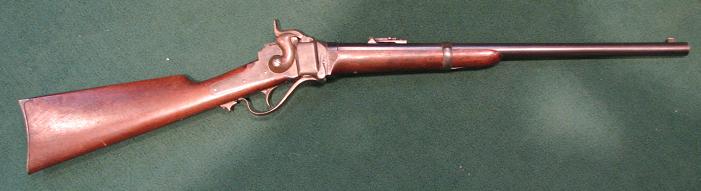
Up to this point of the War, it was an assumed understanding that Confederate cavalry was far superior to that of the Union. But with command structure changes by Joe Hooker, along with the new equipage of the Federal cavalry with the 1863 Sharps Carbine repeating rifles, obviously a new day had arrived for the northern mounted troops.Sharps_1863_Carbine_.50-70_Calibre_antique_original

Though technically a victory for the South, the Battle of Kelly’s Ford was a moral victory for the Union. The Federal loss amounted to 85, whereas the rebels number a total of 146. Among the Confederate casualties was the mortal wounding of John Pelham – a young artillerist who had distinguished himself at Fredericksburg in particular. It was certain that he was a major rising star for the Southern war effort. JEB Stuart mourned his loss in tears, writing to Pelham’s mother, “I loved him as a brother; he was so noble, so chivalrous, so pure in heart, so beloved.”  In fact, Pelham was on the scene due to simply paying a visit to a young lady not far from the action. (There is probably a lesson in there somewhere! … more on Pelham in this blog tomorrow.)

Kelly’s Ford – an oft-used crossing for both sides – would be the host location for a larger Cavalry engagement on June 9th – the Battle of Brandy Station.

Averell did leave behind a return message for Lee, “Dear Fitz, Here’s your coffee, Here’s your visit.  How do you like it?”

(The Civil War Trust has a particularly good set of write-ups on this battle.)

Spring of 1863: Hooker’s Improvements to the Army of the Potomac

In the series of posts that I have been doing on the 150th anniversary dates of major events in the Civil War, it has been difficult of late to find as many significant occurrences to look back upon. Every date (150 years ago) there are skirmishes and demonstrations throughout the varied theatres of the war, but in late winter/early spring – not so much of major consequence. Of course, that is going to change.

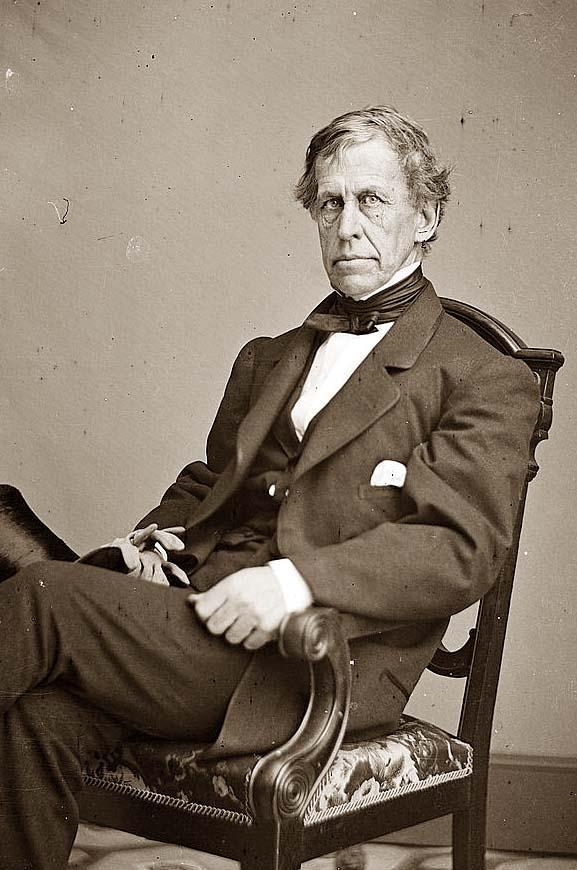
For the Army of the Potomac, it has been a season of regrouping under the command of Fighting Joe Hooker – now in his 7th week at the helm. This was much needed in every way, and Hooker is at his finest in the changes instituted. He improves the diet of the troops, sanitary conditions, the function of the quartermaster department, medical organization, the system of drilling and officer training … to name a few. Hooker also improved morale and cut desertions with an instituted furlough system; and he combined the Union cavalry operation into a single corps. Various command and structure changes also eliminated and transferred generals with loyalties to Burnside or problems with Hooker.

Joe Hooker

Joe Hooker

Though there is no substance to the oft-told story that prostitutes got their nickname as “hookers” because of the camp followers of our person of interest today, it is made believable by reports such as one by cavalry officer Charles Adams who described Hooker’s Falmouth, VA headquarters as “a combination of a bar-room and a brothel.”

Fighting Joe was proud of his troops. He said, “I have the finest army on the planet. I have the finest army the sun ever shone on. … If the enemy does not run, God help them. May God have mercy on General Lee, for I will have none.”

Hooker also instituted a rather ingenious system of corps badges. I find this particularly interesting and will write a separate post on this topic before long.

But on today’s subject of Hooker’s improvements, I’ll finish with this excerpt from the writings of news correspondent William Swinton …

These things <the changes such as written above> proved General Hooker to be an able administrative officer, but they did not prove him to be a competent commander for a great army; and whatever anticipation might be formed touching this had to be drawn from his previous career as a corps-commander, in which he had won the reputation of being what is called a ‘dashing’ officer, and earned the sobriquet of ‘Fighting Joe.’ He had gained a great popularity both in the army and throughout the country—a result to which his fine soldierly appearance and frank manners had much contributed; nor was this diminished by a habit he had of self-assertion, which, however, proved little, since it may be either the manifestation of impotent conceit, or the proud utterance of conscious power. Hooker had shown himself a pitiless critic of his predecessors in command: he was now to be tried in an ordeal whence no man had yet escaped unscathed.

The new commander judiciously resolved to defer all grand military operations during the wet season, and the first three months after he assumed command were well spent in rehabilitating the army.

Union General Caught in Bed (not what you think!)

150 Years Ago – Capture of Union General E.H. Stoughton

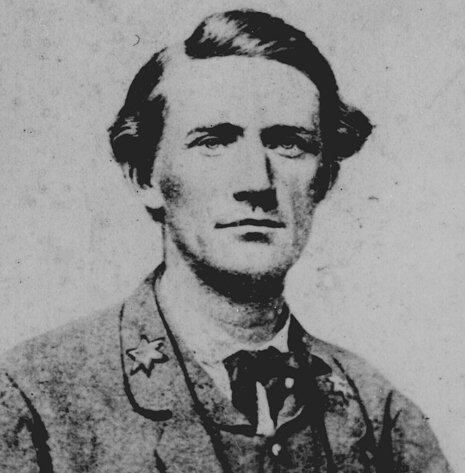
It was 150 years ago on the overnight of March 8-9 that Union General E.H. Stoughton was captured by John Singleton Mosby – as the general was asleep!

john-mosby

John Mosby

Confederate cavalryman John Mosby was known as the “Gray Ghost” for his successes with daring and flamboyant guerilla raids. He was a wanted man.

On this date, Mosby and his gang made a clandestine move behind Union lines at Fairfax County Courthouse, Virginia. Though surrounded by thousands of soldiers, they successfully made it even into the very bedroom of General Stoughton.

Two versions of the story (perhaps both true) say, first – that the general was awakened when Mosby pulled down the blankets and slapped his new captive on his bare butt, and secondly – that Mosby awakened Stoughton by asking, “General, did you ever hear of Mosby?” … to which the response was, “Yes, have you caught him?” The answer, “No, he has caught you!”

The Gray Ghost and his men (total of 30) were able to accomplish this raid without a shot being fired, taking with them 33 men and 58 horses. They alluded capture by moving stealthily through enemy lines. Quite an accomplishment!

Mosby was a colorful character. At age 28 when the War broke out, he had previously shot a fellow student at the University of Virginia. He read law while awaiting trial, for which he was exonerated and released. After the War he would make enemies in the South by supporting the Union efforts at Reconstruction.

Enrollment Act – 150 Years Ago Today

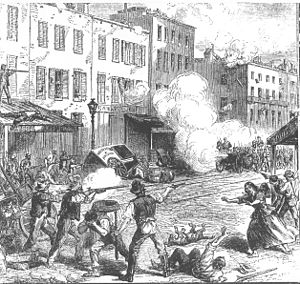
On this date of March 3, 1863, the Enrollment Act (a.k.a. the Civil War Military Draft Act) was passed and signed by President Lincoln. The purpose was of course to provide a new source of personnel for the Union Army. This was a very controversial program, requiring the enrollment of men from ages 20-45. Numerous exceptions were made for physical, mental, criminal, and dependency issues. Quotas were set for each legislative district.300px-New_York_Draft_Riots_-_fighting

To address the unpopularity of this act, particularly for pacifists and people of substance, two provisions were made: substitution and commutation. A person would be exempt if he supplied a sufficient substitute, and the requirement could be commuted upon the payment of $300 … leading to the popular adage, “rich man’s war, poor man’s fight.”

Attempts to enforce this act resulted in civil unrest and even rioting, particularly in July in New York City. (see picture)

The measure did increase the level of volunteerism. Actually, only about 162,000 men were brought to the War through the draft – about 6% in total of those who served. And only about 30% of those drafted served personally, with the remainder furnishing substitutes. Paying the commutation fee would be an addition 87,000.

150 Years Ago Today: Surf and Turf

Battle of Hartwood Church and the Peterhoff Incident

A cavalry clash occurred on this date of February 25, 1863 known as the Battle of Hartwood Church. On a high ground and wooded crossroads in Stafford County, Virginia stood a Presbyterian church that was constructed in 1858. The roads connected to fords on the Rappahannock River.

On the south side, Lee had many reports of Union movements, particularly of the sizeable 9th Corp’s departure from the Army of the Potomac. Burnside’s old corps – with understandable sympathies for their now banished commander, was being removed to the Virginia Peninsula. Lee needed to understand the nature of what was happening, and he sent his nephew Fitzhugh Lee to scout it out.

On the 25th, Lee’s cavalry collided with Union cavalry of the 16th Pennsylvania at the location of the brick Hartwood Church. These green Yankee horsemen were quickly dealt with, but, being merely the outer ring of forces, Lee before long ran into more cavalry and eventually Union infantry. He pulled back from this largely successful engagement, learning that the Army of the Potomac was not making moves for a large-scale action.

Fitzhugh Lee would leave behind a taunting note for his former West Point classmate and friend, Brigadier General William W. Averell, saying, “I wish you would quit your shooting and get out of my state and go home. If you won’t go home, why don’t you come pay me visit? Send me over a bag of coffee.” Nearly one month later, Averell would accept the invitation by retaliating at the Battle of Kelly’s Ford.

Though the Confederate cavalry enjoyed a definitive advantage for much of the first half of the War, the times were changing. Union horsemen would soon emerge as a force to be reckoned with. The best resource on this battle and this evolving season of the war is the lively and very colorfully readable account of Eric Wittenberg entitled The Union Cavalry Comes of Age: Hartwood Church to Brandy Station, 1863.

Charles Wilkes

Charles Wilkes

Also occurring on this date in 1863 was an event many hundreds of miles to the south in the West Indies. The U.S.S. Vanderbilt seized a British blockage-runner named the Peterhoff … in the neutral port of Saint Thomas. This was done under the command of a seriously arrogant “loose cannon” – Acting Rear Admiral Charles Wilkes (written about in one of the best books I’ve ever read – by Nathaniel Philbrick (2003), Sea of Glory: America’s Voyage of Discovery, The U.S. Exploring Expedition, 1838-1842). Though the papers were in order and stated the vessel was bound for Matamoras, Mexico, apparently a crew member indiscreetly said the actual destination was Brownsville, TX. This leak was seized upon as sufficient evidence to seize the boat! After the war the U.S. Supreme Court ruled this seizure as wrongful, and the owners of the ship were compensated.

House Divided Project of Dickinson College

Perspectives on the “Lincoln” Movie

Two of my children, my daughter-in-law, and numerous friends have attended or graduated from Dickinson College in Carlisle, PA. I have become acquainted also with the work of Professor Matthew Pinsker, having mentioned him in this blog in connection with his book on the Lincoln Cottage (Lincoln’s Sanctuary: Abraham Lincoln and the Soldiers’ Home) and his contribution to the anthology upon the occasion of Emancipation at 150 (see HERE for blog on that, along with other links).

Also, having recently commented upon seeing the Lincoln film, I would recommend a fantastic resource regarding the historical evaluation of the varied scenes. These links are a part of the “House Divided Project” of Dickinson College, which is an effort by professors, staff and students to create a wide variety of digital resources in honor of the 150th anniversary of the American Civil War. These are presented amid an array of teaching resources, but provide good reading for anyone.

This first link is a one-stop shopping resource of links to the comments of a wide range of historians’ reactions to the movie. These evaluations cover the spectrum, and Professor Pinsker guides the reader though the list with brief annotations. See it HERE.

Courtesy of the Dickinson College Archives and Special Collections

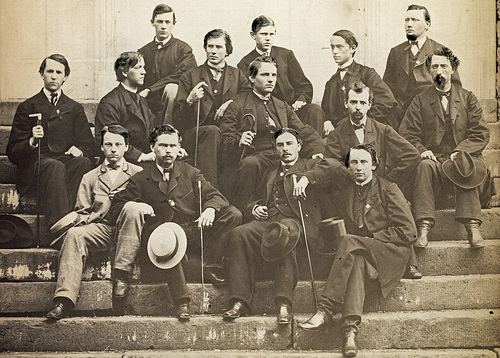
Dickinson College Class of 1865 – Courtesy of the Dickinson College Archives and Special Collections

Pinsker also talks through the film by chronologically walking through the scenes from beginning to end, giving a commentary on the historical basis (or lack thereof) for each. This is a great resource, and having seen the film once, I will have to study this and watch it again. Actually, it will be helpful when I can see it at home and pause while reading each section between the scenes. The list of inaccuracies and employments of artistic license is really quite extensive, yet Pinsker maintains a positive tone throughout – finishing his commentary by saying: Yet as this guide demonstrates, Kushner altered many “key moments” in this profoundly important historical story.  This guide points them out not to condemn the movie, but rather to remind students (and perhaps future filmmakers) that when you read or invoke the phrase, “Based on a true story,” that means it’s not a true story and should neither be judged –nor defended– as one.

This guide, entitled “Warning: Artists at Work” may be found HERE.  And while you are there, look around at all the other resources, as there is a lot of cool stuff. Dickinson College is the school attended by such Civil War era personalities as James Buchanan, Roger Taney, and Andrew Curtin. The student body was relatively evenly divided between North and South.

The Fascination with the Death of Willie Lincoln

Well, being the Civil War geek that I am, I finally found time to go see the movie “Lincoln.” I’m a guy who is almost always disappointed that something is not as big, grand, or awesome as my expectations – like, I thought Mount Rushmore was a terrible disappointment as so very small compared to my imagination.

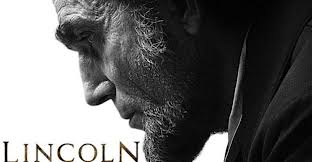
But the Lincoln move did not disappoint. It was every bit as great as I hoped it would be – the portrayal of Lincoln being especially excellent.movie Lincoln

I have just read a couple of critical pieces on the movie. They actually each admitted that their criticisms were truthfully rather nit-picking in light of the bigger picture of all that was done well and portrayed accurately.

A point that I might agree with the critics however is the amount of space given to the character of Mary Todd Lincoln. I believe it gave her more credit as a thoughtful person than she deserved, though it did indeed present her as a very troubled individual.

This is especially true surrounding the emotionally compelling story of her grief upon the loss of their son Willie in February of 1862 (though the movie begins in 1863). There is this incredible scene between Abraham and Mary, containing these excerpts relative to the pressures being applied to each to allow son Robert to join the war:

MARY: The war will take our son! A sniper, or a shrapnel shell! Or typhus, same as took Willie, it takes hundreds of boys a day! He’ll die, uselessly, and how will I ever forgive you?  Most men, their firstborn is their favorite, but you, you’ve always blamed Robert for being born, for trapping you in a marriage that’s only ever given you grief and caused you regret! …

AB: Just, just this once, Mrs. Lincoln, I demand of you to try and take the liberal and not the selfish point of view! You imagine Robert will forgive us if we continue to stifle his very natural ambition?!

MARY: And if I refuse to take the high road, if I won’t take up the rough old cross, will you threaten me again with the madhouse, as you did when I couldn’t stop crying over Willie … I was in the room with Willie, I was holding him in my arms as he died! …

AB: Oh but your grief, your grief, your inexhaustible grief! … screaming from morning to night pacing the corridors, howling at shadows and furniture and ghosts! I ought to have done it, I ought have done for Tad’s sake, for everybody’s goddamned sake, I should have clapped you in the madhouse!

I have written previously in this Enfilading Lines web page about what has so surprised me is the #1 post all-time that I have written relative to the number of page views it receives. This one post is in fact the top-viewed page every week of every month since I wrote it a year ago. In total, it has three times more views than any other article of the 185 in this blog. That post is from 2/28/2012 entitled “The Burial of Willie Lincoln.”  Here is a link to it:  CLICK HERE

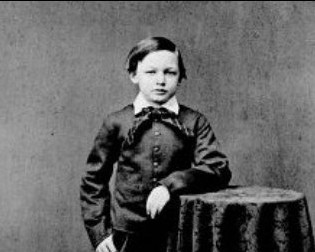
willie LincolnI had previously concluded that the fascination was because of the movie “Abraham Lincoln: Vampire Slayer” and that this post on Willie’s burial 151 years ago this month gets hit upon by people fascinated with that pop culture item of interest. I continue to believe that is true, though having now seen the “Lincoln” film, the emphasis there upon Willie Lincoln may also contribute to the continued stumbling across my blog due to searchable “tags.”

Whatever it is, I remain amazed at the fascination there is with this story from American history. It is indeed a heart-wrenching story of tragedy, which of course was but the beginning of the losses that Mary Todd Lincoln would endure – to include eventually the President, as well as Tad dying at age 18.

Naval War: McPhearson’s “The War on the Waters”

Like the vast majority of people interested in the American Civil War, my interests and focus are upon the great land battles. Living near Antietam guarantees such, along with the abundance of hundreds of little stories and incidents throughout this Washington County of Western Maryland. Even as I type this, I am able to glance out my window at a historic home that surely housed wounded soldiers from Sharpsburg, and my address in on a road oft traveled by Civil War soldiers watching the C&O Canal at Dam Number Four. I live less than a mile from the end of Lee’s defensive line upon the retreat from Gettysburg. My home – situated on the high ground near a crossroad – would be the place where soldiers may well have bivouacked. So, it is easy to focus upon land battles only.War on the Waters cover

Adding to that proclivity is the fact that 95% of those who served in the Union war effort were in the army, and well less than 5% of Confederate forces served upon the waters. Yet the point may be accurately made that the contribution of the Northern fleets was well in excess of 5%. And while Southern efforts were unable to begin to match the Federals in terms of resources and tonnage, they more than held their own in conflicts while also contributing in technological innovations.

A key to understanding the ultimate victory of the North is to not only see the cumulative effects of Union blockades of Southern ports, but to also grasp the significance of Union control of much of the Mississippi for the bulk of the War. New Orleans and Memphis were captured by Union fleets. Vicksburg was the lone holdout, and the victory there by Grant on July 4, 1863 would have been impossible without the contributions of the navy. This was, of course, a major turning point of the war, along with the concurrent Battle of Gettysburg. Lincoln wrote in the late summer of 1863, “Nor must Uncle Sam’s Web-feet be forgotten. At all the watery margins they have been present. Not only on the deep sea, the broad bay, and the rapid river, but also up the narrow muddy bayou, and wherever the ground was a little damp, they have been, and made their tracks.”  And of the capture of Vicksburg he wrote, “The Father of Waters again goes unvexed to the sea.”

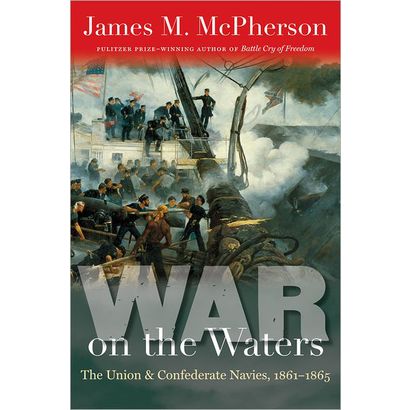
Chronologically detailing the primary contributions of the Union Navy in particular, James McPherson writes in his easy style to take the reader from one end of the war to the other. The marshalling of resources from next to nothing at the beginning, to a significant factor in but four years, is a story not dissimilar to the national resolve and advance during a similar time frame in the 1940s. McPherson develops the naval chronology with a parallel overview to the land efforts defining the four-year struggle: initial Union victories in 61-62, successful Confederate resistance in 62-63, revival of Union momentum in the second half of 63, Southern resuscitation in early 64, followed by final Union triumphs through the end of the war.

McPherson’s The War on the Waters (publication date being on the 150th anniversary of Antietam) got me through four recent plane flights, though I confess that the introduction of so many heretofore unknown personages and places will mean I’ll have to refer to this over and over in coming years… not a bad problem however.

Summary and Final Words of George Freeman Noyes

Over the extent of writing this Enfilading Lines blog, I have often quoted a favorite writer from the Civil War era – George Freeman Noyes and his 1863 book The Bivouac and the Battlefield: Campaign Sketches in Virginia and Maryland. It was somewhere about this time 150 years ago in 1863 that his service obligation expired. He was on the staff of Abner Doubleday during the time that Doubleday was in the 1st Corps – hence my interest in him. As a lawyer and highly educated man, his writing is always colorful – filled as well with abolitionist fervor and emotional Unionist sentiments … very visible today in this final series of excepts.

He here begins his finale by expressions of his respect and affections for the Army of the Potomac, writing of their time in winter quarters after the Mud March:

Thwarted by the elements in its late movement, there was nothing for the Army of the Potomac to do but to go into winter quarters and await a more propitious season. Baffled but not discouraged, this was only one more of those disappointments through which that army has passed, with a courage and determination more ennobling than any success, on its way to future victories. Its day of glory is sure to come. On many a battlefield it has illustrated a heroic valor which has won for it on the Peninsula, in Maryland, and in Eastern Virginia magnificent partial successes—the promise and prophecy of that substantial and decisive victory yet to come. Let me pay to it the homage of my admiration and gratitude for its past sacrifices, and attest my belief, founded upon the evidence of my own experiences, that it is yet to cover itself with patriotic glory. How splendidly this army can fight; how, when a forlorn hope was needed, the men have been always ready; how, after weeks of hard marching and fighting, they have moved with alacrity against the enemy, has been partially delineated in these pages. If the fault has been with its leaders, this is not the place to criticize them, nor do I feel in the mood. Let the dead Past bury its dead.

Noyes turns his attention to some extended evaluation of the character of leadership to be found in the AOP. Certainly these opinions would be inappropriate during his time of service, and they are a bit unusual it would seem during the time of war, yet he does not mention names and is indeed effusive with praise at various junctures – being quite generous in his overall evaluation of the army.

He begins this section by speaking of what was an awkward situation at the war’s start – that regular army officers had to work with volunteers. Of course, at the very beginning, it was presumed by most that this conflict would be over in a jiffy.

When this war began, there existed among officers of the regular army a strong prejudice against the volunteers; but this has, among those who have seen much fighting, almost wholly disappeared. Still, one serious defect, the want of proper discipline, greatly vitiates and impairs the fighting value of our citizen troops—a defect having its origin mainly in the method of their enlistment. Under that method a captain found in his ranks his equals, his friends, his schoolmates and neighbors. To subject these to a strict military discipline was, from the nature of the case, well-nigh impossible. Moreover, a good many poor sticks, from one reason and another, managed to get into positions for which they were totally unfitted, and it took some time to get rid of them. I have known an entire regiment, made up of excellent fighting material, rendered comparatively worthless by having at its head a skulker or two with shoulder-straps. And if there be one lesson which I think I have well learned during my limited experiences, it is the absolute necessity of having for field officers men who respect themselves, men who stand firmly on their own feet-self-possessed, self-contained, elevated and strengthened by a sense of patriotic duty. Imagine a whining incapable leading a regiment upon a desperate bayonet charge! The very first element of discipline is of course respect, and only a whole man can command the respect of his inferiors. No regimental field officer should hold in his hand the great responsibility of the leadership of a thousand men unless he has passed a thorough examination, which shall test not so much his knowledge of tactics as his self-respect, manliness, reserved force, character.

Noyes certainly makes a valid point about the nature of popularly-chosen or politically-connected officers of regiments, etc.  It was a mixed bag for sure. A bit further on he continues with his opining on the state of military leadership coming even from West Point.

Even our West Point school, to whose thorough sifting processes we owe that annual platoon of accomplished officers, scholars, and gentlemen, whose military knowledge has drilled and organized our newly-formed armies, and whose valor and discipline has set so good an example to our volunteers-even West Point, with all its training, cannot manufacture a first-rate officer unless that indispensable ingredient be furnished: a man. Good regimental leaders being thus selected by a commission more anxious for manhood than for those matters of drill which come so easily to ordinary comprehension, we shall soon have that discipline we so much need—a discipline which to the inexperienced might appear almost cruel, but which is really merciful and humane. Absolute obedience at the risk of being cut down on the instant for neglect, the punishment of a coward on the spot—this in mercy to his comrades, and as a necessity to the country, should be the iron rule of our army in battle. …

… This straggling from the line of march should be stopped, even if it require the severest punishment, while the coward in battle should be made to fear the sword of his officer more than the bullets of the enemy. The great majority of our volunteers, brave fellows as they are, are ready and willing to do their whole duty; it is in justice to them that I advocate a more careful selection of regimental officers, and a more rigid discipline. To stand up and face the dread realities of battle requires not only manly pride and the incitement of patriotic impulses, but also a severity of discipline which shall surround each command as with a ring of iron. What every soldier needs is to know that the quickest escape for him out of this bloody lane is to beat the enemy …

As a guy behind the lines dealing with supply, Noyes goes off into quite an extended section of opinion on the waste of ammunition in battle. I don’t really know how to evaluate the validity of his statements here, though they are not rendered without certainty. But Noyes wrote nothing without a solid air of authority! I’ll not include the details, but he quotes extensive numerical analyses compared to European theatres of conflict, compares it also to quotes from Confederate captives about their more limited use of ammunition, and concludes essentially that AOP guys needed to “take much better aim, and consequently waste far less.”

Closely connected with this subject of want of discipline is that of the enormous waste of ammunition in battle. Having gotten our soldier before the enemy, and compelled him by this iron rule to stay there and fight, the next point is that he fight to some purpose.  … There is altogether too much of this wild, reckless firing, the men discharging their pieces before bringing them fairly down to a level, and utterly regardless of taking aim. … I would rather have five hundred men who fired thus, once in two minutes, than a thousand who should be anxious only to discharge their muskets.  

So Noyes concludes with a characteristic note of good cheer and hope …

In conclusion, then, let me once more record my heartfelt admiration of the Army of the Potomac as a worthy coadjutor of our glorious armies of the West, and my belief that it will yet crown its many reverses and sacrifices by decisive victories. And my last words can be only those of hope and encouragement; for, as I review the events of the past two years, I have greater love for our Constitution, which has proved itself a chart sufficiently comprehensive to guide us even over the untried and stormy seas of this rebellion; for our form of government, as challenging the world for the rapidity with which it has organized its power into immense armies and navies; for my country, hardly feeling this draft upon its resources, and growing richer every day; for my countrymen, now beginning to take hold in earnest of this war as a matter of settled and permanent business; for our great underlying principle of Liberty, every day attesting its applicability to men of every color and every rank. It may be that we are to have more reverses mingled with our victories; but these delays are all right, are indeed necessary to ensure for our national disease a permanent cure. One thing is certain, that the man who lends neither his wealth, his influence, nor his right arm to aid on the war, has no right whatever to complain of any delay in its prosecution. Rights and duties are correlative, and only he who performs his duty to the government has any right to criticize its action. As yet, we have hardly begun to bring out our full resources. …  In such a contest, upon whose result Freedom herself depends, there must be no such word as fail. The omens are all propitious; patience, courage, constancy must be ours, and may God defend the right! THE END.

I’m sad to see his writing end, as it takes away a good resource I’ve been using. I realize that written war reflections are of a varied nature as to accuracy and authority. But, in my mind, lending credence to this one as valuable is that it was published as the war was in process, not something after 40 years had passed.

Opinions of Joseph Hooker by Contemporaries

Quite a variety of opinions existed of the new Commander of the Army of the Potomac as he took to this task 150 years ago this season. The army was a mess – significantly damaged by desertions and the depression of failed ventures.

Hooker had his proponents, particularly among those who had served with him. Without doubt, he was a unique character. His command post was variously described by many as part bar room, part brothel – though there is no credence to the oft-recited dictum that the slang term “hookers” originated with General Joseph and his camp followers.

ihookej001p1Hooker’s bombastic self-aggrandizement did much to make enemies and skeptics. Earlier in the War, Philip Kearny – not himself a man who feared rendering opinions – said of Hooker, “He is an ass.” The chief of artillery for Hooker during the Peninsula Campaign Charles Wainwright said that Hooker was “… a delightful man to serve with. I do not, however, like the way he has of always decrying the other generals of his own rank, whose every act he seems to find fault with.”

Particularly disliking Hooker were those officers loyal to General McClellan. Among them could be counted John Gibbon who in this following excerpt from his Recollections of the Civil War gives a sort of summary of the skeptics’ view of the new Commander.

Hooker was a strange composition. Almost my first acquaintance with him was on the field of Bull Run to which I have already referred and where his cool gallant bearing was very much marked. After he was placed in command of the 1st Corps, as McDowell’s successor, I was thrown a good deal in contact with him. His apparently frank manner and agreeable address attracted everybody who approached him and his coolness and nerve at Antietam, gained him a great deal of additional renown. In private he was in the habit of talking very freely and did not hesitate to criticize not only his brother-officers, but his commander. He, like Kearny, always thought that full credit was not given him for his fighting qualities. Neither of these two fine soldiers liked McClellan. In fact I don’t think Hooker ever liked any man under whom he was serving. Yet Hooker’s conduct at Antietam was so satisfactory that McClelland asked to have him made Brig. General in the Regular Army and his request was complied with, but it is doubtful if this effort to reward him would have been accomplished without the aid of Hooker, himself, and his political friends, he having remained in or near Washington whilst suffering from his wound. A great deal of his attractive frankness was assumed and he was essentially an intriguer. In his intrigues, he sacrificed his soldierly principles whenever such sacrifice could gain him political influence to further his own ends.

Gibbon goes on to tell an extensive story of seeing his former command go to an unworthy person, and while calling this privately to the attention of Hooker, learned from him that it was all political and that he was not going to do anything about it. This caused a rift between them.

The injury that Gibbon writes about that had Hooker near Washington was the foot injury from a bullet at Antietam – that had caused a great loss of blood and required Hooker to be taken prematurely from the field at the height of the conflict.

The interpersonal fighting and positioning that went on in this Army during the Civil War is just an amazingly recurrent theme. Surely it drove the President crazy, and it is even worse than dealing with church battles and disputes! Yep.