150 Years Ago Today: Army of Virginia Withdrawal to Washington

Withdrawal to Washington, September 2, 1862

Dispatches from Pope to Halleck revealed a commander in total loss and near breakdown. There was nothing to do but have the army fall back within Washington and reform.Doubleday wrote: General McDowell, with much feeling, directed me to lead off in this movement with my division.  We were not molested, as Lee did not pursue, but rather started… for the invasion of Maryland via Leesburg. The news of the defeat of the army produced in Washington and throughout the country the lowest of all moments; for many, perhaps, the lowest of the War.

Artillery massed in Washington

Lincoln and the members of his Cabinet had watched the affairs of recent days, had seen the rivalries and jealousies of their generals play out, and were especially distrustful of McClellan. But Lincoln had no other military person to turn to for the task at hand; so on the morning of September 2nd, he and Stanton visited McClellan with the request that the general again take command of the Army of the Potomac. Organization was the primary need of the hour, and such was the greatest strength of McClellan. Of course, the Young Napoleon was more than pleased to accept, feeling both affirmed in this convictions and called upon to do no less than save the country.

By the afternoon of September 2nd, McClellan was dressed in his most splendid attire and riding out to meet the Army of Virginia units in retreat, and to take charge of the operation. When news that Little Mac was back became known to the troops, the word spread through the columns like a wave, with cheers and spontaneous celebration. Doubleday recorded his own meeting with McClellan: As I approached Falls Church with my division, I met General McClellan with a large retinue of staff officers—whose brilliant uniforms presented quite a contrast to our weather-stained equipments. He received us cordially and assured us we should be protected. The word jarred on my feelings as a soldier, for I felt that our force was even now superior to that of the enemy, and if he had done all that lay in his power to assist us, instead of doing his best to obstruct our operations, we would have entered as a conquering and not a defeated army. Immediately after this interview, my division was directed to take post at Upton’s Hill.

Pope was essentially finished as a Civil War commander. He was sent west to fight Indians. McDowell, the one Corps commander trusted by Pope, and who was by his side through the entire affair, was rumored to be treasonous at worst and incompetent at best, and sent to an insignificant post in California. The Union general faring the worst was Fitz John Porter. He would subsequently be convicted by court-marital of disobeying orders, and thereby removed from the army. His indiscreet pen had likely cost him as dearly as his derelictions of duty; though more than anything, he bore the brunt of anti-McClellan hostilities. Such attitudes were prevalent amongst Doubleday and his associates and staff officers. Noyes’ written account in 1863 characteristically gave most passionate expression to these sentiments: “But if there be in all this land men with souls so mean that in this crisis of their country’s destiny they could fail to throw their whole mind, body, and spirit into our last battle, could keep back their men lest haply they might reach the field in time to change the issue of the day, or obey their orders so tardily as utterly to foil the plans of the commanding general, then may God help them in that hour when they shall see in vision the accursed treason of their act, and its fearful consequences to the country and the world. Then shall the graves of the victims of their treachery send forth each its bloody witness, while all the tears and all the agony of the widows and orphans, who owe their grief to them, shall testify against them.”


150 Years Ago Today – Battle of Chantilly

Bull Run, August 31 / Battle of Chantilly (Ox Hill), September 1

The following post is an excerpt from my book research project on the life of Abner Doubleday.  This post, along with others surrounding the Bull Run Battle and aftermath, is from the perspective and writings of Doubleday and those close to him. “Noyes” was a staff officer for Doubleday who wrote very colorfully… he was a lawyer from Maine. “Smith” is the historian of the 76th New York.

Again, a battle at Bull Run / Manassas had resulted in a Confederate victory, with Union forces plodding upon the road toward Washington. However, this retreat was much more orderly and lacking in the panic of the first adventure in 1861. Though suffering significant losses, the rearguard action of Pope’s army had allowed the main body to escape a devastating destruction. Massing at Centerville, Doubleday wrote: Our army regarded their position at Centerville as impregnable and so did the enemy, as they had built the forts there [in the months of occupation after First Manassas] and knew the strength of the place.                                                                      

It was not to be the design of General Lee to launch an attack at this place. Rather, with the crushing victory he had hoped for still eluding him, Lee devised a strategy to get behind Pope’s withdrawal by executing the same plan employed on the Rappahannock. While demonstrations were made in Pope’s front across Bull Run, Jackson’s foot cavalry was again sent on a flanking move to the north around Pope’s right. However, the limitations of human endurance were now being stretched beyond what even Jackson could achieve, and the march did not come off with the speed and surprise of the previous venture.

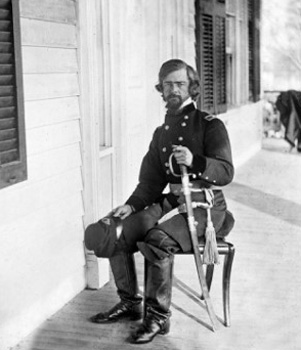
General Philip Kearney

Reno’s Corps under General Isaac Stevens and Kearney’s Division were sent to engage this threat. At 5:00 on the evening of September 1st, at Ox Hill, not far from an old mansion known as Chantilly, the Union forces attacked. Simultaneous with the attack was a severe thunderstorm, adding additional discomforts to the horrors of war. Falling in battle were both Union generals, who suffered mortal wounds. The contest of several hours was indecisive, but accomplished a final halt to any aggressive plans of the Confederate army. The Bull Run campaign was over.

Doubleday’s Division, now placed under command of General Hooker, was not engaged in this action. My own division during this time was posted by order of General Hooker south of Fairfax Court House, facing in the same direction. We remained there all night unmolested, bivouacking in the mud and suffering great discomfort from the pitiless storm.

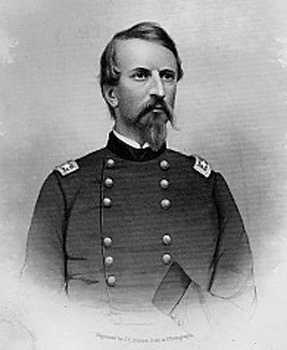
General Isaac Stevens

The cold storm and the discomforts of this particular evening were extraordinarily commented upon by all who wrote memoirs of this day. Smith wrote of the difficulty of marching that entire day, the most severe of the campaign, wading through mud to the knee. Doubleday had been ordered to select a regiment for picket duty, and he selected the 76th N.Y. After a march of four miles, they commenced a guard duty that would never be forgotten. Most of them had long before thrown off the clothing that might have given them a measure of protection for this wretched evening. “The night was so intensely dark, that an object could scarcely be seen five paces distant. The rain and sleet continued unabated, while the north-west wind sent it with almost fatal effect against the shivering and nearly paralyzed forms of the men … Severer tests of courage may have been made upon the Regiment; but never again did the men suffer as during that night.”  Noyes echoed the description of the storm with word pictures only he could conjure: “The rain laughed to scorn our rubber cloaks, filled our top-boots to the brim, trickled in rivulets between our shoulders, while the wind fairly swayed our horses before its fury.”

© Randy Buchman, 2012


150 Years Ago Today – 2nd Bull Run Day 2

2nd Bull Run (2nd Manassas) – Day 2

The following long post is an excerpt from my book research project on the life of Abner Doubleday.  This post, along with others surrounding the Bull Run Battle and aftermath, is from the perspective and writings of Doubleday and those close to him. “Noyes” was a staff officer for Doubleday who wrote very colorfully… he was a lawyer from Maine. “Smith” is the historian of the 76th New York.

2nd Bull Run Day Two – August 30, 1862                                                                                                                                                                                                                                                                                          

Lee had gained the ground from which he could launch his attack of this next day. Pope continued in delusional thinking throughout the night, and determined to give battle again the next day in order to defeat Jackson. Greater wisdom would have advised a retreat across Bull Run toward a reunion with the forces of the Army of the Potomac.

In Pope, Lincoln had an aggressive fighter, but not a wise warrior. Doubleday was relatively gracious in his assessments of Pope, perhaps not so much due to his admiration of Pope, but rather in consequence of his disrespect for the entire McClellan contingent of the army. Doubleday wrote: With the expectation of receiving large reinforcements of men and supplies of forage for the cavalry horses from General McClellan at Alexandria, General Pope determined to hold out for another day and try the chances of battle again. His hopes, however, were all disappointed. McClellan virtually declined to send any forage, and the scant reinforcements were purposely sent forward so as not to arrive until the conflict was over—as they only marched for and six miles in a single day, and made frequent halts with the noise of the battle ringing in their ears urging them forward.

In fact, McClellan was not energized, and had written to Lincoln on the 29th that it may be best to allow Pope to “get out of his scrape,” while making the capitol secure. McClellan’s fixation was upon the scant resources to protect Washington from rumored pending advances upon the very doorsteps of the city.

Pope continued in his grand optimism as dawn arrived. Support had not arrived, and in fact, a courier brought a message from Franklin that supplies were available and awaiting Pope to send a cavalry escort to receive them. Obviously, this could not be done in any timely fashion. As discouraging as this news was to Pope, he recovered his hopes quickly. Particularly reversing his mood was a report brought in by General Marsena Patrick, describing a Confederate movement of troops to the west. The last arriving division of the Confederate army—that of Richard Anderson—had completed a 17-mile march and arrived on the scene at 3:00 a.m. As dawn approached, it was understood by Confederate command that Anderson’s Division had halted in a position too far in advance, were therefore dangerously exposed, and needed to move back to the main line of the army. This redirecting of the division was observed by Patrick, who sent a few artillery shells to hasten their movement. Along with a number of reports by captured prisoners that the Confederate command was overheard to be considering a withdrawal, Pope construed combined events and information to confirm such an action. He sent Halleck an early morning message embellishing accomplishments of the previous day as a solid victory, and stating: “news just reaches me from the front that the enemy is retreating toward the mountains. I go forward at once to see.”  <<O.R. XII, Pt. 3, p.741

At dawn, the men engaged in the twilight battle of the previous evening had opportunity to sort themselves out from the entangled conglomeration and regain their fighting units. My brigade which had been driven back the previous evening by Longstreet’s advance, was reformed at daybreak, and as many stragglers who joined me, who had fallen out of the ranks from fatigue the day before, my number of fighting men was considerably increased. Noyes was not as encouraged by the numbers he saw in the brigade: “… it was enough to give a man the heartache to see the little brigade drawn up in line, not five hundred strong. More than fifteen hundred rank and file had marched with us out of Fredericksburg; some had undoubtedly skulked behind; some were absolutely worn out by our long marches, sleepless nights, and battle fatigues; some, separated from their commands during last night, had not yet rejoined them; but probably the larger portion of the missing were prisoners to the enemy, lay wounded in the hospitals, or slept the last sleep of the patriotic brave.”

As it became obvious through morning reconnaissance efforts that the Confederates had not retreated, Pope ordered his forces under Generals Butterfield and Porter to again attack Jackson, who occupied the same position as the previous day. The attack produced a severe engagement with a savage defense of the strong Confederate position. Doubleday’s Brigade was in a supporting position on the right flank of this assault. Porter’s advance under Butterfield ascended the hill beyond Groveton, but there they encountered such masses of the enemy both in their front and on their left flank, that it soon became evident the enemy were there in full force… Unfortunately, General Pope not knowing what the enemy were doing behind the thick curtain of woods which screened them from view, came to the conclusion that Longstreet’s force would simply be used to reinforce Jackson who still remained in nearly the same position. Pope there threw the main body of his army to the north of the pike to confront Jackson… The strength of the Confederate position in the front of the Union advance, along with an open enfilading artillery fire from the area of the Brawner Farm, resulted in significant losses for the Northern attackers. Though exhausted from continuous battle, Jackson’s troops were more vulnerable than Union command might have imagined from the punishment they were afflicting. A strong reinforcement from A.P. Hill’s command swayed the balance of the conflict in favor of the Confederate efforts, and the Army of Virginia was obliged to fall back. Doubleday’s Brigade was in a third line of assault and was subjected to a severe canister fire, but the general retreat was in motion before his advance could be made.

A mere 8,000 men had been retained on the Union left flank to the south of the pike. Longstreet had about 30,000 amassing for an attack. About the time of the Union retreat, McDowell made the largest tactical error of the day. In order to reinforce the entire situation on the right, he ordered Reynold’s Division to relocate from the left flank and move to the north of the turnpike. This left only 2,200 troops to face the pending attack of Longstreet’s wing. Old Pete’s wing extended a full 1.5 miles in width, and only had about that distance, or a bit more, to cover in order to seize the Henry House Hill. This hill, the scene of the most intense action of the First Bull Run, was again the key to the battle. Seizing it would give the Rebels the high ground from which they could prevent the escape of the Army of Virginia across the stone bridge over Bull Run toward the relative safety of Centerville and Washington. The terrain in front of Longstreet was convoluted and difficult—with streams, woods, and ridges. But the numbers were vastly in his favor. Doubleday described this entire scenario in his journal: General Reynolds, in order to cooperate with Porter and with a view also to ascertain what was in his own immediate front; sent forward two regiments preceded by skirmishers, and also a third regiment, the 6th PA reserves under Colonel Sinclair, to examine the ground on the left of the division. He accompanied this last reconnaissance himself, passed beyond his line of skirmishers in the woods, and went to the outer edge behind which the enemy were formed. There he saw the whole of Longstreet’s forces massed in readiness to seize the commanding elevations south of the pike, drive us from Bald Ridge and the Henry House Hill, and cut us off from our line of retreat by capturing the stone bridge over Bull Run. 

Just as Longstreet was about to advance, Reynolds was ordered to vacate his position and with his division to the right, in order that Porter’s lines might be rallied behind these fresh troops. This movement was wholly unnecessary for there was little or no disorder in Porter’s command. My men fell back in as perfect a line as if they were on parade, and the other corps seemed equally steady. Reynolds therefore was not needed by us and the order was most inopportune for him to leave his important position, just as the enemy were advancing against it.

A savage fight erupted on the Union left as Longstreet unleashed his attack. Extraordinarily gallant efforts were made by the few numbers of troops retained for the defense of this critical juncture. The defenders held out long enough for Reynolds to return and for other forces to be applied to this stand. Doubleday wrote of the fortuitous nature of the shape formed by the forward battle lines of the two armies at this point: It was fortunate for General Pope at this juncture that the convex formation of his army enabled him promptly to reinforce every assailable point, for while our troops moved on the chord of the arc, the enemy moved on the circumference.

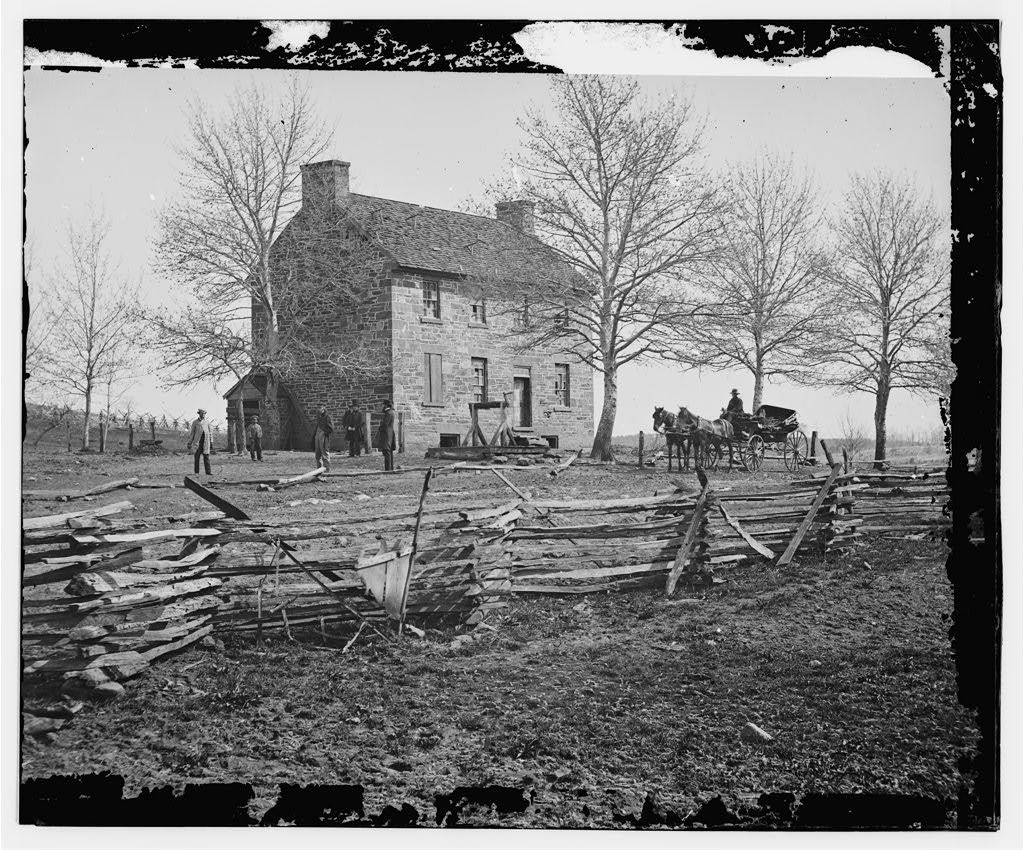
Doubleday’s Brigade had withdrawn during this course of events to the area of the Stone House—a beautiful home marking a distinctive feature of the battlefield—just north of the Warrenton Pike at the intersection with the Manassas-Sudley Road. General Hatch had been wounded, and the command of the division had devolved to Doubleday. A solid line of defense was being established along the Manassas-Sudley Road. Though the most savage of the fighting was now occurring slightly to the left and south of Doubleday’s location, his brigade occupied a position in the relative center of the entire line. He wrote: General Hooker who had relieved General Porter rode up to me, pointed to a depression several hundred yards in front of me on the turnpike near Groveton, and said briefly, “General Doubleday, go into that ravine and hold it.” I immediately formed my division across the turnpike facing west and held the position until dark. We were exposed to a heavy fire from the Rebel artillery in our front, losing a number of men. In the meantime, the roar of battle on my immediate left on Bald Ridge was constant and unintermitting. The broken fragments of regiments came out of the strife all cut to pieces and rallied around me with cries and protestations of loyalty to the flag. Among others, I recollect particularly the 12th Mass regiment, which had just lost its Colonel Fletcher Webster and a large number of its best officers. This Colonel Webster was the only surviving son of the great statesman Daniel Webster. The son had raised up this regiment, who had elected him their colonel; and the regiment was also known as the “Webster Regiment.”

Doubleday’s Division was now the western most unit of Pope’s army. Sufficient defense had been rallied to prevent Longstreet from achieving his ultimate objective of the Henry House Hill, and a general retreat was now in operation. It was very late in the day. The division of Doubleday was under fire from the enemy, but also, due to their advanced position, by the friendly fire of Sigel’s artillery.  I then had a flag waved to let them know who we were, but, they took this as a defiance and redoubled their firing. Finding they were getting my exact range I sent Major Doubleday to stop their artillery practice, and fell back a short distance to let the balls pass over us. When the firing ceased, I moved forward again and resumed my first position. It was somewhat trying to be commanded in front by the enemy, and in rear by our own troops. 

Doubleday’s Division fell back as darkness descended. The bridge was much crowded, and he therefore had his command cross at a ford above it, and bivouac on the east side for the evening. His final written remarks for this date say: With ample time and means to reinforce General Pope, General McClellan had only sent him 21,000 men from the 90,000 veteran troops which came from the Peninsula, and had wholly evaded his request for food and ammunition. Now that the battle was over, Franklin’s and Sumner’s Divisions of that army came up, raising our forces to a number somewhat superior to that of the enemy. Notwithstanding this, as our army was out of supplies, it became necessary to fall back on Washington.

© Randy Buchman, 2012


150 Years Ago Today: 2nd Bull Run (2nd Manassas) – Day 1

The following long post is an excerpt from my book research project on the life of Abner Doubleday.  This post, along with others surrounding the Bull Run Battle and aftermath, is from the perspective and writings of Doubleday and those close to him. “Noyes” was a staff officer for Doubleday who wrote very colorfully… he was a lawyer from Maine. “Smith” is the historian of the 76th New York.

2nd Bull Run Day One – August 29, 1862

Doubleday’s Brigade, along with King’s Division rested throughout the morning hours. General Pope now knew the relative position where Jackson was to be found, and in reality possessed superior knowledge of the enemy location than he did the disposition of his own forces. Pope, believing Longstreet to be too far removed for connection with Jackson, strategized under a presumption of having units positioned to surround Jackson, when in fact, all his disparate Union troops had moved to the south and east of Stonewall’s location. Pope also errantly believed Jackson to be retreating. Rather, the great Confederate general, who had earned his sobriquet of “Stonewall” just across the Warrenton Pike the summer before, was anchoring his wing of the army to repulse a hoped-for Union attack. Positioning his men largely behind the natural fortification of the unfinished railroad cut, they were well-prepared for the impetuous attacks of Pope.

Stone House at the center of the Manassas Battlefield

Throughout the morning, Union attacks probed and developed the position of Jackson’s command. Hard fighting achieved several breakthroughs, but Federal forces were unable to support any of these advances. Pope ordered Porter’s Fifth Corps, located south of Jackson’s position near King’s Division, to advance north and make a grand attack upon Stonewall’s presumed exposed right flank. It was not exposed. The wings of the Confederate Army were closing as Longstreet arrived. Soon, the Southern forces would be positioned in an open “V” formation, with Jackson’s wing facing to the southeast, and Longstreet’s directly east. The arrival of Longstreet had blunted the forward progress of Porter’s Corps, and thereby the primary offensive plan of Pope.

George F. Noyes had written enthusiastically of seeing the veterans of Porter’s Corps passing by them that morning: “As we sat on the ground sipping our coffee and talking over last night’s experiences, cheer upon cheer from one of the brigades of our division arrested our attention. Starting up, I saw a long column of troops moving by, and heard it was composed of some of McClellan’s old army. I did not wonder at the cheers, for now we were assured that McClellan had succeeded in extricating himself from his perilous position on the Peninsula, and that our connection was fully established. For one, I had now not a particle of doubt that every man of that army, to aid in whose rescue we had been undergoing the fatigue and danger of the past three weeks, was flying to re-enforce us.”

Before Doubleday’s Brigade could cook the butchered beef for a long-postponed meal, they were ordered forward with the rest of King’s (Hatch’s) Brigade. Following the same generally northern direction as Porter, they veered to right and around Porter’s stalled Corps, arriving behind the engaged left flank of Union forces. [Doubleday wrote] At 4:30 p.m., Pope ordered Porter to attack the right flank and rear of Jackson’s force. Porter had moved forward from Manassas in the direction Gainesville, but had halted on an eminence about a mile and a half south of the turnpike where there was open ground. His left and front were covered by Buford’s cavalry. Here he remained passive until about 5:00 p.m. when he received orders to attack which he declined to obey, preferring to retreat with his whole force.

Doubleday’s remarks are harsh, though Porter had done much to cook his own goose (not only by sluggardly leadership, but also by previously writing too openly and indiscriminately about his disdain for Pope … all of which would work toward his eventual dismissal from the army.) Earlier orders from Pope had been confusing and misunderstood, and were altogether impractical in light of Longstreet’s arrival and position.

Marching away from Porter’s Corp late in the afternoon, the men of Hatch’s Division and Doubleday’s Brigade found themselves on the Warrenton Pike, less than a mile east of the location of the previous evening’s battle. Actually, only Doubleday’s and Hatch’s former brigade were assembled. Gibbon’s had been detached, and Patrick’s was somewhat behind, due to more confusing orders. Pope, continuing under the false impression that Longstreet was not present and that Jackson’s flank was exposed, sought to exploit Union successes on his own right flank with a grand attack by the left.

For the purpose of cooperating with General Porter’s grand attack, which was to come off on the right and rear of Jackson’s wing of the Rebel army, General Pope now ordered his whole line to advance, and spirited attacks to be made upon every point of the enemy’s position. The troops had already had a good deal of hard fighting but they went forward with gallantry and enthusiasm, expecting every moment to hear the thunder of Porter’s guns in the distance.

Pope envisioned himself to be upon the cusp of a long-awaited victory. The reports of advances on his right, and the sight of wagons moving away to the west on the Warrenton Pike, combined in Pope’s mind to conclude the enemy was in retreat. Others around him rightly presumed the wagons to simply be ambulances moving the wounded to the rear. Doubleday wrote also of this event:

An incident now occurred which induced both Pope and McDowell to believe that Jackson had given up the contest and was retiring in haste from the field. Just before dark, Anderson’s Division of Longstreet’s corps was moving down the pike on their way to Sudley Springs.  Some of Jackson’s pickets told Anderson that the road in front of him was occupied by a large Union force. This induced him to defer this march until daylight and he counter-marched his troops to take post for the night behind the main body of Longstreet’s troops. Pope unfortunately construed this retrograde movement into flight. (Doubleday is mistaken in this account, the events of which actually occurred at dawn the next morning.)

In actuality, the Confederates were planning a probing movement to the east. Lee had been frustrated throughout the day with an inability to attack on this front, due to the large menacing presence of Porter’s Corps. The dust from the march of Hatch’s Division away from Porter toward the center of the battle was rightly interpreted by the Confederate command to believe no Union attack would be forthcoming on this, their right front. Therefore, a twilight probing movement under General Hood was hastily arranged. The result for Doubleday’s Brigade was to be that, instead of pursuing a retreating foe, they would rather be running headlong into another of the Confederate’s finest fighting units.

As the men of Doubleday and Hatch’s Brigades (Hatch’s now being led by Colonel Sullivan of the 24th N.Y.) assembled for their “pursuit,” they were met by McDowell in person. Doubleday complained of this circuitous marching, simply so that McDowell could say a few words: We had marched twenty-six miles with but short intervals of rest, and were now required to run several miles around to the junction of the Pike and Sudley Springs Road, apparently for the purpose of giving General McDowell an opportunity of saying a few words to the 14th Brooklyn Regiment, which was associated with him in the first Battle of Bull Run. McDowell affirmed that they would be pursuing a beaten and fleeing enemy, and to take as many prisoners as possible. “Well boys, you are following a retreating foe. Push ‘em like hell!” <<Smith, p. 130>  Noyes described the same scene: “Hardly have we fairly started before the order comes to move at double-quick. McDowell himself is at the roadside, and as we move quickly by, the news flashes through our lines that the enemy is retreating, and that we are sent forward to pursue and pick up the stragglers. Cheer after cheer swells up from the ranks; officers wave their swords; the fatigue of last night’s fighting and marching is forgotten …”  Some of McDowell’s staff officers said to the men, “All you have to do is go ahead and shoot!” Doubleday wrote that: In many a sharp contest afterwards when we were ordered forward, the men would call out to each other as a bitter joke, “all you have to do is go ahead and shoot.”

Doubleday’s Brigade led the advance, with the 95th N.Y. (who were only engaged the prior evening in support of Gibbon’s battery) given the opportunity to spearhead the movement. All was quiet for quite some distance, as they had advanced a mile beyond the main army. But coming over a rise in the road, they were rudely greeted by a large force of infantry. Smith recalled: “Doubleday’s Brigade was in the advance, and this unexpected attack by the ‘retreating foe,’ produced considerable confusion for a moment. The Brigade finally swung into line and commenced firing. Hatch’s Brigade came up on the left, and Patrick’s on the left of Hatch’s.”

It was nearly dark and the flickering line of fire from 14,000 muskets showed that we had a very strong force to contend with. Hatch’s Division was heavily outgunned and faced fire from the front and a concealed enemy on both flanks. After a fight of about one hour, with darkness setting in quickly, the press was too much and the division began to break. Smith succinctly described it: “It was soon ascertained that instead of pursuing a retreating foe, the alternative was presented to the Union troops to retreat or be annihilated.” Describing the scene of regiments and brigades falling back upon one another and intermingling in unmanageable masses, Smith wrote of Doubleday:  “General Doubleday, always averse to a retreat, was about to order a charge; but just at this point, Patrick’s brigade broke and fell back upon Hatch’s, which, in turn, broke upon Doubleday’s …”

The darkness, and the pursuit of the Confederates, produced several incidents of officers giving orders to soldiers of the enemy. Colonel Livingston of the 76th N.Y. gave an order to a mass of troops, only to find out it was the 2nd Mississippi, who claimed him as a prize. When interrogated, he carried out a successful ruse as a surgeon, and was allowed to cross back to his own lines before the Confederates discovered their error. Doubleday and his staff officers were nearly captured, as the contest became increasingly uneven. He credited the gallantry of Captain Bloodgood of the 95th N.Y. for interposing and preventing this catastrophe. Also receiving special commendation was his brother Ulysses, who, in attempting to save some of our men from capture received the fire of a Rebel regiment, and had his horse shot from under him but escaped unhurt. An additional remark of Doubleday was an observation that the Confederates on their right must have had poor powder, as balls struck like stones without penetrating.  One of their bullets actually stuck in the forehead of an officer of the 76th N.Y., who exhibited himself in that condition to the men around him and then pulled out the bullet and threw it away. It had merely penetrated the skin.

© Randy Buchman, 2012

150 Years Ago Today: The Battle of Brawner’s Farm

The following long post is an excerpt from my book research project on the life of Abner Doubleday.  This post, along with others in coming days of the Bull Run Battle and aftermath, is from the perspective and writings of Doubleday and those close to him. “Noyes” was a staff officer for Doubleday who wrote very colorfully… he was a lawyer from Maine. I will add that this is a favorite and especially interesting piece of Civil War history and collection of narratives.

Brawner’s Farm – also known as “Groveton” or “Gainesville”

On the 28th, General John Pope was moving his varied commands to the north and east toward Manassas Junction “under the supposition [wrote Doubleday drolly] that Jackson would remain there and give battle.” However, Jackson did not remain in that position, rightly understanding he could well be cut off from connection with Lee. Any movement in any direction other than north would be to advance directly into the face of enemy forces. Jackson therefore moved his command north and west of Manassas Junction, across the battlefield of Bull Run from the year prior, and essentially hid them away in a stretch of woodland behind a rise just to the north of the Warrenton Turnpike called Stony Ridge. The excellence of this position was enhanced by an old railroad cut. The Confederates were packed together tightly (like fish in a barrel, according to one of them), but completely out of sight and knowledge of the Union forces and scouts.

Doubleday’s Brigade, with the departure of the Confederates facing them across the Rappahannock, had been withdrawn to the north through Warrenton. Following the curve of the Warrenton Turnpike to the east, they were ordered to continue in that direction on the same road. Pope had been led by captured prisoners to mistakenly believe the illusive Stonewall Jackson was east of the Bull Run in the area of Centreville. He therefore, on the afternoon of the 28th, ordered King’s Division to continue in movement in that direction along the Warrenton Pike. Noyes wrote of their afternoon meal as a delightful one, with thoughts of battle far from their minds. “Several guests joined our picnic under the trees, the general (speaking of Doubleday) was in his most humorous vein, and we rested here two or three pleasant hours. Certainly no one of us, as we reposed after our lunch, placid and content, dreamed of the tragedy which was to greet us before the sun went down. It was late in the afternoon before we were summoned to the saddle, and the brigade ordered to advance.”

The march along the pike unknowingly brought King’s Division directly across the front of Jackson’s Command, hidden within the wooded slope parallel to the wide road. It was a beautiful summer evening. The division was advancing leisurely along the Warrenton Pike with Hatch’s Brigade in the lead, followed by Gibbon, Doubleday, and Patrick respectively. Far from the minds of these soldiers was any anticipation of pending action with a sizeable body of the enemy—who was said to be miles away. Jackson was enjoying one of his impromptu naps when awakened by word from scouts of a significant body of infantry moving along the turnpike below. He mounted his horse and went to examine the situation personally. In an open area at the crest of the hill to the north of King’s Division, Jackson himself was seen by the Federals. Doubleday wrote: “As I stopped for a moment to converse with General Patrick, I saw a large man on horseback suddenly appear on a hill about 200 yards off to the north of the turnpike. I made a remark that he must be a Rebel officer, but I was assured that the ground in front of us had been scouted half an hour before and that no Rebels were there at that time . . . [It] was Stonewall Jackson himself, who suddenly turned around and made a motion to some in the rear. A section of Rebel artillery immediately galloped up, unlimbered and opened fire upon us.”

The Brawner farmhouse and orchard sat about one-quarter mile to the north of the pike. The slope was largely open to the wooded crest lest than a half mile parallel to the road. A stretch of woods along the pike, to the south and east of the farm afforded some protection for the brigades of King’s Division. Hatch’s Brigade had already passed this location for some distance and was well to the east on the pike. Gibbon’s Brigade had just passed through the woods, and Doubleday’s was approaching it when the Rebel artillery opened upon them. Noyes wrote that “so sudden a transition from a doze on horseback to the position of target for Rebel artillery exercise was by no means agreeable to me. . . The general at once thundered out, ‘Bring the van forward at double quick; and double-quick it was for some five hundred feet, until we were out of range, with a thick wood between us and the Rebel batteries.”  Gibbon’s Brigade had also sought the shelter of this same woods, and here Doubleday and Gibbon met and conversed.

As it was positively stated the Jackson’s main force was still at Centerville, both General Gibbon and myself supposed we had simply been annoyed by one of the batteries attached to Stuart’s Cavalry, and that it could easily be captured or driven off by sending a small infantry force against it. So I passed General Gibbon and he asked me what I thought we had better do. I replied that we were subordinates, and it was for our division commander to give orders, but I thought we ought to storm the battery. He replied, “By heaven, I’ll do it!” and immediately ordered Colonel Edgar O’ Conner, an accomplished gentleman and graduate of West Point, to march forward obliquely with his regiment (the 2nd Wisconsin) and take the battery in flank.
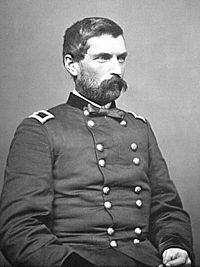
John Gibbon

Gibbon’s Brigade consisted of four regiments of volunteers, entirely from the west: the 2nd, 6th and 7th Wisconsin regiments, and the 19th Indiana. Presuming the artillery to be attached to a cavalry unit, Gibbon ordered the 2nd Wisconsin to dispense with it. Known as “the Ragged Ass 2nd” because of the condition of their trousers, this regiment consisted of the lone veteran unit within Gibbon’s Brigade of westerners. They had fought just a couple of miles to the east of this location in the first Battle of Bull Run the previous year. Apparently, a good amount of posturing had gone on within Gibbon’s Brigade, with the 2nd Wisconsin proudly affirming their veteran status. Here now was an opportunity to demonstrate their skill. And soon, the remaining raw regiments of the brigade would have opportunity to demonstrate that they too were as tough as their words.

Gibbon was especially adept at understanding the character of men and knowing how to motivate and build unity, discipline, and soldierly character. He instilled a pride in the naturally tough character of men hailing from the west, in an army where they were significantly outnumbered by the masses of regiments from the northeast. Gibbon had equipped his brigade with a distinctive black felt hat. He had also drilled and trained them exceedingly well. As their fighting reputation grew in the course of the war, Confederates were known to groan at the sight of “those damned black hat fellows” opposing them.

Gibbon deployed the 2nd Wisconsin obliquely through the woods along the road. As they exited the woods onto the open slope, the Confederate artillery had withdrawn, and over the crest of the hill appeared infantry troops of the famed Stonewall Brigade. Hearing an increasing amount of musket fire, Gibbon deployed the 19th Indiana to the left of the Badger regiment. Jackson likewise threw more troops into the escalating engagement. These Confederate forces were under the divisional command of General Ewell and General Taliaferro. With the rising tide of Confederate forces on the right flank of Gibbon’s growing line, he now deployed the 6th and 7th Wisconsin regiments. As well, he sent aides to request the assistance of other brigades within King’s Division. The only response was from Doubleday, who advanced two of his three regiments, the 76th New York and the 56th Pennsylvania. Doubleday wrote that “… General Gibbon sent to implore me for heaven’s sake to come to his assistance immediately. Our division commander, General Rufus King, had had an epileptic fit the day before. On the present occasion, he dashed by me at full speed with his hat off going in the direction of Gainesville. I never heard that he issued orders to any one until the contest was nearly over. I certainly received none, and came to the conclusion I would have to act for myself. I at once sent in the 76th New York under Colonel William Wainwright, and the 56th Pennsylvania under Colonel Sullivan E. Meredith… ”  Doubleday retained the 95th New York, his other regiment, as support for the six guns of the Battery B of the 4th U.S. Artillery, also known as “Campbell’s Artillery.” This artillery unit, formerly under General Gibbon before the outbreak of the war, was rather permanently attached to Gibbon’s command, and would serve with great distinction, especially at Antietam. On this occasion, Doubleday was the ranking officer on the field, and as Gibbon was engaged with his infantry, moved the artillery to the right flank along the road to achieve a fire into the enemy’s flank (as Doubleday wrote: to take the Rebel line “en echarpe”).

Many artistic depictions of 18th and 19th century warfare present the contending armies mere yards apart, firing into the very face of the enemy. Of course, for the artist to get both sides on the same canvas, this is rather necessary—when in fact, the reality of the situation involved an exponentially greater separation. On this occasion, such an artistic rendering would not be nearly so dramatically opposed to reality. The irresistible force had met the immoveable object. Clashing head-on were the respective armies’ ultimate version of true raw-boned tough guys who would not back down. They each stood firmly at ranges as close as 50 to 75 yards, volleying stubbornly into the faces of the other. An officer of the 2nd Wisconsin wrote: “the 2nd had been through First Bull Run and swaggered a bit as veterans, in consequence. They rather patronized the others, put on veteran’s airs, swore by their own officers, O’Connor, Fairchild and Tom Allen, but had little use for any one else. The 6th, 7th, and 19th had not had the 2nd‘s opportunities but were sure that when the time came they could fight as well and stay as long. It was this that accounts in a large measure for the stirring feat of arms that followed. The 2nd having talked so much could not be the first to fall back. The others would not budge while the 2nd stayed.” <<from http://www.secondwi.com/wisconsinregiments/battles2.htm … article in the Washington Star, March 16, 1913 by 1st Srg, Gilbert Motier Woodward>>

The brigades of Gibbon and Doubleday were significantly outnumbered in this contest, but did not give any ground. Jackson had the greater number of forces not only engaged, but also in reserve. However, he was unable to quickly deploy his forces in an efficient manner, in part due to both of his division commanders being wounded. Ewell was shot in the knee, and would have his leg amputated, while Taliaferro’s body collected three musket balls before it was over. Darkness was the agent of mercy to bring the fight to a close, though the final volleying continued for some time beyond any ability to visually see the enemy, as each side aimed at the muzzle blasts of the other.

Patrick’s Brigade, though not far from the action and fired upon by another Confederate battery at the outset, remained unengaged. General Patrick was awaiting orders, which of course did not arrive due to King’s medical condition, and he therefore did not choose to operate independently. He was also much disposed in the task of re-gathering the 20th New York Regiment, which demonstrated their raw nature by fleeing the initial cannonade. Hatch’s Brigade, which was somewhat advanced down the pike, did return, but too late to be thrown into the action. Of their arrival, Doubleday wrote: As his [Hatch’s] advanced regiment came on, I requested them to cheer for the purpose of indicating to our exhausted men that reinforcements were coming to their assistance. As soon as the enemy heard these cheers, they ceased firing and fell back a short distance, leaving their pickets on the line the main body had originally held.

The butcher’s invoice for the battle was quite significant, given its short duration. At least a third of Gibbon’s Brigade was killed, wounded, or missing, including the colonel of the 2nd Wisconsin—Edgar O’Conner. Confederate losses were as significant also. On both sides, many surviving officers achieved rapid advancement due to the losses of higher-ranking comrades. It was a most grim task to locate the wounded in such proximity to the enemy. An effort was made to collect as many as could be found yet alive. A livid General Gibbon met with the officers of the division, King now being present. Gibbon was bitter at the losses of so many in his regiment and the sluggardly way only Doubleday had come to his assistance, while the other two brigades offered no help whatsoever. His irritation is quite evident even within his official report where he wrote: “I sent repeated and earnest requests to division headquarters for assistance. Two of General Doubleday’s regiments finally got into line and the fight was kept up vigorously until after dark, when finding that we were far outnumbered and outflanked on the left, where I at length lost all hope of getting help from Patrick’s brigade, I ordered the line to fall back, which was done in good order.”  All the evidence from witnesses within both brigades indicates that Doubleday responded rather quickly to the situation. Gibbon even admitted that in fact, the regiments of Doubleday’s command who did respond were positioned in such a fashion as to have been out of his view. Gibbon also seemed to be rather unaware of the role of the 95th New York in supporting his own brigade’s battery.

Doubleday had interrogated some wounded prisoners, and the commanders of King’s Division now understood that they had engaged the main force of Stonewall Jackson. Discussion ensued as to the appropriate course of action. They were at the base of an incline occupied by a massive force of enemy, who was certain to open upon them with artillery at dawn. Neither the commanding general (Pope) or the corps commander (McDowell) was within range of contact. Confusion reigned supreme on this dark evening. McDowell was riding to consult with Pope at Manassas Junction, though Pope was not actually there, but rather at the Bull Run crossing toward Centreville. General Reynolds, who earlier had ridden to the sound of the fire, consulted with Doubleday, and went to bring up his division for support, but got entirely lost in the darkness. The decision arising from the consultation of the generals of King’s Division was to withdraw toward Manassas and reunite with the army there, or connect with units hoped to be proceeding toward assisting them.

The result of this decision was to essentially march away from a field of battle, only to have to march back to it the next day. Divergent reports of this consultation and decision are evident in the subsequent writings of those present. Many years later, Gibbon wrote that he alone was in a talking mood among the generals present, even though he ranked as the junior officer. King, who was certainly not at the top of his game, was disposed to carry out his orders to march to the east to Centerville. Gibbon was accurate in his assessment of this thought, and verbalized how it was futile to march toward the now obsolete supposed location of an enemy, when in fact the enemy was a mere one-half mile away. Writing years later that, in response to a silence of all the other generals gathered, he proposed marching to the southeast toward Manassas Junction, in order to connect with reinforcements that may well be coming toward their division. Gibbon stated that he did not at that time know that Reynolds had met Doubleday and promised to bring his division by daybreak. Doubleday’s journal records this meeting by saying that General King called his brigade commanders together and asked their advice, as the Corps commander, General McDowell, was absent, and General Pope’s headquarters were unknown. General Gibbon strongly recommended a retreat to Manassas Junction at 1:00 a.m., and so as he had great influence with General King, his opinion prevailed. I was strongly opposed to this movement. It left the way entirely open for Jackson’s force to unite with that of Longstreet.

It is difficult to assess exactly what did transpire. Both Gibbon and Doubleday were prone at times in their subsequent writings toward a selective memory of events and an analytical brilliance of hindsight. But it is difficult to imagine such a meeting where Doubleday would sit meekly and not render an opinion. It is certain that a tremendous breakdown of higher command had resulted from an entire sequence of unanticipated circumstances. Though Doubleday and Gibbon would fight successfully together on a number of fields, their politics and views upon army structure were quite in contrast. Gibbon was a staunchly strong McClellan proponent, even decades after the war. Doubleday was more gracious than Gibbon in his assessments, but clearly, they were not immensely fond of one another. For example, Doubleday wrote in his account that when all was quiet along the lines, General Gibbon, desirous of monopolizing the entire glory for himself, sent a telegraphic dispatch to the effect that his brigade had had a battle with two of Jackson’s divisions. He entirely omitted to state that my men fought by the side with his, and lost in the same proportion. General King countersigned Gibbon’s telegram at his request; but I doubt if he knew much about the engagement, and he was soon after relieved from command of the division.

The truth is that both generals and their brigades fought well in the contest. But Gibbon would never be content with the amount of credit received (or not received) for the battle, and would always feel abandoned by the other brigades within his division. Gibbon expressed this quite vehemently in a letter written in December of 1863, wherein he complained bitterly that he had not yet seen published reports of Doubleday, Patrick and himself in connection with this contest. At that date, only the report of Pope had been public, and Gibbon’s contention was that the other reports would cast a more favorable and accurate light upon the accomplishments of his brigade. Stating that Pope’s report spoke of the action as involving “King’s Division,” Gibbon wrote that “my single brigade was left almost alone to sustain itself against a division of the enemy, and that the division as such was not engaged at all; that in place of being ‘supported handsomely by Doubleday’s brigade,’ but two regiments of that brigade came to our assistance, and then only when the brigade commander had been repeatedly urged to send them by my staff officers, and the late Major-General Reynolds, who came upon the ground during the fight.” The comment is certainly ungenerous, in that Doubleday only had three total regiments, and one was clearly needed to support Gibbon’s battery from being targeted and overrun. Gibbon wrote of the poor nature of the reconnaissance that day, and of Patrick’s Brigade as remaining immoveable without firing a shot. He concluded, “This statement I deem necessary as an act of justice to my command, and respectfully request that it may be published as such and a copy furnished Major-General Pope.”

At 1:00 a.m. the movement toward Manassas Junction commenced, and the division covered the eight miles in about five hours. Doubleday’s diary records his extensive critical evaluation of the lack of wisdom in this movement. Written from the grand perspective of hindsight, it rightly notes the greater advantage that would have been gained from staying in the vicinity of the previous evening’s engagement. Such a course of action might have contributed toward an inability of the two wings of Lee’s army to reconnect. However, quite a chain of positive events would have needed to ensue, and Doubleday’s record is not without a critical tone about the character of some of those directing these needed events. “Had King’s Division remained on the ground it had so gallantly won, it would have been speedily augmented by Sigel’s Corps and by Ricketts’ and Reynolds’ Division of McDowell’s Corps.  While these forces were to interpose between the two wings of Lee’s army, Heintzelman, Reno, and McClellan were expected to act in concert and isolate Jackson.  The unaccountable retreat of General King’s Division on Manassas, which also involved the withdrawal of Ricketts’ Division, and the strange behavior of General McClellan in purposely delaying either to reinforce General Pope or send him supplies, put an end to the plan of the campaign.”

© Randy Buchman, 2012



Marching Around Virginia in August 1862 – part 4

The following is from a draft of my long-planned and maybe never to be completed (??) book on Abner Doubleday. The text alternates between remarks from an obscure Doubleday journal and those of his adjutant George F. Noyes (who published a book in 1863 entitled “The Bivouac and the Battlefield”). After having his command stuck in Fredericksburg for many months, Doubleday’s men were now on the move at this time 150 years ago – taking them through Virginia to fight ultimately at Brawner’s Farm, Bull Run, South Mountain, and Antietam.

Jackson’s grand flanking movement was begun on the 25th of August with Stuart’s cavalry leading the advance. Jackson’s troops proved their value and mobility once again, as his 23,000 men covered a distance of 25 miles in 14 hours. This was seen by Union scouts, but wrongly interpreted by Pope as Lee simply moving to the Shenandoah Valley away from his stalled front along the Rappahannock. The next day (the 26th), Jackson descended east through Thoroughfare Gap and on to Bristoe Station on the Orange and Alexandria Railroad (Pope’s supply line from Washington). His command easily captured this lightly guarded location, and with little more difficulty also captured the huge depot of supplies at Manassas Junction, just miles to the north. What they could not consume, they burned—several million dollars worth!

Manassas Junction

As Jackson’s command was accomplishing this maneuver and enjoying the spoils at Manassas Junction, Doubleday was part of Pope’s forces opposite Longstreet along the Rappahannock. The Confederates continued active artillery shelling, and successfully crossed a body of troops at Sulphur Springs. Doubleday’s Brigade, as part of King’s Division, was sent to recapture that place on the 26th. This was done largely through artillery fire, with Doubleday’s brigade in support of the batteries. Also crossing the river at this time was “a flag of truce [Doubleday recorded in his diary] sent over by the enemy to return to us a German woman who had been captured in male attire while fighting as a soldier.” Additionally, the 76th New York was detached to successfully deal with sharpshooters across the river. In evaluation of this entire activity, Doubleday wrote that “all these movements on the part of the enemy, however, were merely to detain Pope while Jackson gained our rear . . . as soon as darkness set in, Longstreet started to join Jackson by the same route the latter had taken.”

When Pope realized that Jackson had severed his communication with Washington and was in the rear of his position, temptingly separated from Lee and Longstreet, he determined to interpose between them. However, Pope did not know precisely where the illusive Jackson was to be found. Doubleday’s Brigade would quite accidentally and inadvertently be a major player in answering that question.

Running the Hills of Antietam

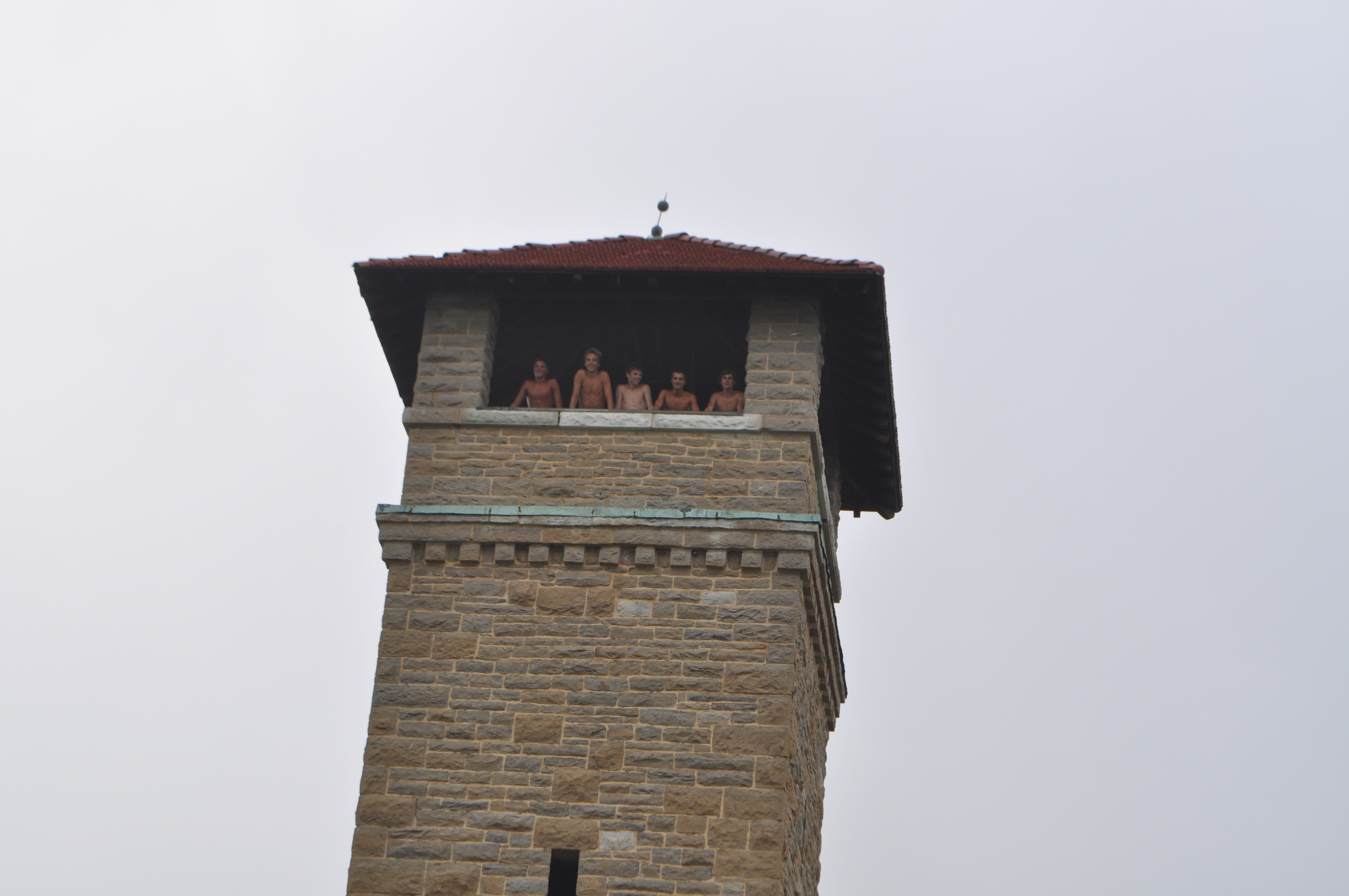
Yesterday morning I combined two of my favorite avocations – coaching distance running, and the Antietam Battlefield. I coach the boys and girls cross country teams at Williamsport High School. Currently, my boys team is among the best in Maryland. We were 2nd in the state last year and we only lost one runner to graduation.

The top boys call themselves “the D-crew” … which means “the distance crew.”  So I took five of them to Antietam to do some pre-season training. Locals sometimes run on the battlefield, and everyone around here knows how difficult that is. Though the northern part surrounding the cornfield is reasonably level, the south end of the field is extremely hilly.

The boys ran a total of 8.25 miles – charging up the hills like the 9th New York Hawkin’s Zouaves of Fairchild’s Brigade (although we’d never be caught dead wearing red – being a school of blue, black and white).

Marching Around Virginia in August 1862 – part 3

The following is from a draft of my long-planned and maybe never to be completed (??) book on Abner Doubleday. The text alternates between remarks from an obscure Doubleday journal and those of his adjutant George F. Noyes (who published a book in 1863 entitled “The Bivouac and the Battlefield”). After having his command stuck in Fredericksburg for many months, Doubleday’s men were now on the move at this time 150 years ago – taking them through Virginia to fight ultimately at Brawner’s Farm, Bull Run, South Mountain, and Antietam.

With the contending armies in a position to view one another across the Rappahannock River, and attempts at sustaining movements across the water exceedingly difficult, a significant artillery conflict ensued over a period of days. Doubleday’s Brigade acted in support of this action, which was the first live fire for most of his men. Noyes humorously wrote of this experience: “Our own infantry were at once ordered down to support the batteries, and be ready to oppose any attempt to force the passage of the river. As we moved across the plain, the shell bursting over our heads, and the shot screaming in our very ears, I cannot say that I enjoyed the situation. Now for the first time under fire, I had not become accustomed to the shrill whizzing music of the iron projectile. Had I been alone, I should probably have given my horse a chance to try his speed in the opposite direction; as it was, I had to ‘grin horridly a ghastly smile,’ and carry it bravely, as if charmed with these yelling messengers of war. I confess that I was not sorry when we reached the bluff, behind which we were comparatively safe, and could hear them shriek over us with entire equanimity.”

Observing this artillery dueling, Doubleday himself could not resist working personally with the big guns. On the 22nd, he wrote: “The cannonading was very lively, but the enemy not being able to force our men back, moved their batteries in the afternoon farther up the stream. My brigade was accordingly moved higher up and close to the bank of the river. There the artillery engagement was resumed. I personally took charge of the guns in my immediate front, and succeeded in demolishing one of the enemy’s limbers, and in doing other damage.”  Noyes was impressed by Doubleday’s interest in this duel and said, “Our general had not forgotten his military art, and occasionally lent his aid in sighting the guns or advising as to the length of fuse.”  A.P. Smith, of the 76th New York wrote extensively in regard to this incident: “General McDowell made his appearance about nine A.M., and ordered up fresh batteries, which being posted, General Doubleday, assisted by his gallant brother, Major Doubleday, took charge of two pieces, and did much damage to the enemy’s batteries on the opposite side of the river.” An officer of McDowell’s staff later rode up to find out who was manning the pieces doing such destruction, and when told it was General Doubleday, responded that such accounted for the close shooting. Smith wrote, “This spoken in the presence of the men, could not fail to fill them with admiration for their General . . .”  Smith continued his account with a paragraph of praise for Doubleday’s bravery, as an officer who was willing to risk personal exposure in a manner beyond his general observation of high ranking officers.

On this same day, Jeb Stuart was engaged in a cavalry raid behind Union lines, and captured Pope’s personal baggage, gaining much valuable information. Lee had this information in hand by the next day, the 23rd of August. He was now able to read reports Pope was sending to Halleck in Washington—detailing troop strength and locations. He also read of Fitz John Porter’s Fifth Corps having already arrived and in position opposite Lee’s right flank. Porter represented the first of McClellan’s troops arriving from the peninsula. Clearly, Lee needed to act. He was stalled against the Army of Virginia along the Rappahannock. There was no opportunity to flank Pope on the east, and efforts to flank him on the west had proven ineffective in recent days. There was a need for a bolder initiative. Lee determined to send Jackson on a wide flanking march through the Shenandoah, around the right flank of Pope’s army. Doubleday wrote in his journal of his admiration for Lee’s audacity in making this move: “Nothing could be more hazardous or opposed to military science than the proposed movement. To divide his army in two parts with Pope’s army between the wings was simply to run the risk of being beaten in detail. 

CREDIT: O’Sullivan, Timothy. “Fugitive African Americans Fording the Rappahannock River. Rappahannock, Virginia, August 1862.” Selected Civil War Photographs, 1861-1865, Library of Congress

Marching Around Virginia in August 1862 – part 2

The following is from a draft of my long-planned and maybe never to be completed (??) book on Abner Doubleday. The text alternates between remarks from an obscure Doubleday journal and those of his adjutant George F. Noyes (who published a book in 1863 entitled “The Bivouac and the Battlefield”). After having his command stuck in Fredericksburg for many months, Doubleday’s men were now on the move at this time 150 years ago – taking them through Virginia to fight ultimately at Brawner’s Farm, Bull Run, South Mountain, and Antietam.

Once Lee was certain of the withdrawal of McClellan from the James, he made hasty plans to move as many forces as possible to the area of Gordonsville. Clearly, the Federal strategy called for a gathering of forces under Pope, and speed of maneuver was the need of the hour for the Confederate cause. It was necessary to strike Pope before he could be reinforced by McClellan. Much of the redeployment of Lee’s forces from south of Richmond was accomplished by rail, and Lee himself made the move on August 15th.

General George Baynard

Lee rallied his army with preparations to launch an attack against Pope at the earliest advantageous moment, but a variety of circumstances were working against him. One misfortune involved his plans falling into the hands of the enemy. Doubleday wrote of this: Some of our cavalry capture Lee’s Adjutant General with important dispatches by which General Pope learns that Lee’s Army, set free by the retreat of McClellan, is to be slammed against us with a view to cut Pope off from Washington and Fredericksburg. In light of this intelligence, Pope decides to retreat to the north and establish a new line along the Rappahannock River, thereby being in a better defensive position closer to the route of McClellan’s reinforcements. Doubleday’s brigade was near the back of the line, and found the roads so clogged on the 18th that they were unable to move until the next morning. Noyes wrote of this delay: “The delay was inevitable, but slightly discouraging. Our general, with his usual cheerful nonchalance, thought only of the weary troops; some of his staff, however, could not help feeling very tired and considerably disgusted.” By dusk of the 19th, they had reached the Rappahannock and were among a small percentage encamped on the south side—leaving their horses saddled due to the proximity of the enemy. At dawn the next morning, they crossed the bridge and took a position north of the railroad and a short distance from the structure. We were scarcely over before the enemy’s cavalry, which had been constantly skirmishing with ours and which had had a severe engagement with Bayard at Brandy Station, now made a dash and attempted to capture the bridge.  A sharp cavalry battle immediately ensued with charges and counter charges, in which the Rebels were worsted.   

(Bayard is General George Dashiell Baynard – Union cavalryman and 1856 West Point grad. He would be killed in the Battle of Fredericksburg.)

Marching Around Virginia in August 1862 – part 1

The following is from a draft of my long-planned and maybe never to be completed (??) book on Abner Doubleday. The text alternates between remarks from an obscure Doubleday journal and those of his adjutant George F. Noyes (who published a book in 1863 entitled “The Bivouac and the Battlefield”). After having his command stuck in Fredericksburg for many months, Doubleday’s men were now on the move at this time 150 years ago – taking them through Virginia to fight ultimately at Brawner’s Farm, Bull Run, South Mountain, and Antietam.

Doubleday’s brigade was finally ordered to move west from Fredericksburg to reinforce Pope’s army. The movement commenced on the afternoon of August 9th, and Doubleday reported that his brigade, along with Patrick’s, marched a distance of nine miles, camping in the vicinity of Chancellorsville.  As our men were not accustomed to marching, they made but slow progress and did not reach camp until midnight. In the meantime, the battle of Cedar Mountain had taken place, both armies occupying the field. Prior to departure from Fredericksburg, Captain Noyes enjoyed a final dinner with Doubleday and the staff at an inn, saw to some details relative to the wagon train, and eventually rode forward to ride with Doubleday at the front of the column. He wrote, “It was a lovely night for marching, the troops moved on well, their arms glistening in the moonlight, and yet, so slow is the movement of an army, that it was nearly midnight before we reached our halting-place, nine miles distant from Fredericksburg.”

Doubleday and Noyes caught a few hours of sleep in a farmhouse before setting out the next day with an early start. The day would prove to be among the warmest of the season, placing a severe strain upon the men, with a great many stragglers being lost along the way. Crossing the Rapidan near sundown, the officers came upon the home of an impoverished farm family, who were frightened in the extreme by the appearance of the Yankee army. Noyes wrote: “To convince them that we were friends, not enemies; that not an article would be taken without their consent, and that ample reward should repay every accommodation, was our first duty; but even after the entente cordiale was established, I noticed with pain a young girl, the only interesting person on the premises, still trembling with apprehension. Taught by the leaders of the rebellion that the Northmen were wild beasts in ferocity, that all chivalry and gentlemanliness were monopolized by the Southern slave-trader, it was no wonder that this, her first experience, should thus have startled her.”

The night’s rest would be ended not long after it began. A messenger arrived from General McDowell with news of the battle of Cedar Mountain, and urging the column to leave heavy baggage behind and move forward rapidly.  At 1:00 a.m. the march was commenced again, and the brigades of Doubleday and Patrick soon reunited with those of Hatch and Gibbon (who had crossed the Rappahannock and come by a different route). On what Doubleday termed the hottest day of the season, his brigade covered 24 miles, and brought them a short distance beyond Culpepper and within three miles of the battlefield.  Noyes wrote of the march as covering 26 miles in a period of 22 hours, while also recording several deaths from the heat.  The men had marched with a full expectation of being imminently in battle. However, Jackson had retreated south in the direction of Gordonsville, and the engagement was not recommenced. Doubleday’s handwritten journal adds an extra note to that which is contained in his print journal from the National

U.S. Signal Corps on the Rapidan – from the National Archives

Archives. Both journals note Stonewall’s retreat across the Rapidan to await the arrival of Lee’s main army, but the handwritten version adds the editorial comment that Jackson acknowledged him beaten by retreating. This is an overstatement, as Jackson drove the Federals from the field, but the ground did not afford good opportunity to follow up the victory. As well, Jackson knew Pope was able to call upon a great many more reinforcements within the general region than Jackson could wisely contend with. Prudence, and the orders of Lee, called for maneuvering rather than head-on engagement. However, the fight at Cedar Mountain did stall Pope’s move southward and save the vital Central Virginia Railroad line of supply. These events also brought Doubleday’s Brigade to a connection with the Army of Virginia as the Second Brigade of King’s Division of McDowell’s 3rd Corps.

By this time, Lee was certain of the withdrawal of McClellan from the James, and made hasty plans to move as many forces as possible to the area of Gordonsville. Clearly, the Federal strategy called for a gathering of forces under Pope, and speed of maneuver was the need of the hour for the Confederate cause. It was necessary to strike Pope before he could be reinforced by McClellan. Much of the redeployment of Lee’s forces from south of Richmond was accomplished by rail, and Lee himself made the move on August 15th.

(I’ll continue this narrative in several posts in coming days and weeks … check back – especially for an extensive section on Brawner’s Farm – August 28th.)