Thanksgiving Season Miscellany

Lincoln’s Thanksgiving Proclamation

We are yet a year away from the 150 years since Lincoln called for a national day of thanksgiving. The proclamation itself was on the date of 10/3/1863 – calling for the final Thursday of November for the commemoration itself. I’ll be sure to write more about it next year (so y’all plan to come back then!).  But without going too political on you, and in accord with my sad evaluation of the condition of our country in these troublesome times, Lincoln’s words toward the end of God’s providential hand of blessing seem appropriately applied even to our time, as we too might “fervently implore the interposition of the Almighty Hand to heal the wounds of the nation and to restore it as soon as may be consistent with the Divine purposes to the full enjoyment of peace, harmony, tranquility and Union.”  The more things change, the more they stay the same.

Thankful for a year of blogging about Antietam and the Civil War

Well, almost a year … and this is post 149 … and it is great fun! I’ll simply interject here again a simple word about my purposes in doing this. It is primarily a blog of posts that I trust would be of interest to those with a general understanding the Civil War, as well as others with a more advanced knowledge. Though I write at times with a rather scholarly approach, and though my natural proclivities would be toward most enjoying that, my target audience is populist – targeted especially toward those who have been, or are considering being guests of the Antietam Battlefield Guides.

McClellan – the pitcher

Every so often my varied worlds of life and writing cross each other. I regularly feed 3-4 different blogs with words. One of them is a Baltimore Orioles baseball blog on a sports network (www.birdswatcher.com).  And in my reading disciplines for staying abreast of all news related to the Birds, I came across this headline today: “Orioles show no interest in McClellan.”

Kyle McClellan is a free agent pitcher for the St. Louis Cardinals, and is one in whom the Orioles had some interest in obtaining a year ago. But he has had some health issues over the past two seasons and is therefore deemed to be uncertain as to what quality of performance would be gotten from him in a deal. It would be a risk to give the ball to McClellan … hmm … the more things change, the more they stay the same.

Sesquicentennial Series

Those who read my blog in any regular fashion know that I particularly enjoy writing items on the exact 150th date of the given topic. Right now, there is not much to write about. Most of the people whose journals and histories I read have little to say about this current time. The eastern theatre armies are on the move toward Fredericksburg and there is little to write about.

General Geary Letter

And speaking of McClellan, I’ll include one simple item – a letter from the political general John White Geary to his wife, dated 11/11/1862.  “These are times of changes. You see our commanders are changed almost with the breeze. For my own part I am quite quiescent and easy. I think Burnside a first rate man & I think there is no doubt he will be much more active than his predecessor. If so, it is a God-send to the country. ‘Nuff sed.’”   …. The more things change, the more they stay the same.
Seddon Named CSA Secretary of War

150 Years Ago Today …

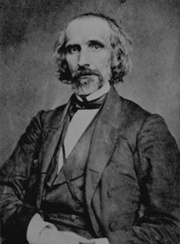
On this date of 11/21/1862, James A. Seddon was named as the CSA Secretary of War. He was the fourth to hold this position, and he would prove to be the longest – maintaining it until January of 1865. The successful length of his tenure accrued from his ability to work well with Jefferson Davis – also managing the criticisms and complaints of generals and others who were opposed to the Confederate President.

Born in Virginia and becoming a University of Virginia trained lawyer, he was also a Democratic congressman who supported secession.

In a move not entirely dissimilar to the apparent suppression of information relative to the current Benghazi affair, Seddon ordered that “bread riots” in Richmond not be reported in the press – as he did not want the demoralization of the country if the nature and scope of the uprising were to be made widely known. Nor did he want to fuel northern propaganda. But word leaked out to the North, some of it carried by freed prisoners who saw the April 1863 riots from their prison windows.

Some of the brunt of criticism regarding the deplorable conditions of Union prisoners fell at Seddon’s feet. He was thus imprisoned for a brief time immediately after the War. He then retired to his Richmond area home where he died in 1880 at the age of 65.

Antietam Guides Annual Dinner

This evening, the Antietam Battlefield Guides, Western Maryland Interpretive Association, National Park associates, and varied friends gathered at the South Mountain Inn for our annual dinner.

The Inn – known as the Mountain House during the Civil War – is located on the National Turnpike where it traverses South Mountain at Turner’s Gap just above Boonsboro, MD. (You can link to the history of the Inn HERE.) This is one of the gaps where the Confederates sought to hold off the advance of the Union Army on Sunday, September 14th of 1862 – just three days before the Battle of Antietam. The Rebels were successful in holding the gap until darkness fell, but then retreated to the west through Boonsboro and ultimately over the Antietam Creek to the Sharpsburg Ridge.

In this blog I often include unpublished journal remarks of Abner Doubleday. He was a brigade commander under General Hooker during the Battle of South Mountain – fighting on the right of the Union line. This would position him to the north of the National Pike – ultimately at a higher mountain location from which a road would descend and empty onto the Pike at the location of the Mountain House.

Doubleday wrote in his journal entry as he began his September 15 remarks: In the morning I assembled the division and went down to report to General Hooker. He was seated with Sumner on the porch of the tavern in the gap. Sumner told Hooker if he did not hurry up he would be ahead of him in the pursuit of the enemy. General McClellan was not aware that the enemy had gone until some time after daylight. I reported to Hooker the victory we had gained on the right of the road, and he was much pleased.”

It was too cold for us to meet on that porch this evening, but we did gather in the upper room of the old Inn – which is also located at the very spot where the Appalachian Trail crosses the Pike. This is the spot where tomorrow morning the most famous of ultra-marathons – the JFK 50 – will turn onto the Trail for a 16-mile segment taking the participants to the Potomac River near Harpers Ferry.

Park Superintendent Susan Trail spoke to the group, reflecting particularly on the recent 150th commemoration. She called it “the four most amazing days of my career.”  Today also marked her first anniversary at Antietam.

The Guides organization also recognized the three new guides who have joined the organization this year – having passed the grueling qualification process.

An award was given for the first time – the O.T. Reilly Award – which was given to John Schildt. Those familiar with the literature written on the Battle of Antietam know that quite a number of books have been penned by John. He has made a lifetime study of the battle, the battlefield, the participants, and the local population of the time. It is certainly appropriate that John would receive this upon his 50+ years of giving tours to varied groups. O.T. Reilly (1857-1944) was a lifelong Sharpsburg resident who began giving tours at age 15. He would often give up to seven tours a day! He personally met literally hundreds of the veterans, and O.T. was truly the first tour guide of Antietam.

The Guides have given about 800 tours this year.

McClellan Dismissal Reactions – part 3

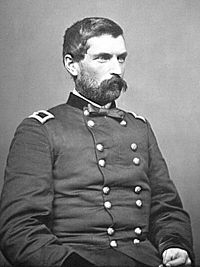
Here in this final of three consecutive posts on reactions within the Army of the Potomac on the dismissal of General McClellan, I quote the most gracious of the excerpts. This text is of John Gibbon writing his evaluation of the situation. Gibbon was a strong McClellan advocate, evident clearly from these words from his book Personal Recollections of the Civil War (pp. 96-99).

John Gibbon

Gibbon begins his writing on this subject by inserting a letter that he wrote on the 9th of November 1862…

Yesterday the army was thunderstruck by the news that Gen. McClellan had really been relieved from the command of the army and Burnside appointed in his place. There is but one opinion upon this subject among the troops and that is the Government has gone mad. It is the worst possible thing that could have been done and will be worth to the south as much as a victory. Everyone feels gloomy and sad that a man who has done so much for his country, should be treated in this manner. He takes it as coolly as possible, says it will all come right in the end, begs all his friends to give Burnside the same support that they would give him, and will remain here long enough to give Burnside all the information he has.

Next, Gibbon continues with his writing for his Recollections book …

It would be impossible to give anything like an adequate description of the impression made on the army by this order. I think it took the army completely by surprise and that the term made use of in my letter <thunderstruck> was not too strong a one. Some few might have anticipated the possibility of such a thing, but I doubt if any did just at that particular time.  …

As for the private soldiers, they, without knowing all these details of the military situation, looked upon McClellan’s relief as simply a separation from a commander they liked and had confidence in. Before leaving Warrenton, McClellan was induced after much persuasion as I learned later to ride round through the camps in the vicinity to bid good-bye to the troops. It was an impressive sight, a painful and in some respects an alarming scene. As he rode along in front of the paraded troops, the men burst out into tumultuous cheers which were kept up as long as he was in sight … one general officer had called to him as he rode past his command, “Lead us to Washington, General, We will follow you there.”  …  I saw noting of this kind, myself …

Gibbon, in this section of his book, quotes from his next letter at the time, describing McClellan taking his leave …

The dissatisfaction is almost universal and I am afraid it will have a bad effect on the fighting qualities of our men. There is no doubt about the fact that they fight better under him than they do under anybody else. Burnside feels as badly as any of us and would much rather serve under McClellan than be in command of the army himself. Although smarting under the wrong done him, McClellan acts coolly and nobly through it all, giving Burnside all the information possible and begging all his friends to aid him to the uttermost of their power. Yet many seem to think now that McClellan is out of the way, we are going to Richmond on the wings of the wind. ‘We shall see.’

Returning to his Recollections writing some years later, Gibbon pens …

The last three words as they lie underscored in the letter before me now look like a prophecy fulfilled. Of course, there were many in the army who took a less gloomy view of the condition of affairs tan I did as there were many who did not have the same kind of confidence in McClellan or look on his relief as such a calamity. With these the “On to Richmond” spirit now began to develop itself. But the “brakes” had already been applied to our “swiftly moving train” and the few days delay required to transfer the command brought the army to a full stop whilst the “legs” of Lee’s forces were rapidly concentrating his army in front of us.

It is a significant fact, noted at the time, that the same train which carried McClellan from Warrenton, bore also Gen. Fitz-John Porter, relieved by orders, from the command of the 5th Corps. His trial, conviction and dismissal soon followed.

This except and Gibbon’s evaluation of the situation remind me much of the nature of the political divides of our day … amazing in the nature as to how two sides are able to look at the same set of circumstances and draw entirely different but equally pretty and persuasive statements upon the visible facts. Such divergent views are I suppose what makes life, and history, interesting and compelling.


McClellan Dismissal Reactions – part 2

This is the second of three consecutive posts on reactions within the Army of the Potomac on the dismissal of General McClellan. These are taken from some of the original sources that I like referencing, as they are enjoyable to read and oft quick and willing to render opinions and evaluations of events around them.

The first of two that I’ll share today in this post is from Our campaigns; or, The marches, bivouacs, battles, incidents of camp life and history of our regiment during its three years term of service. Together with a sketch of the Army of the Potomac by E. M. Woodward, adjutant, Second PA Reserves.  This unit fought at Antietam in the extreme southern-most point of the East Woods at dawn of day. This is just northwest of where the Mumma Lane connects to the Smoketown Road. These troops engaged the 21st Georgia in front of them, crawling on their bellies in the woodlot. Woodward wrote:

With the exception of a violent snow-storm, nothing of note occurred while we laid at this camp, until the morning of the 10th, when we were called out to bid farewell to General McClellan, the then love and idol of the Army of the Potomac, who had been relieved of his command, and superseded by General Burnside.

His departure from the army was a scene never to be for gotten; the deafening shouts of the columns he had so often led to honor; the caps tossed high in the air; the tears, those true tests of affection, stealing their courses down the weather-beaten cheeks of the veterans of the Peninsula, truly told the deep hold he had upon the hearts of the men. The officers of some of the regiments sent in their resignations in a body, but their generals returned them, with a gentle admonition.

General Fitz John Porter soon after was relieved of his command and was subsequently dishonorably dismissed the service, by sentence of a court-martial, for his conduct at Bull Run, and forever prohibited from occupying any position of honor or trust under the Government, but we are not aware of there being any particular amount of “weeping and wailing and gnashing of teeth” at the event.

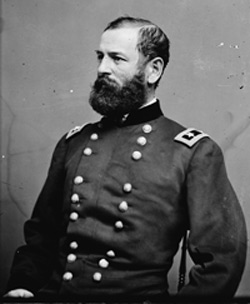
Fitz-John Porter

Haha… that last statement is the sort that keeps me interested in these original writers and their opinions. I’ll sometime in the future post about the enigmatic Fitz-John Porter and the little village of Porterstown – on the east side of the Antietam, named after him and where his forces camped. I went there the other day to take a picture of it, but am not sure what there really is to take a picture. There is really only one house old enough to have likely been original to the time, so run-down places surrounded by junk, and a nearby housing development.

A second excerpt to be shared today comes from the History of the 76th Regiment New York Volunteers by A.P. Smith (pp. 184-185) … These troops were originally under Doubleday’s command in his brigade prior to his promotion to divisional command after South Mountain. The words here of Smith are quite measured and out of an obvious effort to be balanced and respectful.

A.P. Smith – 76th NY

At Warrenton, General McClellan was relieved of his command of the army. The parting scene was truly affecting. General McClellan was a kind-hearted man, and as such, endeared himself to the men; and now, as he rode along the lines, the demonstrations of the men must have in some measure, quieted his sensitive mind, naturally annoyed as being dismissed at such a time as this. He who has the hardihood to declare that General McClellan had no good traits of character, even for a general, does himself injustice. No general ever exhibited a better faculty for winning the confidence and esteem of his men; none ever took better care of his troops; few excelled him in organizing an army; but still, the fact was patent that he was an unsuccessful general on the march and in the field. Those unacquainted with military science may not be able to point out accurately the defects in his military character; but there certainly was wanting the necessary element, success. A general may be an excellent draughtsman, and make splendid maps of intended operations; he may be skilled in engineering, and detect in a moment the salient points in a given fortification; he may understand perfectly the science of approaches by parallels; but if he fails when he takes the field; if he tires the people by his dilatory marches, and fails to reap the results of repeated victories, the people will consider him and history will write him, a failure! With all his good qualities, the halting at Yorktown; the failure at Richmond; the failure to give support to Pope, and the neglect to gather the fruits which the heroism of our gallant soldiery placed in his power at South Mountain and Antietam, must ever arise to accuse General McClellan.

These are the sorts of quotes from the contemporaries of McClellan that cause me to have great difficulty in turning from the traditional and historic evaluation of the man, and to now join the movement to grant him a more gracious and generous reconsideration. I believe McClellan’s assets and liabilities are fairly well laid out in these remarks of this historian of the 76th New York.

McClellan Dismissal Reactions – part 1

This is the first of three consecutive posts on reactions within the Army of the Potomac on the dismissal of General McClellan. These are taken from some of the original sources that I enjoy referencing, as they are enjoyable to read and oft quick and willing to render opinions and evaluations of events around them.

Rufus Dawes

The first of three that I’ll share in this post is from Service with the 6th Wisconsin by Rufus Dawes. This great-grandson of the William Dawes of fame associated with Paul Revere, and father of a future Vice President (under Coolidge), would write this book in 1890. A Republican Congressman from Ohio, he fought as a major at Antietam in the famed Iron Brigade – writing colorfully of his experiences in the cornfield and along the Hagerstown Pike.

While we were in this camp, on November 7th, 1862, General George B. McClellan was relieved from the command of the Army of the Potomac by President Lincoln, and General Ambrose B. Burnside appointed to that ill-starred responsibility. There was considerable expression of feeling. No acts of insubordination occurred. There was talk of resignation by officers, but in our brigade, the sturdy faithfulness of Colonel Lysander Cutler, then commanding, and his known determination of character, had an excellent restraining influence. He declared that he would recommend for dismissal, for tendering a resignation in the presence of the enemy, any officer who offered to resign for such a reason. There were no resignations sent to his headquarters.

This second excerpt is from the “History of the Twenty-ninth Regiment of Massachusetts Volunteer Infantry : in the Late War of the Rebellion” by William H. Osborne (p. 201).

This regiment of old-line blue-blood aristocrats with some heritage even to the Mayflower were brigaded curiously with three New York Irish regiments as the famed Irish Brigade at Antietam. In spite of their glaring ethnic and cultural differences, they fought well together – though their time in the same brigade was to be short-lived. This historian in 1877 wrote:

The 7th of November also witnessed a change in the command of the Army of the Potomac, though this was not known to the troops until the 9th, when the fact was promulgated by general order. At this time the Army was massed in and near Warrenton; and here the farewell address of General McClellan, and the order of General Burnside, announcing his assumption of the command of the army, were read to each regiment.

Actually, this following paragraph preceded the one above, and demonstrates probably the greater feelings of sadness by the men on this date:

On this day, the news of the death of Major General Israel Richardson, who formerly commanded the division, reached the regiment. General Richardson died at the house of Mr. Pry, near the battlefield of Antietam, from the effects of the wound received in that battle, and his death cast a deep shadow of gloom over the entire army, and particularly over the Second Corps, in which he had long served, and in connection with which he had won a most enviable reputation as a brave and skillful soldier. The loss of such an officer as General Richardson was an event which might well have called forth a more universal expression of sorrow.

George Noyes only covers this dismissal in a sentence in The Bivouac and the Battlefield, which is curious given his strong feelings that I would have expected to make him critical of McClellan. But Noyes, whose duties involved supply, clearly he had bigger problems of his own to deal with at the moment …

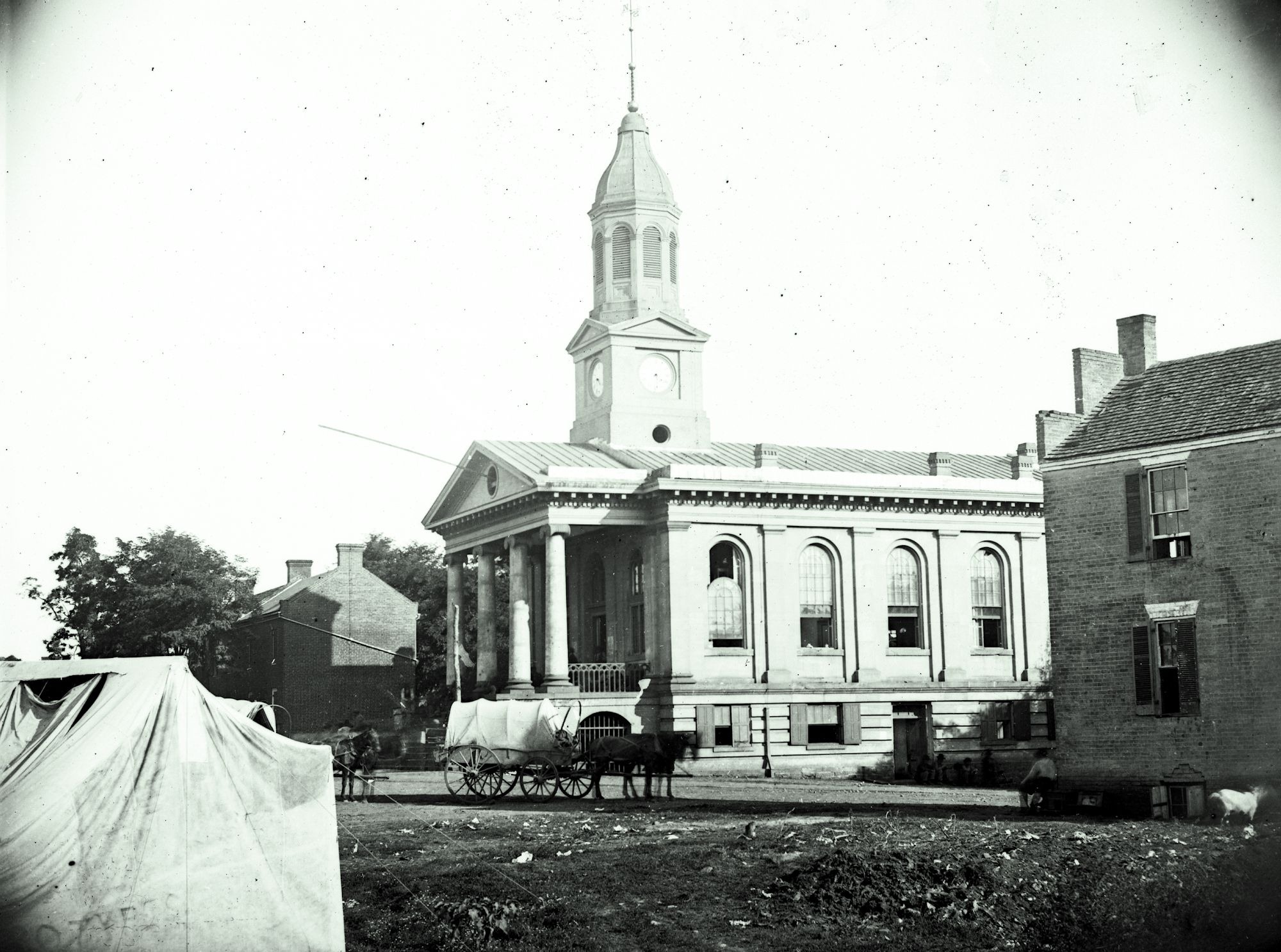
Courthouse in Warrenton, VA 1862

We remained in Warrenton four days, during which period General McClellan was relieved by General Burnside. Our staff tents were pitched around the school-house, which was still used as a mess-room; the weather was cold, and quite a heavy snow-storm gave notice of approaching winter. The first two days were to me full of anxiety, as there was no subsistence depot at Warrenton; the railway connection was not completed, and no one seemed to know positively where or when supplies could be obtained. I have before expressed my opinion as to the admirable organization and management of the commissary department; but when the railways are broken up, and other transportation is limited, it is a Herculean task to feed a large army. Some military authority has said, with laconic point, “An army moves on its belly;” and it was clear that unless food was procured our division would have to pause. And most of the other divisions were similarly situated. In the midst of a driving storm, I sent off a subordinate with a wagon-train a mile long, and with a sort of roving commission among the stations where supplies might be reasonably expected. Great was my relief when, late at night, after being two days out, he reported the train coming in with rations for our eight thousand men for nearly a week.

McClellan Dismissed from the Army of the Potomac – 150 Years Ago Today

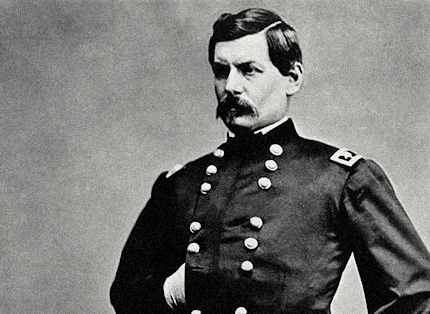
On this date of November 7, 1862, General George B. McClellan was officially removed as commander of the Army of the Potomac. The extensive reservoir of patience of President Lincoln had at last drained to the last dregs. The end had come.

Though Lincoln was gratified that at long last the Army was on the move and had crossed into Virginia, he was not encouraged by the slow movement of it, along with the ability of Lee to move more quickly and interpose his force between McClellan and Richmond.  Lincoln’s fear that such would happen was completely prescient, and it therefore became the final straw.

It had taken the Army of the Potomac six days to cross the river – an action that Lee had accomplished overnight on the evening of September 18-19. It then took another six days to travel 40 miles to the area of Warrenton, VA.

What was a reasonable expectation?  Historians have fought about that ever since. Even at the time, it was seen from varied perspectives. Interestingly, even McClellan himself spoke of it as slow. On November 6th, the General wrote to his wife Nellie, “The army still advances, but the machine is so huge and complicated that it is slow in its motions.”  On the other hand, speaking of the same movement of the same time over the same terrain, John Gibbon wrote (of the effects of McClellan’s removal), “But the “brakes” had already been applied to our “swiftly moving train” and the few days delay required to transfer the command brought the army to a full stop whilst the “legs” of Lee’s forces were rapidly concentrating his army in front of us.

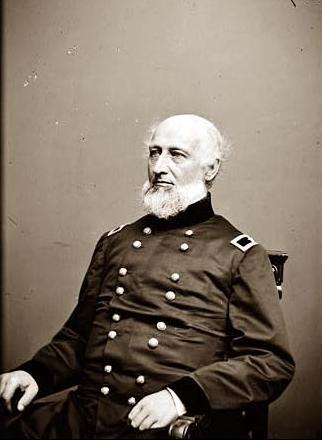
Lincoln had decided to give the command to Ambrose Burnside, whether he wanted it or not – and of course, he did not, having previously demurred twice. Burnside doubted his ability for such high command, and he was not desirous of seeing this removal happen to a dear friend. But he was told by the special courier Brigadier General Catharinus P. Buckingham (a classmate at the Point with Robert E. Lee), that McClellan was a goner – that if Burnside did not take the command, it would be granted rather to Joseph Hooker. There was no way that Burnside wanted such to eventuate, so he reluctantly agreed and accompanied Buckingham to deliver the orders to McClellan.

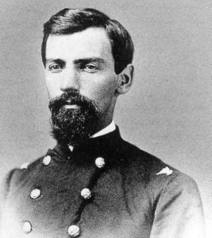
Catharinus Buckingham

The Little Napolean amazingly took the news well in stride. His written word to the Army to announce the occasion in a special order is a beautiful piece of writing: “In parting from you, I cannot express the love and gratitude I bear to you. As an army, you have grown up under my care. In you I have never found doubt or coldness. The battles you have fought under my command will proudly live in our nation’s history. The glory you have achieved, our mutual perils and fatigues, the graves of our comrades fallen in battle and by disease, the broken forms of those whom wounds and sickness have disabled—the strongest association which can exist among men—unite us still by an indissoluble tie.”

The good soldier in McClellan caused him to depart in the most gracious fashion imaginable. Reactions of various contemporaries to this departure will be the theme of three postings in this blog over the next three days.

Sleeping on a Grave – Follow-up

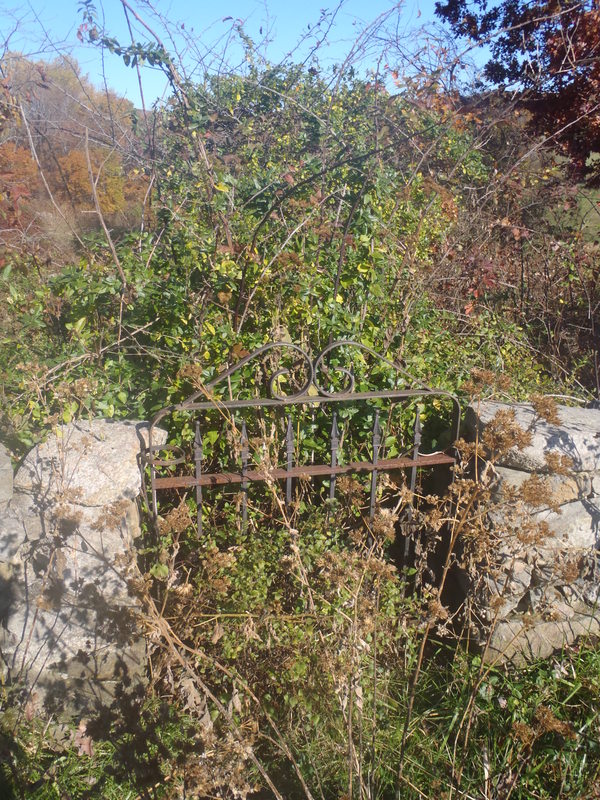
This is an additional follow-up to the material shared yesterday about the account of Frederick Hitchcock of the 132nd PA – who wrote of spending the night (11/5/1862) inside a walled graveyard, and of sleeping himself in the depression of a buried member of a Virginia family. I went researching to find a possible location of which he might be speaking, and was drawn to a probable location of an Armistead Cemetery near Upperville, VA. My posting yesterday finished with a picture of the gate of this cemetery – located in a remote location.

The picture contained an email address of the woman who visited this location, so I wrote her a note, sharing with her also the blog entry. Her information sent back would, I believe, tend to lend support for this spot as the very place of which Hitchcock wrote.

The email returned from Jennifer Whiteree was really very fascinating. She visited this cemetery over a year ago after struggling quite a bit to even find its exact location. It is literally in a remote location in a cattle pasture. Her only access was “to scramble over part of the wall on the back side and drop down into the inside.  The blackberry bushes are thick and there are many trees that are growing up out of it.”

Regarding the location in terms of a place where a Civil War headquarters camp might be established … “the cemetery is up on a hill overlooking a small stream valley with a single tree as a sentinel.  On one hand, it would have made for an excellent outpost to see down the valley.  On the other hand, the knob certainly would leave one exposed to the winds.” That sure squares with Hitchcock’s account!

Jennifer also wrote “Considering the historical nature of those buried there, it is tragic how badly overgrown the cemetery is.”  Among those she referenced and of whom she took a picture of a fallen gravestone was a Col. Walker Keith Armistead. This is the father of the Confederate Brigadier-General Lewis Addison Armistead – mortally wounded of course in Pickett’s Charge at Gettysburg. Walker Armistead – who served in the War of 1812 along with four of his brothers – was appointed in 1801 by Thomas Jefferson to the new military academy, and he was the 3rd graduate of the institution. His brother George Armistead commanded Fort McHenry during the Battle of Baltimore in the War of 1812. Walker served a long Army career in engineering, and was the commander of the United States troops that opposed the Seminole Indians in Florida in 1840-41.  He died in Upperville, Virginia, October 13, 1845.

Sleeping on a Grave – 150 Years Ago Today

I find no greater joy in Civil War research than to read the remarks of those who were there – to follow their journals and memoirs. So many of these works are extraordinarily well-written, and they often are even humorous.

So I am going to share more of these excerpts in this Enfilading Lines blog over the years to come – especially as it relates to Antietam, and for the next 2.5 years also as it relates to the 150th anniversary timeline of events.

So here is an excerpt from the writing of Frederick Hitchcock, taken from his book “War from the Inside.” Hitchcock was a part of the 132nd PA – a regiment that had their baptism of fire during the attack upon the Bloody Lane at Antietam. The Scranton native writes about the severe weather of this date in 1862. Quite a number of the other regimental histories that I read also mention this day as a particularly uncomfortable one. The Army of the Potomac has now been more than a week in Virginia, is moving toward Warrenton, and eventually toward the next big conflict at Fredericksburg in December.

November 5 found us near Upperville, where we bivouacked alongside and old graveyard, our headquarters being established inside the enclosure, to get the protection of its stone wall from the cold wind that was blowing. The temperature had fallen during the past twenty-four hours, so that is was now decidedly chilly—good for marching, but cold in bivouac. My notes say that I was chilled through until my teeth chattered; that I slept in the hollow made by a sunken grave to get warm; that my dreams were not disturbed by any unsubstantial hobgoblins of the defunct member of an F.F.V. whose remains might have been resting below me. The letters F.F.V. meant much in those war days. They stood for “First Family of Virginia,” an expression much in use by her slave-proud aristocracy, and, of course, much satirized by us of the North.

Hitchcock, in referring to his notes, was doing this about 40 years after the event when he wrote his book of reminiscences – obviously referencing written materials from the time of the War.

By speaking of a “First Family of Virginia” – this meant that they were of the upper class, not that they were necessarily first in sequence of settlers. Perhaps I could illustrate with a theological reference here (after all, I am a pastor, and my doctorate is in the area of theology, not history). It says in Colossians 1:15 about Christ that, “The Son is the image of the invisible God, the firstborn over all creation.”  This does not mean that Jesus was created, for he existed eternally with the Father; rather it means that he is preeminent over all creation – first in rank and authority, not it sequence. So also with the Virginians – they were those families of wealth and influence. Among those listed as F.F.V. is the family named “Armistead,” and I note that there is an Armistead Family Cemetery near Upperville, VA. Perhaps that is the grave Hitchcock was sleeping upon! And perhaps the cemetery gate and wall here pictured is the one! I found this picture of this Armistead Cemetery online with the caption:  “Gate to the cemetery. Entire cemetery is overgrown as of November, 2011.” … by Jen Whiteree

The Swift Flowing Stream – The Antietam

When I talk with guests and host them for a tour of the Antietam Battlefield, at some point in the introductory session I usually mention that the word “Antietam” in Indian talk (Algonquian) is thought to mean “swift-flowing stream” or “fast-moving water.”  And then I usually say something like, “So when you see the Antietam, I think you’ll agree with me that the Indians were easily impressed with moving water!”

Indeed, the Antietam is most often a very placid and slow-moving stream – particularly around the Burnside Bridge. From the Georgian Overlook position on the west bank, it is easy to see how shallow is the water. Often there are leaves floating very slowly on the surface of this most beautiful of picturesque Civil War locations.

Flooding from Hurricane Sandy – 10/30/12

However, on those occasions when a hurricane blows through the area, the stream can indeed live up to its name. And yesterday was one of those days.

I drove over to the area of the Antietam to attempt to see what it looked like and maybe even take a few pictures. I was honestly not surprised to see that the road to the southern portion of the battlefield was blocked off – as I knew that the Park was closed for the day. But here is a picture of the Burnside Bridge that I have taken from the Antietam National Battlefield Facebook page (you should become a “fan” if you are not already, as lots of great information gets posted there … and “like” Antietam Battlefield Guides while you’re at it!).

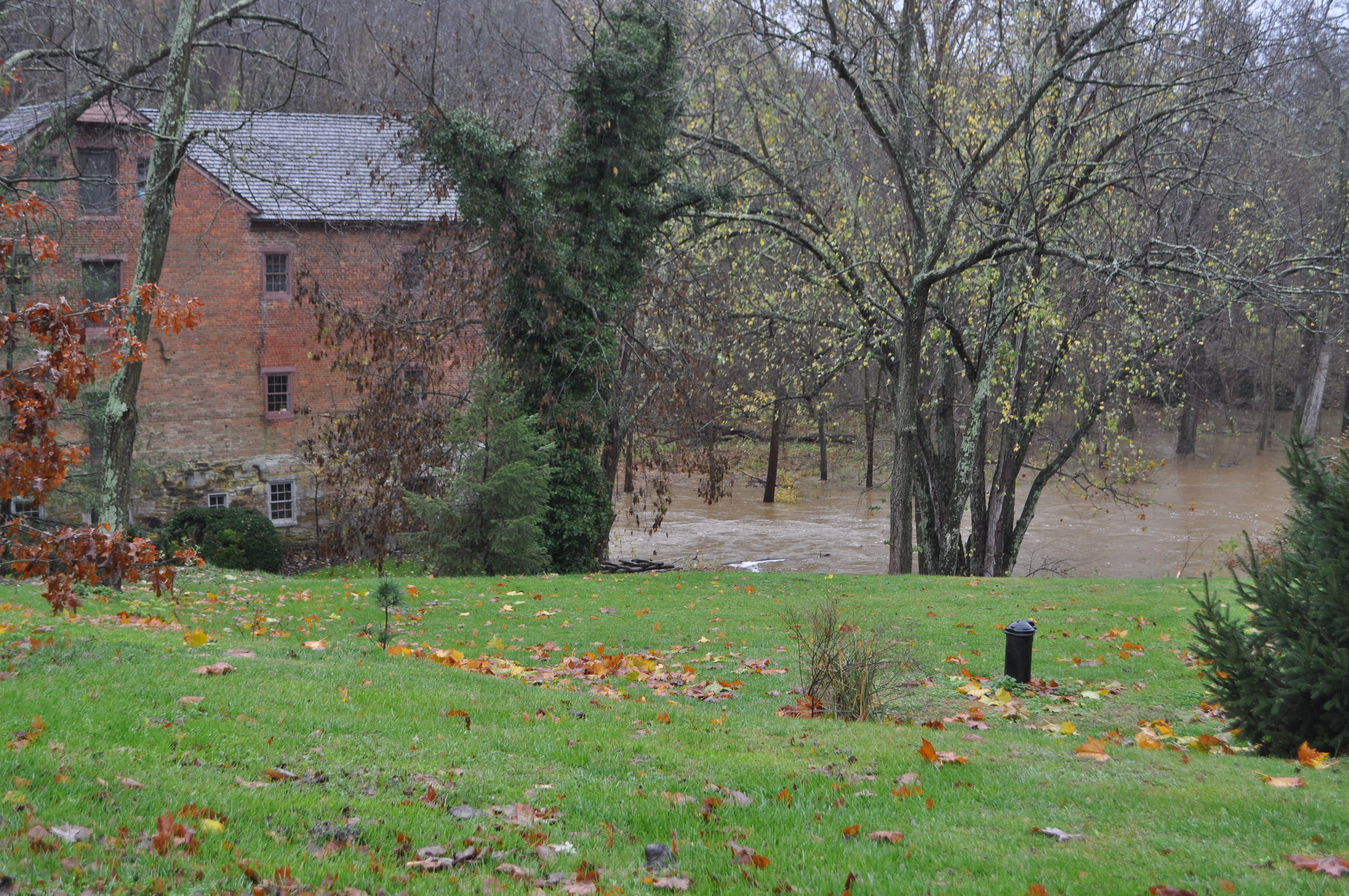
Flooding of the “Little Antietam” behind the Pry Mill – just before the stream empties into the primary Antietam

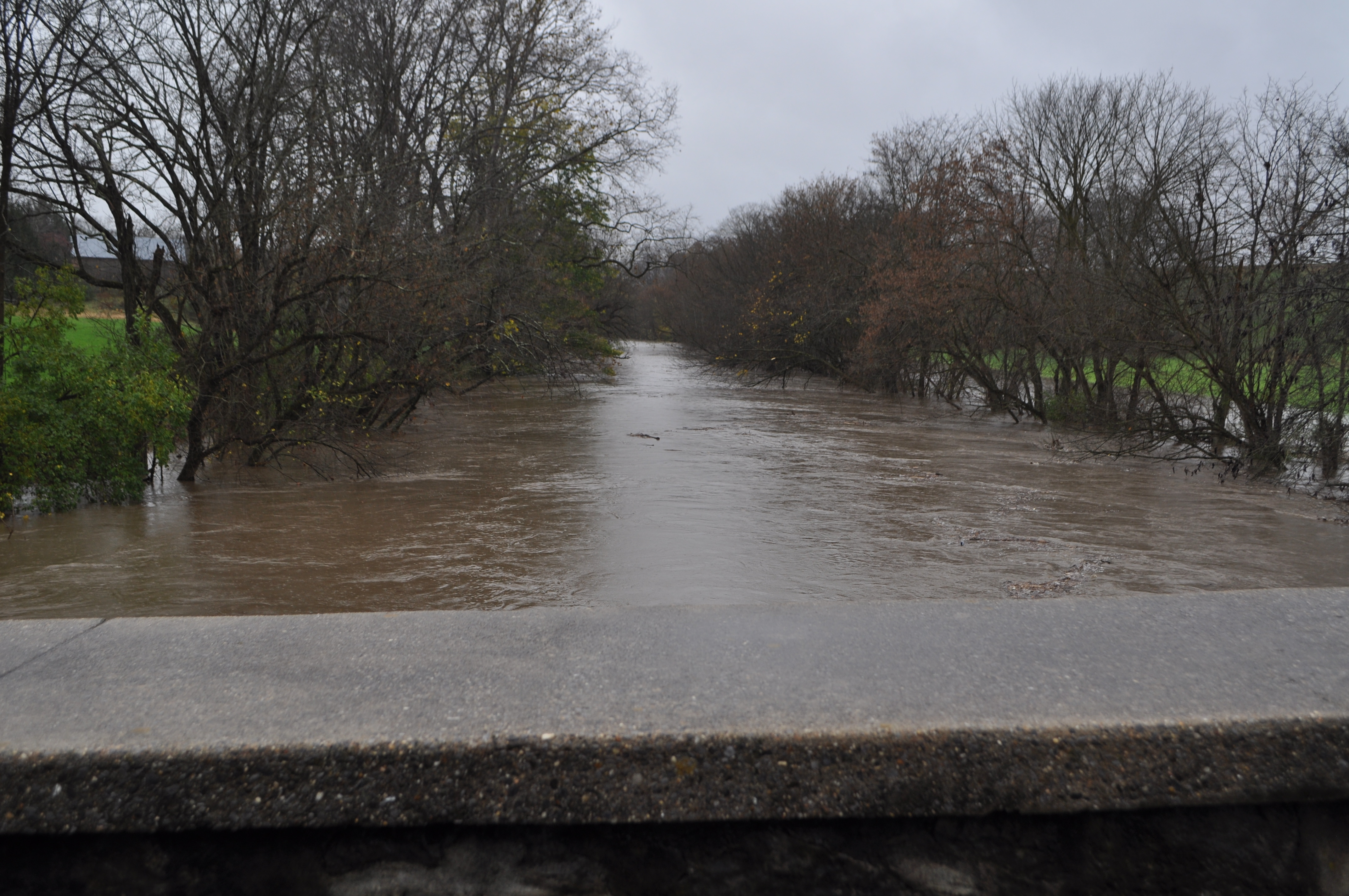
I next drove toward Keedysville and then took the back road past the Pry Mill and over the Upper Bridge (both pictured). The sight was impressive. More and more, when time permits at all, I take people on this route to begin a tour and to share with them a more wide-ranging view of the area. This enables me to share with a guest the following sights not commonly seen on a typical tour: The Newcomer house and farm, the location of the Middle Bridge, the staging areas of the east side of the Antietam, the Pry House, the town of Keedysville, the route of the 1st and 12th Union Corps, the Pry Hospital, the Cost Hospital, the Upper Bridge, and the valley of farms approaching the battlefield described in Noyes’ account of September 17, 1862 (about arms and legs piled high outside the barn doors).

Though we had some power outages and flooding and a few trees down, compared to New Jersey and New York, we are thankful to have escaped with relatively little damage.

The Upper Bridge as seen from the east side

The Antietam – looking south from the Upper Bridge