150 Years Ago Today – The Capture of New Orleans

The Southern city of New Orleans was defended downstream by two forts – Fort Jackson and Fort St. Philip. For several weeks, U.S. Navy Flag Officer David Farragut and his Union fleet had been near these forts, spending days of bombardment with mortar shells. During this siege, crews cut through heavy chains strung across the river, granting access (on the 24th) for a fleet of 13 ships that successfully bypass and run the gauntlet of fire from the forts. The garrisons of these forts eventually surrendered on the 28th – being cut off and essentially behind lines.

Upriver, the city of New Orleans is forced to surrender on today’s date 150 years ago. The city is rather defenseless, with only 3,000 militia troops armed with a mishmash of weapons. The ring of defenses anticipated a land attack rather than an assault from the river. With the levee system, the ships of Farragut were actually at a level higher than the city.

The people and the authorities were defiant, refusing to surrender to Captain Bailey of the USS Cayuga. Farragut could have destroyed the city at that point, but chose rather to assault positions upstream. And on the 29th, Marines secured the capture of New Orleans.

This was not the end of defiance, as I’ll write again in a few days on the nature of the occupation of the city.

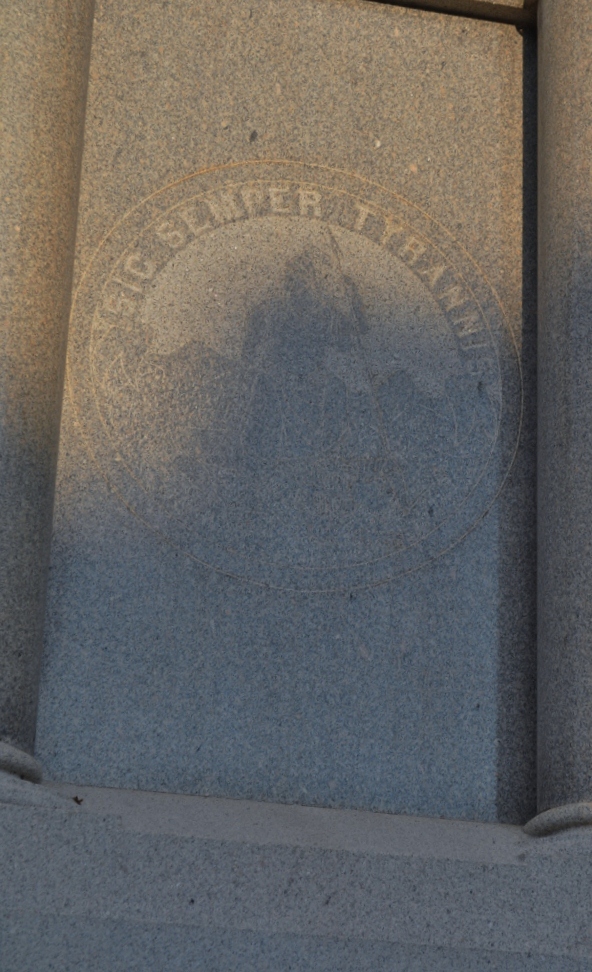
Sic Semper Tyrannis

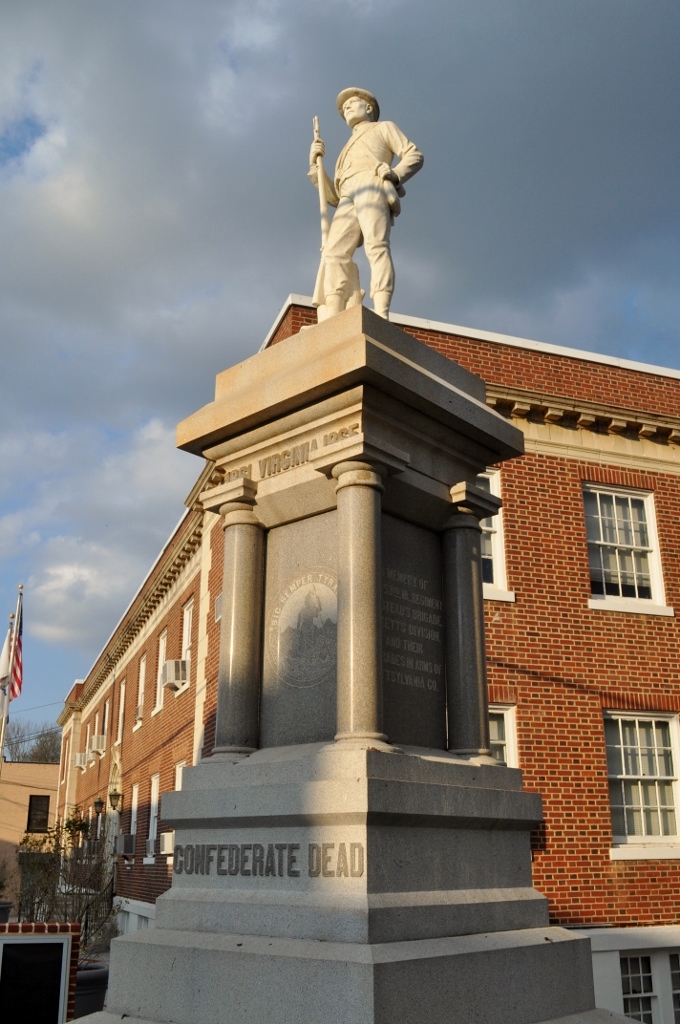
Sic Semper Tyrannis

I am sure that as I write my way through this blog upon Civil War themes, some who read it are going to think from time to time, “You’re just learning that now?”  Ah … yep … I’m probably late to the table on a lot of things!  I’m just a good old boy here – learnin’ a wee bit and writin’ it down as I go.

On a recent trip through Virginia, while driving north on Route 29, I saw a sign about visiting historic downtown Chatham. So … hooked me! (I’m a pretty simple guy!)  I exited the highway and drove into town to see what was historic about it. A town web site says: “Chatham was established as a town in 1777 during the turbulent years of the American Revolution. Chatham has been affectionately called the ‘Prettiest Little Town in Southside Virginia.’ It has also been called the hub of American architecture by some, as she boasts a fine representation of pre-Revolution, Federal, Victorian, and post-Victorian architecture.”

Among items I saw was the impressive Hargrove Military Academy for boys – dating back to 1909. And I’ll have another post in July on the home of Lt. Col. Rawley W. Martin, who led the 53rd Virginia on Pickett’s Charge at Gettysburg.

In the downtown I stopped to view a Civil War monument to these Confederate soldiers of Pittsylvania County. On the side of the monument was a seal with the statement “sic semper tyrannis.”  I associate those words immediately with the utterance of John Wilkes Booth – upon the assassination of President Lincoln as he hit the stage and broke his leg. What I did not know (that likely lots of you scholars out there know – remember, I’m from New Jersey) is that this is the motto of the state of Virginia.

The Latin phase most often is translated as “thus always to tyrants,” though it has at times been wrongly construed to mean “down with the tyrant.”  (This is why it sort of caught my eye in Virginia – almost like a post-war statement about the lingering view of the “late unpleasantness” of that “war of northern aggression” … when all it really is about is the state motto.)

The phrase is also attributed to Marcus Brutus in connection with the assassination of Julius Caesar on March 15, 44 BC.

(Odd things at no extra charge: The saying is also the motto of the city of Allentown – where my wife grew up …. And Timothy McVeigh was wearing a T-shirt with a picture of Lincoln and these Latin words on it when arrested on the day of the Oklahoma City bombing.)

1861 Arrival in NY of the Sumter Defenders

151 Years Ago Today ………

To finish off my previous posts on Sumter – writings I would have rather had a year ago, though I had no blog then – here is some more material from my years of Abner Doubleday research. As always when I post something about Doubleday, the words in italics are from him.

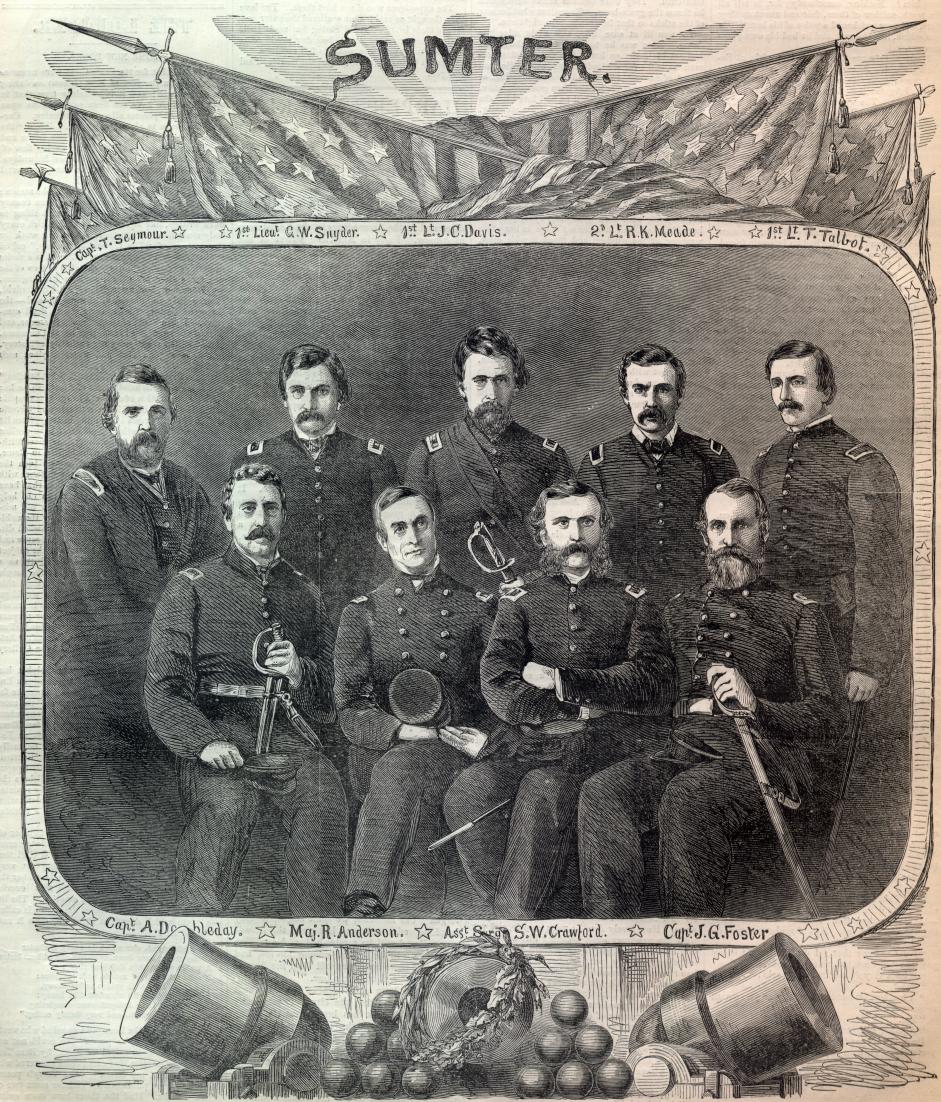
Having been evacuated from Charleston, Abner Doubleday and the Sumter contingent of Companies E and H of the 1st U.S. Artillery arrived in New York Harbor on April 18th, and at Fort Hamilton on the 19th.  Major Anderson was granted immediate leave, and the command devolved to Doubleday. Anderson was soon after permanently detached (April 30th) and made a brigadier-general in his native Kentucky, but his system had been undermined by his great responsibilities; he was threatened with softening of the brain, and was obliged to retire from active service. <1>

Anderson's Command at Fort Sumter

An incredible reception of unbounded enthusiasm greeted the defenders of Sumter upon their arrival in New York. Passing steamers saluted with bells and whistles along with cheers from ferries and other vessels in the harbor. The major newspapers of the city all extended a royal reception and a hearty welcome. For a long time the enthusiasm in New York remained undiminished. It was impossible for us to venture into the main streets without being ridden on the shoulders of men, and torn to pieces by hand shaking. Shortly after our arrival, Henry Ward Beecher came down to the fort to meet us, and made a ringing speech, full of fire and patriotism. It seemed as if every one of note called to express his devotion to the cause of the Union and his sympathy with us, who had been its humble representatives amidst the perils of the first conflict of the war. <2>

The speech from Beecher is noted as occurring on the 11th of May, when the garrison renewed the oath of allegiance. The day was replete with a military parade to render the ceremony more impressive, and a great many visitors heard the spirited speech of the famous Congregationalist clergyman, orator, and brother of Harriet Beecher Stowe—the author of Uncle Tom’s Cabin. <3>  Other noted visitors, many of whom were among the most highly distinguished in all walks of life, were regular guests at Fort Hamilton. The Chamber of Commerce of New York voted a bronze medal to each officer and soldier of the garrison. This was certainly of a special pleasure to Doubleday, who had some weeks previously, in the midst of the Charleston Harbor standoff, pondered how very appropriate it would be for them to receive such an honor. On March 1st, Samuel Wylie Crawford wrote in his journal: “Doubleday seems to think that we will be rewarded in some way after our exit from here. Spoke of the metal to be struck as desirable should the suggestion be made with a representation of the evacuation of Moultrie on one side and the word ‘fidelity’ on the reverse.” (Crawford also mentioned that the men were busy on this Sumter day in “playing ball and leap frog.”) <4>

  1. Abner Doubleday, From Moultrie to Sumter, p. 49.
  2. Abner Doubleday, Reminiscences of Forts Sumter and Moultrie in 1860-’61, pp. 175-176.
  3. Supplement, vol. 1, serial 2 – Journal of Abner Doubleday, p. 196.
  4. Supplement, vol. 1, serial 1, p. 42.

150 Years Ago Today – Emancipation in Washington

On this date in 1862, President Lincoln signed a bill entitled “The District of Columbia Compensated Emancipation Act.”  Though this particular bill was not composed by Lincoln, he had while serving as a congressman in 1849 introduced a similar measure. That was, of course, unsuccessful at that time.

The emancipation bill of 150 years ago today resulted in the compensated freedom for about 3,200 slaves residing or working in Washington. The total cost was around $1,000,000 ($300 per slave to owners) … and this is the only compensated emancipation act ever completed in the USA – though others were debated. In fact, at this very time, debates were swirling in Congress relative to dealing with slavery in the border states.

The passage and signing of this bill set the stage for larger efforts and measures to come – ultimately of course the Emancipation Proclamation – announced in the wake of Antietam on September 22nd.

April 16th is “Emancipation Day” in Washington and is celebrated annually as such.

Emancipation statue in DC

The Evacuation of Fort Sumter – 151 Years Ago Today

As I’ve written in recent days, I would have rather put this in the blog a year ago – though no blog yet existed. And as well, the following is an excerpt from my researching and writing on the life of Abner Doubleday:

EXCERPT>>

The troops packed their belongings on that Sunday morning of April 14, 1861. A great fanfare was planned by the secessionists—people from surrounding areas crowded into Charleston; and the harbor was dotted with all sorts of vessels and people in holiday dress. A fifty-gun salute to the flag was offered (at which time an accident cost the life of one Sumter soldier named Daniel Hough), and Doubleday marched out at the head of his column to a waiting vessel with the drums beating Yankee Doodle. The tattered American flag came down, The Palmetto Guard marched in, and a new banner went up to the whistles and cheers of the multitudes. Doubleday pondered what a strange sight it must have been for the hordes gathered around to see their small group of only about 60 people, as compared to the hosts that had surrounded them. He further pondered:

It was an hour of triumph for the originators of secession in South Carolina, and no doubt it seemed to them the culmination of all their hopes; but could they have seen into the future with the eye of prophecy, their joy might have been turned into mourning. Who among them could have conceived that the Charleston they deemed so invincible, which they boasted would never be polluted by the footsteps of a Yankee invader until every son of the soil had shed the last drop of his blood in her defense—who could have imagined that this proud metropolis, after much privation and long-suffering from fire and bombardment, would finally surrender, without bloodshed, to a negro regiment, under a Massachusetts flag—the two most abhorred elements of the strife to the proud people of South Carolina?

It is doubtful that there were any on either side of the newly commenced war who would have anticipated the full scope of all that would befall them in the succeeding four years. Anderson feared it greatly and passively sought to prevent it. Doubleday would soon be heard to anticipate its scope in a fashion beyond others—though surely still only fractionally as compared to the final tally of lives lost.

The transport took the Sumter contingent to the Baltic where they were warmly received by Captain Fox and the crew. They sailed for New York, arriving on April18th. None of their lives would ever be quite the same, but such a statement would equally now apply to the lives of millions of Americans.

Fort Sumter in Flames – 151 Years Ago Today

This is again some information I would have rather had in this blog last year, but alas, I was not writing it back then … so here it is for today. This is an excerpt of some of what I’ve written in my proposed book on Abner Doubleday – this segment speaking of events at Fort Sumter on 4/13/1861, the day after the initial attack (the italicized words are from Abner Doubleday).

<Excerpt>>>

On the 13th, the battle continued. Heated shot from Moultrie set several fires, and ultimately a large blaze in the officer’s quarters. Before long, the fires could no longer be contained. The soldiers had a difficult time of relocating powder and ammunition in a safe manner. After a time, a shot disabled the door to the magazine, setting a definite limitation as to the amount of ammunition and powder available to continue the fight. The fire and smoke now “. . . was terrible and disastrous. One-fifth of the fort was on fire, and the wind drove the smoke in dense masses into the angle where we had all taken refuge. It seemed impossible to escape suffocation. Some lay down close to the ground, with handkerchiefs over their mouths, and others posted themselves near the embrasures, where the smoke was somewhat lessened by the draught of air. Every one suffered severely.”

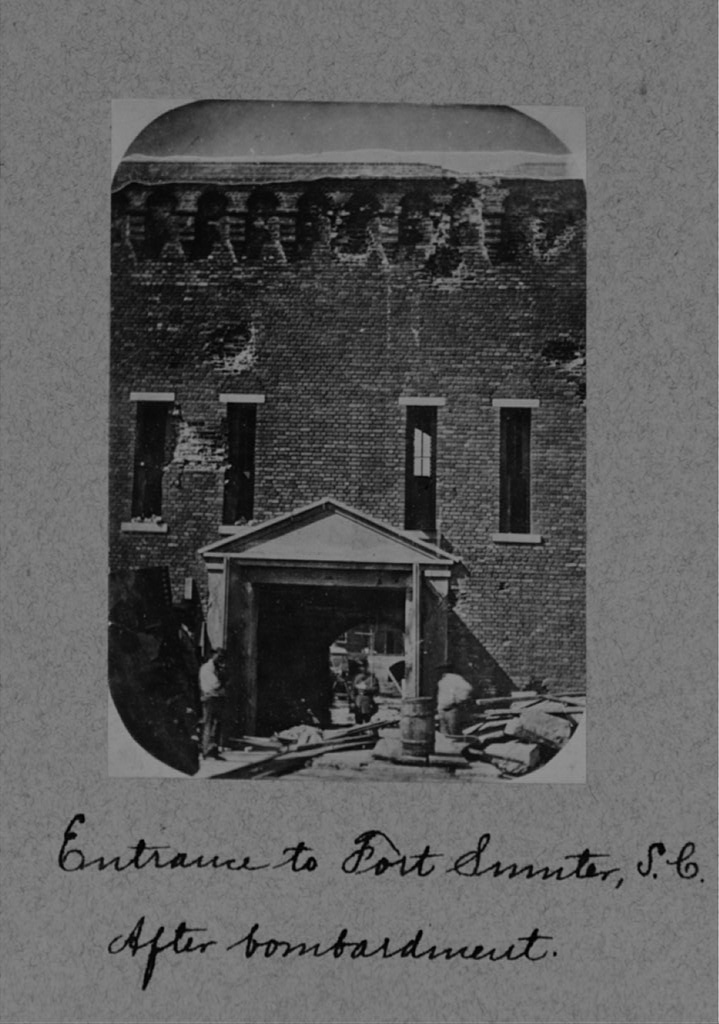
Sumter under Confederate Control

The pounding of Sumter continued, with crashing shells and the explosions of fortress shells within burning rooms. The massive wooden gates had burned completely, opening the installation to the potential of invasion. At 12:48 the flag fell, only to be replanted on the parapet by a Peter Hart, who under great fire effectively used a spar for a temporary flagpole—an act of heroism that would be celebrated throughout the North. The garrison at Sumter was now able to only answer with an occasional shot. Amazingly, under such an onslaught, there was no loss of life in the fort. Sumter was actually the safest place for Doubleday to be. “While the battle was going on, a correspondent of the New York Tribune, who was in Charleston, wrote that the populace were calling for my head. Fortunately, I was not there to gratify them.”

Doubleday could not resist taking a shot at a particular building on Sullivan’s Island. It was a very fine resort hotel near the shore. During the time of the increased hostilities, Doubleday could see that it was being used as a barracks for troops, and decided to send two forty-two pounder balls through the upper story. Through his glass, Doubleday could see masses of people tumbling out of the building. Later, during negotiations for the surrender of Fort Sumter, a South Carolina officer on the side raised the question with Doubleday as to the reason for firing upon this building. Doubleday wrote, “Not caring to enter into a discussion at that time, I evaded it by telling him the true reason was, that the landlord had given me a wretched room there one night, and this being the only opportunity that had occurred to get even with him, I was unable to resist it. He laughed heartily, and said, ‘I understand it all now. You were perfectly right, sir, and I justify the act.’”

A white flag was of necessity flown and a series of negotiations begun between Major Anderson and the agents of Beauregard. The terms involved the evacuation of the fort with their personal arms and belongings (leaving all other war material behind), and with permission to salute the flag, along with the honors of war. All of this was arranged to occur the next morning.

Doubleday recorded a near fatal incident during the negotiation. Roger A. Pryor, a former Virginia senator and future officer for the Confederacy, was with the negotiating party and seated at a hospital table in a dark area (this location being about the only place on Sumter safe from the flames). Near his right hand was a tumbler of drink, as well as a dark bottle. While mechanically reaching to pour a drink, he instead accidentally poured the contents of the bottle into a glass and swallowed what turned out to be iodide of potassium. The doctor, Samuel Wylie Crawford (who would give up medicine during the war to eventually become a general) took him outside to apply a stomach pump. Doubleday later told the doctor that if the leaders of secession wanted to come over from Charleston and commit suicide by poisoning themselves, he could think of no reason “to interfere with such a laudable intention.” Crawford responded with similar humor, reasoning that he was responsible for government property, and could not allow it to be taken away in Pryor’s stomach.

<Back to the blog>>>  Roger Pryor was an officer of the Confederacy who fought at Bloody Lane at Antietam, and I’ll save that info for some better research and writing on another day. (And Crawford was at Antietam also – along with quite a number of other Union officers at Sumter.)

And check back tomorrow for some additional words of the turning over of the Fort to the Confederates.

Sumter today as seen from the Harbor Cruise

Abner Doubleday, Fort Sumter 151 Years Ago, and the Baseball Legend

Today, April 12, 2012, is a sort of convergence point for a number of my most valued hobbies and interests. As a Civil War history enthusiast, it marks the 151st anniversary of the essential beginning of that 4-year struggle. The first Union shoot – a cannon blast from Fort Sumter in response to the Confederate attack in Charleston Harbor – was aimed by Captain Abner Doubleday, about whom I’ve written most of a book. And Doubleday was for many years considered the father of the great, great American game of Baseball – hence the location of the Hall of Fame in Cooperstown, NY.

So there is no way I can let this date go by without a posting on Doubleday and baseball. And since this writing is going to end up longer than most, here is the conclusion for anyone who can’t read to the end: Doubleday was an effective Civil War General who had nothing to do with inventing the game; he was more of a boy scout than a little leaguer; he would have demanded credit for it if he did invent it; baseball is more about evolution than creation; Doubleday may have only ever written the word “baseball” once in his life.

If I ever do get around to publishing my book on Doubleday, the baseball part of his story will be the shortest chapter. I knew when going into the project that the General had no serious connection, but no book on Doubleday could be complete without at least some explanation as to how his name got attached to the great American pastime.

Part of my research took me to the archives room at the Baseball Hall of Fame in 2005. A summer intern met me at the door and escorted me to the inner sanctum. There, an archivist, hearing what I was interested in researching, said to me, “I’ll get you the Doubleday file, but I’ll tell you right now there’s not much in it.”

Whereas Abner Doubleday would ultimately write extensively in the latter years of his life, a subject he did not address was the origins of baseball. But others surely have and continue to do so today. Though now largely discredited as the inventor of the game, he remains a sort of Paul Bunyan or John Henry folklore figure for the sport.Baseball’s founding is in fact more about “evolution” than “creation”—having evolved from a variety of bat and ball games played in American towns probably for even decades before Doubleday.

So how does an admittedly non-athletic, even somewhat portly person of military fame, who never claimed to be associated with a sport that had gained public and professional prominence long before his death, end up as the George Washington of the great American pastime? Only a convoluted storyline could yield such a result.

In 1905, sporting equipment manufacturer Albert Spalding determined it was in the public interest to establish definitively the origin of the great game of baseball. This baseball executive and former star pitcher assembled a group of like-minded associates to research the ancestry of the sport. The “like-minded” aspect of this group defined a joint hope that baseball was truly fully American, owing no connection to the English children’s game called “Rounders.”

The chairman of the commission was National League President A.G. Mills. Other members included several men associated with the sport, and two United States Senators. A vast amount of communications came to the committee, including a letter from an Albert Graves, a mining engineer in Colorado. Graves claimed to be a Coopersburg boyhood friend of Abner Doubleday, and said that the Civil War General in 1839 devised a scheme for changing the game of “Town Ball” to include a diamond formation, four bases, and a certain number of players with specific positions.

The final report of the commission was issued on December 30, 1907, and concluded that “the first scheme for playing baseball, according to the best evidence obtainable to date, was devised by Abner Doubleday at Cooperstown, N.Y. in 1839.” The notion of the game being invented by an all-American war hero native of New York State caught on with the public.

Almost immediately, there were those who disputed the findings by noting that the alleged Doubleday innovations were in wide use prior to 1839. But their voices could not compete with the official version of the commission, and the identification of Doubleday with the sport was permanently cast. Added to this was the 1934 discovery of an old baseball inside a trunk in the attic of a home having some connection to the Doubleday family. The ball became known as the “Doubleday Baseball.” Stephen Clark, a Cooperstown resident and philanthropist purchased the ball for five dollars and displayed it with other baseball items in a room of the Village Club. A business partner of Clark, by the name of Alexander Cleland, proposed the idea of a National Baseball Museum. National League president Ford Frick and other baseball executives supported the proposal, and before long a supply of baseball memorabilia began to collect in Cooperstown.

In that there was to soon be in 1939 a centennial anniversary of the declared invention of the sport, Ford Frick and other baseball executives proposed that a Hall of Fame be created to honor the great players of the game. The Baseball Writer’s Association of America was tasked with the selection of those from the history of the sport who should be the first honorees. Five famous players were selected: Babe Ruth, Honus Wagner, Ty Cobb, Christy Mathewson, and Walter Johnson. A total of 25 players were elected by the time of the grand centennial celebration in 1939.

Due to the publicity of the Hall of Fame being established, a new round of investigations and assertions by baseball historians proved the Doubleday connection to the founding of baseball to be a myth. The fact is that the game has a variety of roots—not only to the game of Rounders, but also to a wide assortment of bat and ball games played in towns for decades before the alleged incident in Cooperstown in 1839. An individual name more justly appropriate to associate with the “creation” of baseball is Alexander Cartwright, who in 1845 published a set of baseball rules that were widely adopted. Associated with the earliest forms of professional baseball clubs, particularly the New York Knickerbockers, the first recorded game was played in 1846 in Hoboken, New Jersey. The National Association of Base Ball Players was the first organized league in 1858.

In recent years, other discoveries of early forms of baseball have been uncovered—most notably a Pittsfield, Massachusetts bylaw from 1791 that prohibits the playing of baseball within 80 yards of the windows of a new town meeting house.

Part of the debunking of the Graves claim is that he was roughly 14 years younger than Abner Doubleday—though Doubleday did have a cousin with an identical name who was the same age as Graves, and lived in the same community. The incident Graves recalled may well involve a mistaken identity. Such a scenario as Graves penned was surely the mere replication of events in many locations where boys shared their knowledge of the growing codification of the rules of the game. Doubleday was nowhere near Cooperstown in that summer of 1839. And were Abner Doubleday the inventor of the game, he would have never allowed the issue of the origin of baseball to be disputed to the extent that it was in his lifetime, without taking claim for its beginnings. Doubleday had a highly advanced sense of justice and credit—so much so that it became problematic for him in his late Army career. He never claimed credit nor mentioned any affection for the sport in his many writings; and nothing is said upon the matter in his obituary or remembrances written by others who knew him.

One reference actually does exist of Abner Doubleday penning the word “baseball.” Near the end of his military career in 1871 he was stationed at Fort McKavett, Texas as the colonel in command of the 24th U.S. Infantry Regiment. This was one of four army units that were entirely African-American. To the Army’s Adjutant General in Washington he wrote:

“I have the honor to apply for permission to purchase for the Regimental library a few portraits of distinguished generals, Battle pictures, and some Rogers groups of Statuary, particularly those relative to the actions of the Colored population of the south. This being a colored regiment, ornaments of this kind seem very appropriate. I would also like to purchase baseball implements for the amusement of the men and a Magic Lantern for the same purpose. The fund is ample and I think these expenditures would add to the happiness of the men.”

Referring to bats, balls and bases as “implements” hardly sounds like the vocabulary of the founder of the sport! The Rogers Groups of Statuary referenced a very popular form of durable plaster sculpture. The images pictured ordinary people performing ordinary deeds of life—depicting amusements, social customs, literary topics, historical figures, etc. The statues varied in size from eight inches to forty-six inches. Practically anyone of means in Victorian America possessed them, and the announcement of a new issue was cause for much publicity. The social interests and educational concerns of Doubleday may be seen in this request for the benefit of his regiment. The “Magic Lantern” was the name of an immensely popular 1870 invention that may be thought of as the ancestor to the modern slide projector.

Though Doubleday would surely prefer to have been remembered for his military accomplishments and his advanced sense of social justice, he has instead been remembered more for the sport of baseball, and Cooperstown, New York. It has frequently been said that if baseball was not invented in Cooperstown, it should have been. Cooperstown is the classic All-American town—with tree-lined streets of Colonial and Victorian homes, and a Main Street of storefront shops and merchants. Situated on the south shore of Glimmerglass Lake, the town reverberates from an enchanted past. Beyond what Abner Doubleday’s dubious legend has brought to the community, it factually stands in memorial to the life and work of James Fenimore Cooper—the famed author of The Last of the Mohicans, and the son of the founder of the town. The natural beauty of the lake, woods, and mountains easily conjure the settings for Cooper’s Leatherstocking Tales about Indians, settlers, pioneering, and wild animals.

But James Fenimore Cooper does not even get to first base compared to the plethora of acknowledgements of Abner Doubleday in Cooperstown. The brick ballpark built in 1938-1939 in Phinney’s Pasture (the actual location of the alleged moment of creation) by the Work Projects Administration is named “Doubleday Field,” and serves as the location for a yearly exhibition game between two professional teams. Nearby are the Doubleday Batting Range and the Doubleday Club House Shop full of souvenirs. The visitor may enjoy an ice cream cone at the Doubleday Dip. For a meal, there is the Doubleday Café, complete with a large, framed, crude drawing of a corpulent Abner Doubleday in military garb holding—not a sword or revolver—but a baseball.

The Baseball Hall of Fame is the frequent brunt of criticism for making too much of this spurious heritage, and thereby perpetuating it. The fact remains that the legend, though now proven devoid of substance, did account for the location of what has become a major museum and library attraction for visitors from across America and around the world. The legend, as a story, must be embraced. Indeed, the Hall of Fame writes that the events recorded by Abner Graves “capture that point in time when rapid changes in the game of town ball arrived in one typical American community and caused a minor revolution on the sandlot.”

Summary

Abner Doubleday did “throw out the first pitch”—but not in the game of baseball. Rather, it was the first salvo of the Civil War at Fort Sumter in South Carolina. As political columnist and baseball fan extraordinaire George Will notes:

Precisions about origins is appropriate in the national pastime of a nation that knows precisely when it got going: July 4, 1776. Not that there hasn’t been a rhubarb about that. Lincoln at Gettysburg in 1863 made a point of pinpointing the nation’s birth fourscore and seven years earlier, at the Declaration of Independence. He did so because some wily Confederates were arguing that the country came into existence in 1789, with the ratification of the Constitution, which was, they said, a compact among sovereign states that therefore retained a right to secede.

Lincoln had sound reasoning and, more important, the bigger army, so his view prevailed. It did so with the help of General Abner Doubleday, who, before he fought at Antietam, Fredericksburg, and Gettysburg, fired the first shot in defense of Fort Sumter. So in a sense he really did start something. Just not something as important as baseball.  <<George F. Will, Bunts, (NY: Touchstone, 1998), 273>>

I’ll write some more for tomorrow about the actual events at Fort Sumter … but I’ll need to save some of my stuff for more “April the 12ths” as they come around!

Three Tour Families in 24 Hours

This past Sunday and Monday was a time I was able to meet with some people coming to Antietam Battlefield. Sunday was Easter, and as a pastor, it is a busy morning – especially this one when my primary musician and his wife both called very early to tell me they were sick and could not make it. I had to scramble and put together the music package with our worship team, along with speaking, doing a skit with four of the children, etc., etc. But it all worked out. And then there was a family lunch at home where 4 of my 5 boys were able to come.

I got a call during lunch to see if I could meet with some folks at 3:00; and I already had plans for two families for Monday. Together, these three families are somewhat a common case study of the wonderful sorts of people that I meet as part of the Antietam Battlefield Guides program.

Sunday Afternoon – The family was an older couple from Westminster, Maryland who brought with them their 20-something-year-old granddaughter from Nebraska. The granddaughter is currently serving in Washington as an with one of her Nebraska U.S. Senators – Mike Johanns. The family had been to Gettysburg and enjoyed it so much that they also decided to Antietam. Clearly the young lady had received a good education in Nebraska and asked wonderfully insightful questions … a very sharp gal indeed!

Monday Morning – An older and retired couple went around the battlefield with me, having arrived the day before and spent the night at a bed and breakfast in the Keedysville area. They went on the Sunday afternoon Ranger walk with John Hoptak – focused on Lawton’s Brigade and the West Woods. As if that was not enough hiking, they also did the Cornfield Trail by themselves. This couple had many insightful thoughts that led to good questions and comments, and I’m sure they went away with a very solid grasp of the battle and its context in the Civil War. These folks particularly exemplified the primary characteristic of the majority of people that I meet – no matter what age, there is a personal commitment to be a lifelong learner.

Monday Afternoon – I especially enjoy meeting families, and I met a really good one this afternoon – a family of five from Wisconsin. There was dad, mom, sons about age 14 and 11, and a daughter I’d guess to be about age 8.  The younger son was REALLY interested in the Civil War!  I meet some kids like this every once in a while and really like them – because that was me when I was their age! We made sure to especially place some emphasis upon the Badger State guys of the Iron Brigade on the west side of the Cornfield. And I am going to send them the excerpt from my Doubleday research on the conflict at Brawner’s Farm (3 weeks before Antietam) – where the Brigade had their baptism of fire (though the 2nd Wisconsin had fought earlier … the guys known as “The Ragged Ass 2nd”– due to their worn clothing).

So anyhow … these are the kinds of people who so often come and engage with the Antietam Battlefield Guides. If you are thinking about visiting at Sharpsburg sometime, yes, do it!  I’d love to meet you, as would any of my colleagues who so much enjoy this endeavor.

Appomattox – 147 Years Ago Today

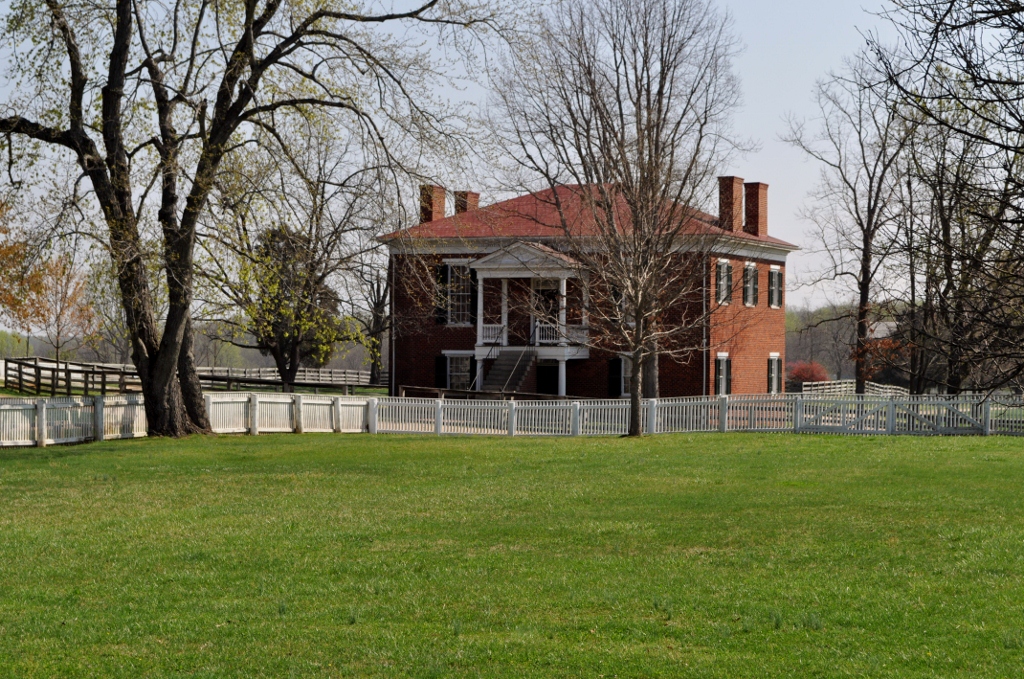
I recently made my first visit ever to Appomattox Court House – the site of Lee’s surrender to Grant. I’ll save most the pictures and remarks for a posting on this date in 2015!

Appomattox Courthouse

It really is a great place to visit. There is an entire restored village there at the site of the courthouse in the 1860s. In subsequent decades, the courthouse building burned and the town of Appomattox grew a couple miles away where the railroad was located.

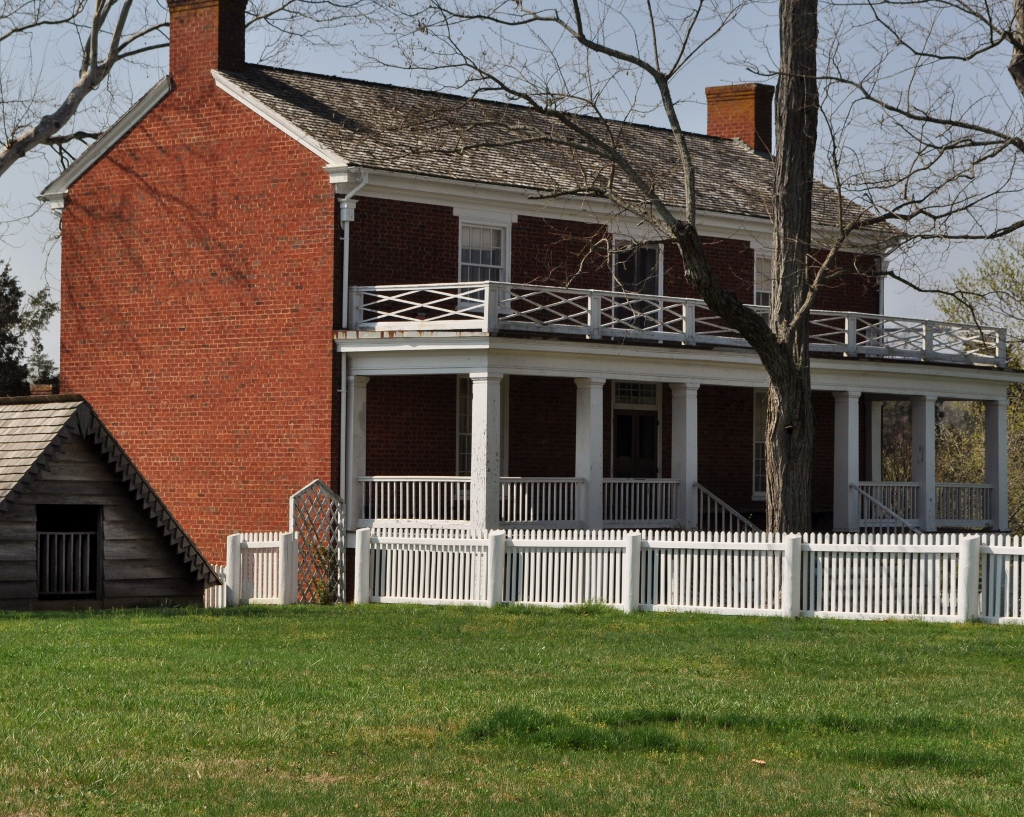
The actual home in which the contending Generals met was the McLean house. Of course we all know the story of Wilmer McLean – whose family departed their home in Manassas, Virginia in order to escape the War, only to have it find them again.

After the actual documents of terms of surrender and acceptance were dealt with, six commissioners – three from each side – were chosen to work out details of the surrender itself. General John Gibbon was among those for the Union, while John B. Gordon was one of the three for the Confederates. Of course, they were less than a mile apart on the Antietam Battlefield.

The Wilmer McLean House

The McLean House Parlor


150 Years Ago Today – The Battle of Shiloh

Today is the sesquicentennial of the bloodiest battle of the Civil War up to this point (almost one year after the inception at Fort Sumter). It is also known as the Battle of Pittsburg Landing, and was in fact a two-day affair.

Since I am a bit short on time to research and write very extensively on this topic, I am going to refer the reader to two excellent sources:

1.  Here is an excellent summary of the battle from the following page connected to the Civil War Trust (http://www.civilwar.org/battlefields/shiloh.html) …

On the morning of April 6, 1862, 40,000 Confederate soldiers under the command of Gen. Albert Sidney Johnston poured out of the nearby woods and struck a line of Union soldiers occupying ground near Pittsburg Landing on the Tennessee River. The overpowering Confederate offensive drove the unprepared Federal forces from their camps and threatened to overwhelm Ulysses S. Grant’s entire command. Some Federals made determined stands and by afternoon, they had established a battle line at the sunken road, known as the “Hornet’s Nest.” Repeated Rebel attacks failed to carry the Hornet’s Nest, but massed artillery helped to turn the tide as Confederates surrounded the Union troops and captured, killed, or wounded most. During the first day’s attacks, Gen. Johnston was mortally wounded and was replaced by P.G.T. Beauregard. Fighting continued until after dark, but the Federals held. By the next morning, the reinforced Federal army numbered about 40,000, outnumbering Beauregard’s army of less than 30,000. Grant’s April 7th counteroffensive overpowered the weakened Confederate forces and Beauregard’s army retired from the field. The two day battle at Shiloh produced more than 23,000 casualties and was the bloodiest battle in American history at its time.

2.  I would also refer the reader to the blog of a very sharp young man who is a part of the Battlefield Guides organization at Antietam – Dan Vermilya. His blog can be found at www.fieryordeal.blogspot.com. Dan is a seasonal person around Antietam, and was recently named as one of two recipients of a Joseph Harsh research award. I am sure I will be writing about this at some point in the future. In Dan’s blog, he has been writing a series on Shiloh, and it contains quite a few great pictures and tons of information.