150 Years Ago Today – Battle of Gaines’ Mill

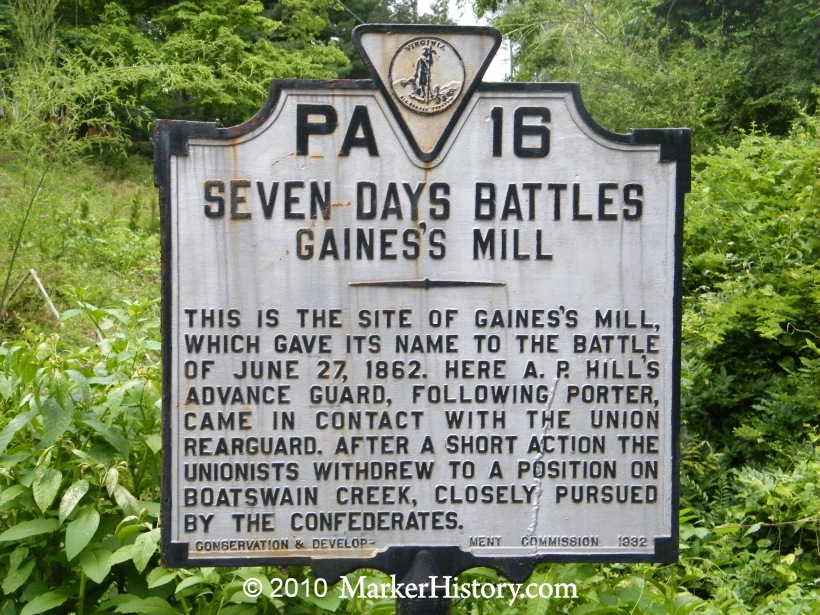
Battle of Gaines’ Mill

<<Today is the third of a series of posts on the Seven Days Battles near Richmond, Virginia that occurred 150 years ago this week.>>

On this date of June 27, 1862 occurred what will be the deadliest battle in the east to this time during the Civil War .

The events of the day before aroused great concern in McClellan’s mind that Jackson and his forces were lurking to his east in danger of threatening his supply lines. Orders were given early on the 27th for the army to change its base to the James River – the retreat was on in full flight. It was the role of Fitz John Porter to hold the Federal line north of the Chickahominy.

Porter selected a rather strong position with a new 1.75-mile-long line behind a marshy creek called Boatswain’s Swamp. Here the Confederates sent wave after wave of attacking men under the two Hills, Ewell, and Longstreet – piling up casualties at an alarming rate. The Union badly needed reinforcements, who came too late. The weight of Jackson’s additional troops broke the line, and only darkness prevented a total disaster.

Gaines’ Mill – the largest of the Seven Days Battles – was the only clear-cut Confederate tactical victory of the Peninsula Campaign. Union casualties from the 34,214 engaged were 6,837 (894 killed, 3,107 wounded, and 2,836 captured or missing). Of the 57,018 Confederates engaged, losses totaled 7,993 (1,483 killed, 6,402 wounded, 108 missing or captured).

All of McClellan’s fury toward Washington came pouring out. To Stanton he wired that he was “overwhelmed by vastly superior numbers … I have lost this battle because my force was too small … I should have gained this battle with 10,000 fresh men.”

As if that was not enough venomous spewing, in a wire that was not sent on from the War Department Telegraph office by its head Edward Sanford, McClellan said, “ … I have seen too many dead & wounded comrades to feel otherwise than that the Govt has not sustained this Army. If you do not do so now the game is lost. If I save this Army now I tell you plainly that I owe no thanks to you or any other person in Washington – you have done your best to sacrifice this Army.”

150 Years Ago Today – Battle of Mechanicsville

June 26, 1862 – Battle of Mechanicsville, VA – aka – Beaver Dam Creek / Ellerson’s Mill

<<Today is the second of a series of posts on the Seven Days Battles near Richmond, Virginia that occurred 150 years ago this week.>>

With McClellan’s Army of the Potomac divided by the Chickahominy, Lee determined to attack the Union right flank on the north side of the river. This exposed the immediate front of Richmond and Lee’s Army to odds of 2:1 against them to their east, but McClellan – not believing he had superior numbers – did not launch an attack.

The Confederate movement to attack Fitz John Porter’s Corps north of the river involved the three divisions of A.P. Hill, D.H. Hill, and Longstreet, along with the newly arriving forces of Stonewall Jackson. The plan was that Jackson would open the attack on the extreme right Union flank. But even Jackson could not perform marching miracles every day, and his men were late to arrive. Finally, in the afternoon, A.P. Hill launched the attack without Jackson – about 14,000 assaulting an entrenched 15,000 – all the way to the Beaver Dam Creek. Jackson arrived late and added inconsequentially to the fight.

The result of this battle on this date of June 26, 1862 was a Union victory – the Federals suffering only 360 losses as compared to 1,500 for the Rebels. But McClellan snatched defeat from the jaws of victory, as spooked by the entire affair, he initiated plans for a change of base to the James River – euphemistically speaking, a retreat. Porter pulled back in the evening to Gaines’ Mill, nearer to the bridges over the Chickahominy. This would be the place and name for battle the following day.

Sketch by Waud for Harper’s Gazzette

Oak Grove Action – Prelude/Intro to the Seven Days Battles

 <<Today is the first of a series of posts on the Seven Days Battles near Richmond, Virginia that occurred 150 years ago this week.>>

Background to the Seven Days Battles

General McClellan has throughout the Spring been bringing his vast Army of the Potomac up the peninsula of the York and James Rivers in an effort to capture the Confederate Capital of Richmond. Over the several months of this movement, McClellan has – along with an intense rainy season – been enduring arguments with President Lincoln and Secretary of War Stanton that he is outnumbered and needs additional reinforcements to have any certainty for success. He numbers about 100,000 at his disposal, with Lee’s forces now having grown to about 85,000 with the addition of Jackson’s Command – fresh off his successful Valley Campaign.

On this date of June 25 in 1862, McClellan wires Stanton that total Confederate forces are “stated as 200,000 including Jackson and Beauregard.”  He continued, “I will do all that a General can do with the splendid Army I have the honor to command & if it is destroyed by overwhelming numbers can at least die with it & share its fate.”

As McClellan considered his situation, he had the choice of a siege or an assault. The latter required a confidence and reality of overwhelming force, and the former required a strongly established base of operation. He believed he possessed neither of these; but feeling his only choice was a siege, he ordered up his siege guns.

Some few miles to the west in Richmond, Lee understood he could not sit still and endure a siege – which would surely not end well for the Rebels. He needed to force the action and do battle by maneuver in open fields. So Lee took the initiative to turn Lee’s right flank north of the Chickahominy, just as McClellan was also ready to finally move upon the city.

The Battle of Oak Grove – (also known as “King’s School-House” or “French’s Field” or “The Orchard”)

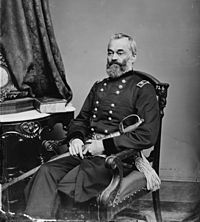
General Samuel P. Heintzelman

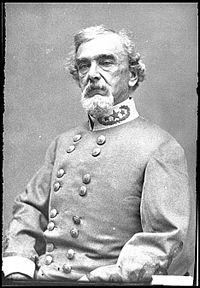
The Union command of General Samuel P. Heintzelman is ordered forward across the headwaters of the White Oak Swamp for a more advanced placement of siege guns, and in advance of a general movement the next day. The Federals are met by General Benjamin Huger’s Confederate Division. McClellan, who is three miles distant, calls back the advance around 10:30 to the original entrenchments until such time as he is able to come to the field. Arriving at 1:00 he sends his men

General Benjamin Huger

forward again over the same ground. This prelude to the Seven Days Battles tallies less than 100 deaths on each side and just over 1,000 total casualties. The action is insufficient to halt the major movement of Lee that will result in the next day’s battle at Beaver Creek Dam near Mechanicsville.

Artillery Shells Overhead – An Antietam Story

I don’t think there is any Civil War writing that I enjoy reading quite so much as regimental histories. These are written by men who were there, and are often written by guys with a very colorful style of communicating that rings of the unique verbiage of the era.

A regimental history that I’ve read and enjoyed in that of the 76th New York. My interest in them relates to their time of service under Abner Doubleday – first in his brigade, and then later still within his divisional command.

A.P. Smith – 76th NY

The history is penned by a fellow named A.P. Smith in 1867 – stated as the “late First Lieutenant and Quarter Master, Seventy-Sixth N.Y. Volunteers. The full name of the history is: “History of the Seventy-Sixth Regiment New York Volunteers; What it Endured and Accomplished.”

The following excerpt is a description of the morning phase of the Battle of Antietam, where the 76th NY of Hofmann’s Brigade in Doubleday’s Division of Hooker’s First Corps was held in reserve near the Hagerstown Turnpike north of the Miller Farm buildings. Here is a description of the scene – referencing the Confederate fire from Nicodemus Heights…

In the morning, as it became sufficiently light to clearly distinguish objects, the pickets of the Seventy-sixth found the rebel pickets so near that they might almost, in some instances, shake hands. The position was a delicate one for both sides; but by mutual consent, due deference was paid to their short acquaintance as individuals and no picket firing was indulged in by either side. The Seventy-sixth lay behind a fence in a depression of the earth, on the Hagerstown Pike. A state of inaction was not, however, long indulged in. Shortly after daylight, a heavy fire was opened by the rebel artillery, occupying a little eminence about a half a mile distant. Our artillery was soon brought to a small elevation about forty rods in rear of the Seventy-sixth, and from daylight until about ten o’clock, a brisk artillery duel was carried on over the heads of our men. Usually the balls and shells passed harmlessly over their heads; but now and then a shell with an improper fuse would burst in quite too close proximity for the enjoyment of the men; and occasionally a ball fired at too small an elevation, and falling short of its intended object, would plow up the soil, scattering the dust and stones promiscuously over the Regiment.

This being placed between the fires of two armies, while it is very exciting, is too much like holding an apple upon one’s head, to be shot off as a target. The marksman may be ordinarily correct in his aim, but the position of the man under fire is more a post of honor than enjoyment. <History of the 76th NY, pp. 164-165.>

Various men of the 76th New York

150 Years Ago Today: Law Prohibiting Slavery in the Western Territories

On this date of June 19th in 1862, President Lincoln signs a law prohibiting slavery in the Western territories. Having been passed by Congress, he quickly signed it. This action stood in opposition to the 1857 opinion of the Supreme Court of the United States in the Dred Scott Case that Congress was powerless to regulate slavery in U.S. territories.

Lincoln had throughout this season of 1862 been continuously rolling the question of slavery through his mind. There is no doubt what his heart would tell him to do; yet there was the matter of political expediency. It was necessary to play his cards wisely. Voices from competing quarters pelted him with their strong opinions, and the President needed the team support from varied competing sides.

Efforts to get the Border States to voluntarily abolish slavery were not proceeding as hoped. Lincoln had told these leaders that they should surely be able to read the times … to be ahead of what would be inevitably forced upon them.

Of course, the big idea of all ideas coming out of the Battle of Antietam was that Lincoln would use the occasion of this Union victory to announce the Emancipation Proclamation – that would change the terms of the War completely.

An Abolitionist’s Evaluation

In my Doubleday research, I came across a journal entry by him during the spring of 1862 where he was on supply line duty in the Fredericksburg area: As the fugitive slaves are coming in in great numbers, I employ them as laborers for military purposes, and find them exceedingly useful. An officer under Doubleday – an abolitionist lawyer from Maine of the last name of Noyes wrote of the various tasks being undertaken by these men who were working as blacksmiths and teamsters and in various works of service. In evaluation, he spoke most positively of their honesty, diligence, energy, patience, and capacity to learn. Noyes wrote, “I have witnessed their exultation when, for the first time in their lives, they received honest pay for their honest labor, and am satisfied that this is impulse sufficient with them, as with us, to induce their best efforts.” <Noyes: The Bivouac and the Battlefield, p. 43>


Doubleday in Williamsport in 1861

<This post would have best fit into my ongoing Sesquicentennial Series a year ago – but I was not active with this blog at that time, so this is yet another in a series of “catch-up” postings until the first anniversary of this Enfilading Lines blog>

For those of you who are not local to my area and know me, I begin by reporting that I live near the town of Williamsport, Maryland on the Potomac River. As well, I’ve done extensive research on the life of Abner Doubleday – whose early ventures in the Civil War brought him geographically into the pathway of my life in Maryland. Here then is material that is mostly excerpted from my hopeful biographical book project someday… this information detailing activity in this Chambersburg to Williamsport to Martinsburg/Harpers Ferry area in June and July of 1861 …………….

The time in Chambersburg was brief, as on June 7th Doubleday’s command under George Thomas’ brigade led the march to the south toward the Mason-Dixon Line, and toward the Rebels occupying Harpers Ferry under the command of General Joseph Eggleston Johnston. This entire period throughout June of 1861 was one of organizational comings and goings. Companies would be promised or assigned to one command, only to be transferred soon after to another. Patterson’s orders from Washington were also confusing and indefinite, leaving him uncertain as to pursue the enemy and fight, or to maneuver against the Rebels in a more protective and cautious way. He was told to not risk his command, and he was, with good cause, skeptical as to how effectively his thousands of green recruits would perform in a battle against Johnston.  At Harpers Ferry, Johnston was aware of Patterson’s movements, as well as those of George McClellan to his west (who was successfully fighting against the Rebels in the mountains). Fearful of these Union forces combining and cutting him off from communications with Richmond and with the other major Confederate force to the east at Manassas, he chose to abandon Harpers Ferry and reform in a more defensible position at Winchester.  He commenced this movement on June 13th by burning the United States Armory buildings, by destroying all surplus stores, and by sending to Winchester all war material that could be made available.

By the 15th of June, Doubleday was in Williamsport, Maryland.  The two companies of infantry were detached from his command, but he retained the two artillery units. His orders were to secure (from New York) a number of heavy siege guns and fit them out for action. While awaiting the arrival of the guns in Hagerstown, a false alarm in Washington ordered all of Patterson’s Regulars to a defense of Washington under General Irwin McDowell. While going by rail, Doubleday’s command passed their heavy guns in Harrisburg on the evening of the 17th, and upon arrival in York at 2:00 a.m. on the 18th discovered by telegram the order had been countermanded (due to another rumor that Johnston was now about to attack Patterson’s depleted forces).  Returning to Hagerstown, Doubleday was ordered on the 19th to move his battery at once to Harpers Ferry. With harnesses not yet prepared to accomplish such a movement, this order was also countermanded. By the 22nd, Doubleday’s battery of two 8-inch iron howitzers and two iron 24-pounders moved to Williamsport and posted opposite the ford in the center of town. <a>

     The town of Williamsport, in Washington County of Maryland, sits on the Potomac River at the point of its confluence with the Conococheague Creek.  Williamsport was a significant port of commerce on the Chesapeake and Ohio Canal, and the warehouse and boat docking area known as Cushwa Basin is preserved to this day, housing a canal museum.  It was also a location where the Potomac could be forded, as was done by Jackson’s command prior to Antietam (to capture Harpers Ferry) and by a substantial portion of the retreating Confederate Army in the week after Gettysburg.

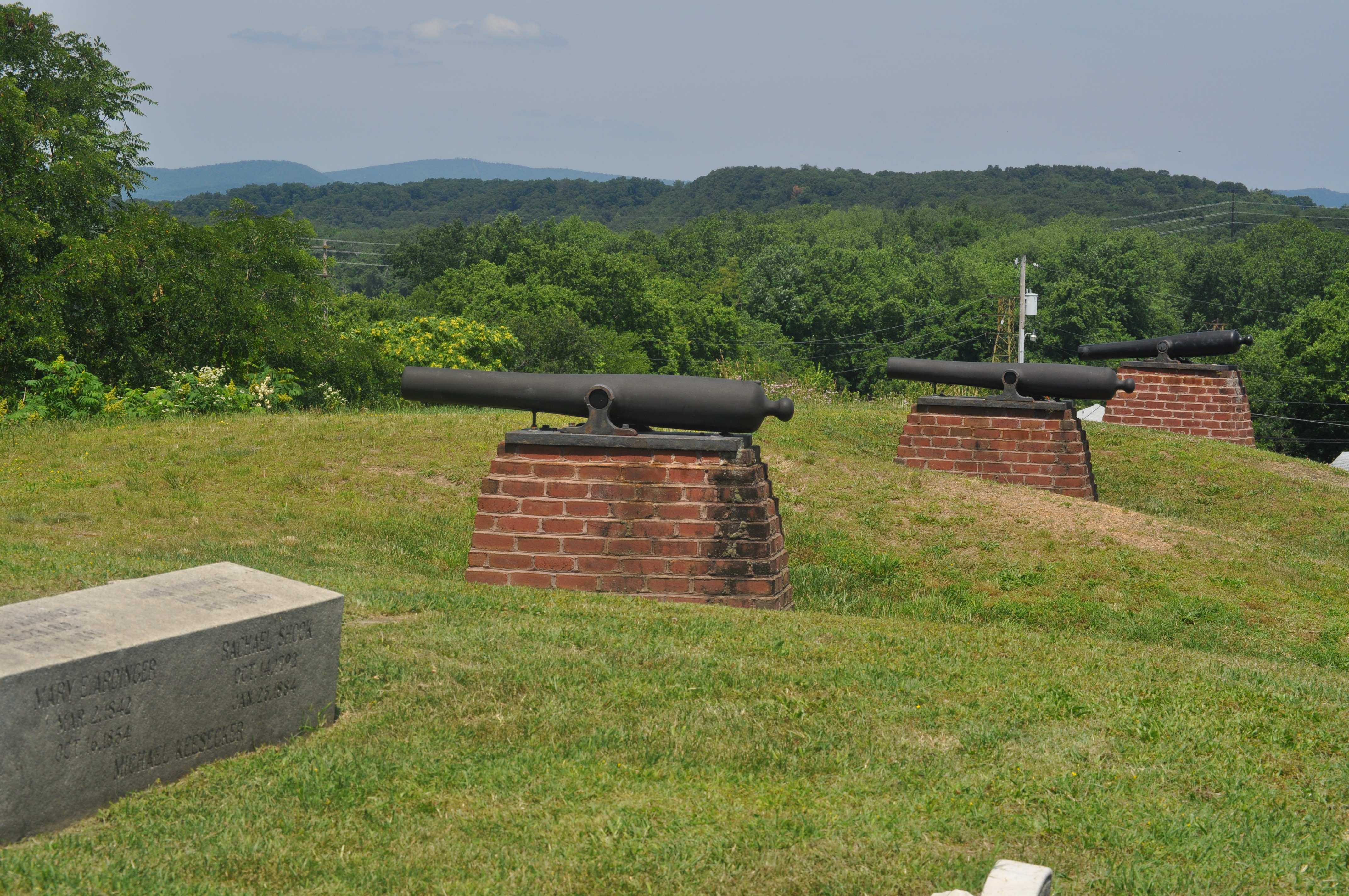
A few hundred yards downriver from the Cushwa Basin is a hill—the highest point in Williamsport.  On this hill, Abner Doubleday placed his battery in a commanding position of the river ford and the Virginia side of the Potomac.  (The old town cemetery has grown at this location, but the earthen parapets for the battery may be seen to this day. A sign marks the location.)

     Perhaps it was this very location that a local resident visited in the summer of 1861. A Mrs. Angela Kirkham Davis lived in the nearby village of Funkstown, operating a Main Street general store with her husband. They were very pro-Union in sentiment, though surrounded by a great division of thought, with many, such as their closest friends, embracing the cause of the South.  In her writings, she portrayed Western Maryland in the summer of 1861 as “occupied, more or less, by United States troops under the command of Major General Patterson, afterwards, superseded by General Banks.” The soldiers were to be seen everyone and were customers of the store in search of “crackers and cheese, whiskey, and tobacco, cigars and letter paper.”<b> The couple frequently visited various encampments in the vicinity.

We visited Fort Sumter Garrison, which consisted of about 100 men and were introduced to Captain Doubleday, who was with General Anderson at the time Fort Sumter was besieged by the Rebels and was obliged to surrender. He was a fine, modest, unassuming young man. His tent was very pleasant, having flowers, books, etc.<c>

     It was from this elevated position that Doubleday’s battery fired a number of rounds at the Rebels, as the Baltimore Sun newspaper on June 24, 1861 reported: “Confederate pickets exchanged shots across the river with Federal troops.  A battery of 24-pounders, armed by gunners who had been at Fort Sumter and commanded by Captain Abner Doubleday, drove them off after firing about eight rounds.”<d> Doubleday wrote of this incident: “I open fire upon a marauding party of the enemy’s cavalry (one company) opposite the ford and disperse them.  They leave their horses tied to the trees and had a force been sent over, we might have captured them.” <e>  A more colorful rendition of this event was told by a member of the 10th Pennsylvania regiment. This account reports Doubleday’s battery as placing a well-aimed shot of the 24-pounder onto the corner of stone structure occupied by Rebels about a mile into Virginia. A second shot from the howitzer scattered them completely and finally, all to the cheers of thousands of Union soldiers who witnessed it from the north side of the river. <f>

On July 2nd, Patterson moved the bulk of his force across the ford at Williamsport. Doubleday’s battery was left behind to guard the crossing in the event of a necessary retreat. An engagement occurred about five miles south of the river at a place called Falling Waters. Stonewall Jackson sought to slow the Federal advance, which he did for some time, but being outnumbered was compelled to fall back. Patterson occupied Martinsburg, while Johnston was 20 miles to the south in Winchester.  Doubleday joined the army on the Virginia side on the 3rd, but in another example of the right hand not knowing what the left hand was doing, he was ordered back to the ford without escort on the 6th.  This order of Patterson’s Adjutant General Fitz-John Porter was countermanded, and Doubleday made a return to Martinsburg the next day. Doubleday credited himself with saving his battery by acting so promptly to return, asserting that J.E.B. Stuart’s cavalry had plans to cut him off on the 8th. A Council of War on the 9th of July resulted in a decision to abandon any forward movement toward Winchester, but rather to fall back to Charlestown, near Harper’s Ferry, to be in a position to reinforce McDowell if necessary.

NOTES

<a> Supplement – vol. 1-2, serial no. 2, p. 198.

<b> S. Roger Keller, Crossroads of War: Washington County, Maryland in the Civil War. Shippensburg: Burd Street Press, 1997, p. 7

<c> ibid., p. 8.

<d> From The Civil War in Maryland by Daniel Carroll Toomey, p. 25 (Toomey Press, Baltimore, MD – Seventh Edition 1994… First Ed. 1983).

<e> from “My Record During the Rebellion” at HFC – vol. 1, p. 15.

<f> from the web page http://www.pacivilwar.com/cwpa10history.html

150 Years Ago Today – The Battle of Secessionville, S.C.

On this date of June 16, 1862 occurred the Battle of Secessionville, S.C.  (also known as the First Battle of James Island).

At first glance upon the name, one would presume this town was named in honor of Civil War events of the withdrawal of southern states from the Union … particularly being located in the Charleston area. Rather, it was named in remembrance of an earlier attempt of some plantation owners to rebel.

On this date, Union forces under Brigadier General Henry Benham attempted to seize Charleston by land. Confederates forces under Nathan Evans – though outnumbered well more than 2-1 – successfully defended the city, which would never be taken by the Federals in this fashion.

Though a small conflict by Civil War standards, the salvation of Charleston was significant for the Confederate cause and for morale during this difficult season.

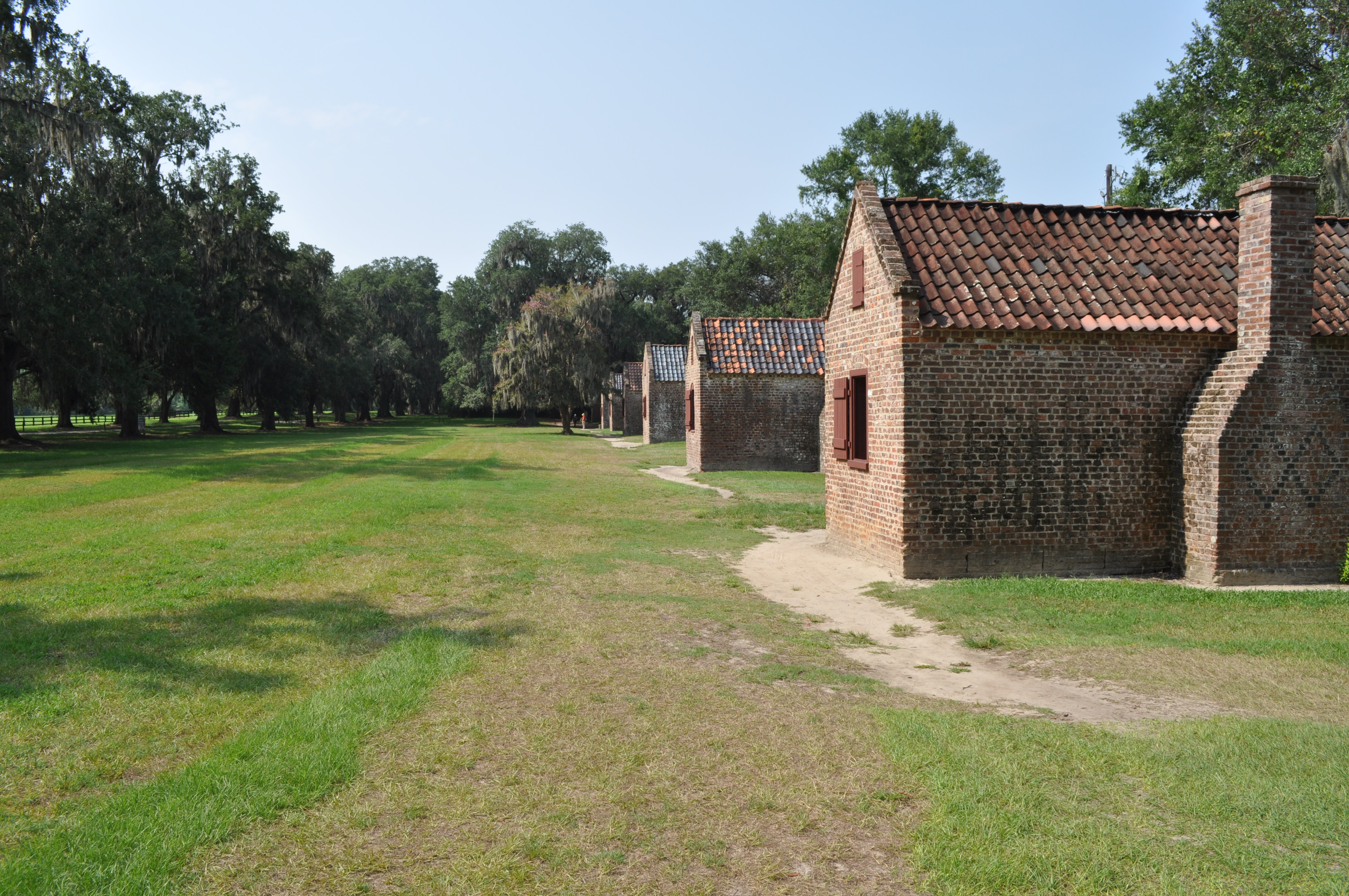
The Battle of Secessionville is annually re-enacted each November at the famous Boone Hall Plantation – a gorgeous place to visit, particularly for the “Avenue of Oaks.”  I was there last summer and include these pictures from that occasion:

150 Years Ago Today – J.E.B. Stuart Circles the Army of the Potomac

It was on this date of June 15, 1862 that the bulk of J.E.B. Stuart’s Confederate cavalry completed their daring 150-mile round trip reconnaissance ride around McClellan’s Army of the Potomac.

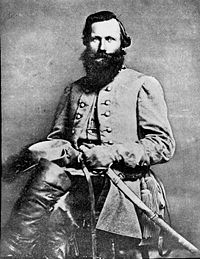
J.E.B. Stuart – 1863 – Gardner

This daring venture began on the 12th when Lee gave permission to Stuart to not merely gain intelligence about McClellan’s right flank north of Richmond, but to completely encircle the enemy. Lee was familiar with the flamboyant cavalryman from both his (Lee’s) time as Superintendent at West Point and from Stuart’s presence with Lee in the matter of dealing with the John Brown Raid in Harper’s Ferry in 1859.

Among those riding with Stuart were Fitz Lee and Rooney Lee – the nephew and son of Robert E. Lee.  To make it even more of a “family reunion” adventure, the Confederate cavalrymen also skirmished with Union cavalry forces of Philip St. George Cooke – Stuart’s father-in-law.

Other adventures on the ride included an effort to stop a Union supply (rail) train at Tunstall’s Station on the York River Railroad. They assembled a hasty wood barricade where the engineer, rather than stopping, applied more speed and successfully plowed through the obstacle – though being shot dead while so doing.  Stuart’s men also constructed a temporary bridge across the swollen Chickahominy, burning it behind them.

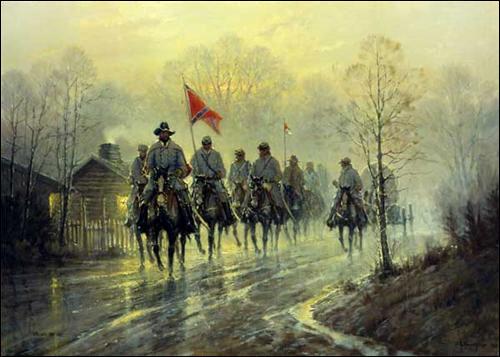
Stuart Returns – painting by G. Harvey

The information gained on this venture was significant for Lee in fashioning the strategy and attacks that would drive McClellan from the threshold of Richmond.

The press – both north and south – had a heyday reporting and recounting this adventure that gave rise to Stuart’s reputation … that arguably returned to haunt him in the Gettysburg Campaign.

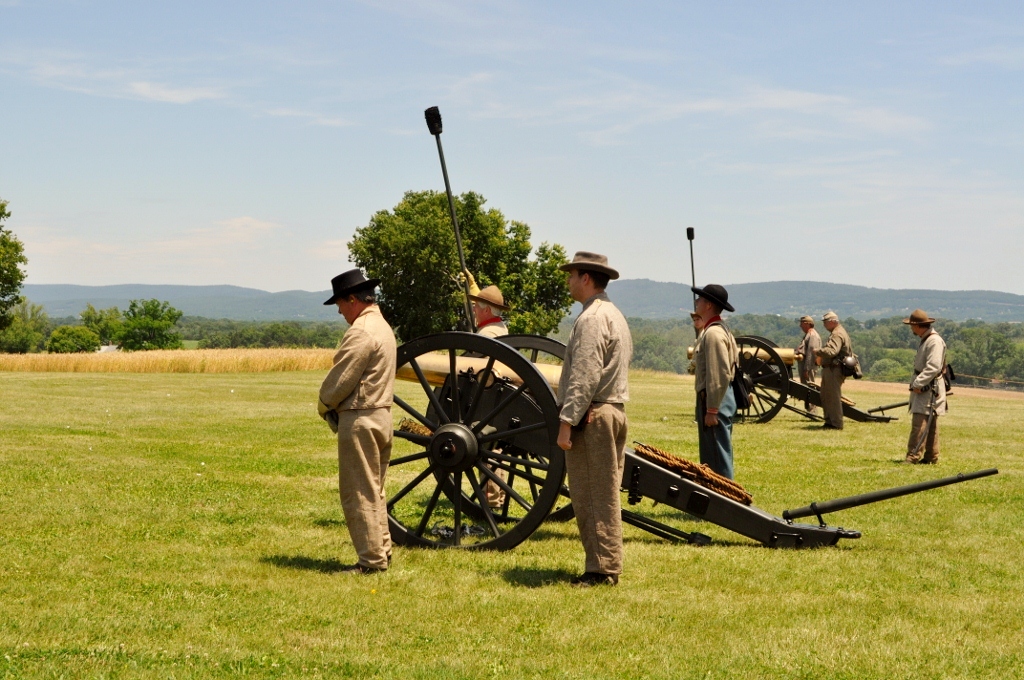
Artillery Weekend at Antietam

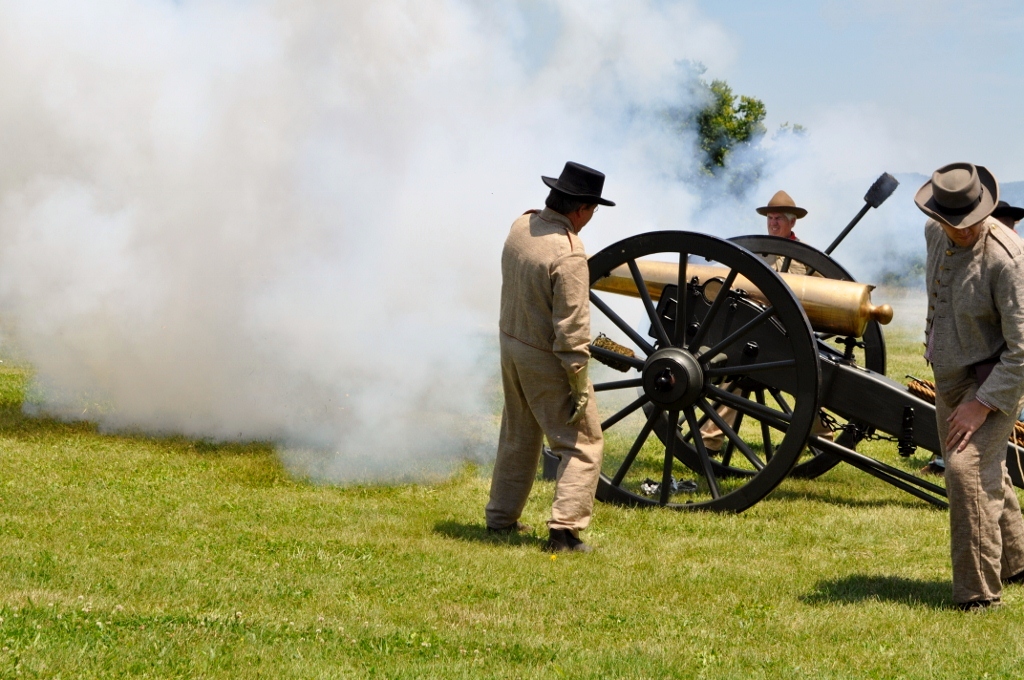
This weekend featured some living history re-enactors portraying S.D. Lee’s Artillery – the Confederate guns posted at Antietam at the spot where the visitor’s center is today.

They were firing with one-half the load, with no projectile of course … but even so, the concussion of sound is very, very impressive.

150 Years Ago Today – The Battle of Port Republic

<A fuller understanding of the larger context of this battle would be gained from reading these remarks in conjunction with yesterday’s post on the Battle of Cross Keys.>

On this date of June 9th, 1862 – a Monday – the final conflict of Stonewall Jackson’s Valley Campaign transpired just north of the town of Port Republic, VA. A total of about 3,000 Union forces of General Shields, along with at least six artillery pieces, were deployed on a high mound called

The Frank Kemper Home in Port Republic – also known as the Turner Ashby House – where Ashby was taken after his death – visited there by Lee… is now the Port Republic Museum

the “Coaling” and stretched acrosss a plain to the west (facing south). It was a strong position… attacked unsuccessfully by the Stonewall Brigade – that was driven back about one-half mile toward town. There in Port Republic, Confederate reinforcements from Ewell (victorious a day earlier at Cross Keys) joined to counter-attack to the north. As well, they burned the bridge over the Shenandoah at Port Republic to prevent Fremont’s forces from following.

Especially assaulting the “Coaling” (an area bare of trees at that time – for the purpose of charcoal) – was the Louisiana Brigade of Richard Taylor. After a back and forth contest on the hill – with Union artillerists fighting with their implements – the Rebels proved successful in driving the Yankees back while capturing five guns.

The Valley Campaign was a near total success for Jackson, as it established his credentials for strategic fighting and accomplished the goal of diverting Union forces from more fully supplying and enhancing McClellan’s Peninsula Campaign. The focus will now shift to Richmond, as will Jackson’s troops to reinforce Lee’s defense of the Capital in the pending contests of the weeks ahead.

This is the view from atop the “Coaling” looking to the SW – Union troops at the outset would have attacked toward the south from the plain to the right of the picture. This is the view of Union artillery.

As I wrote in a previous blog post, while atop the “Coaling” a tour bus pulled up with a group being led by no less than Ed Bearrs!!