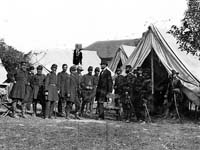
In the Valley of the Shadow

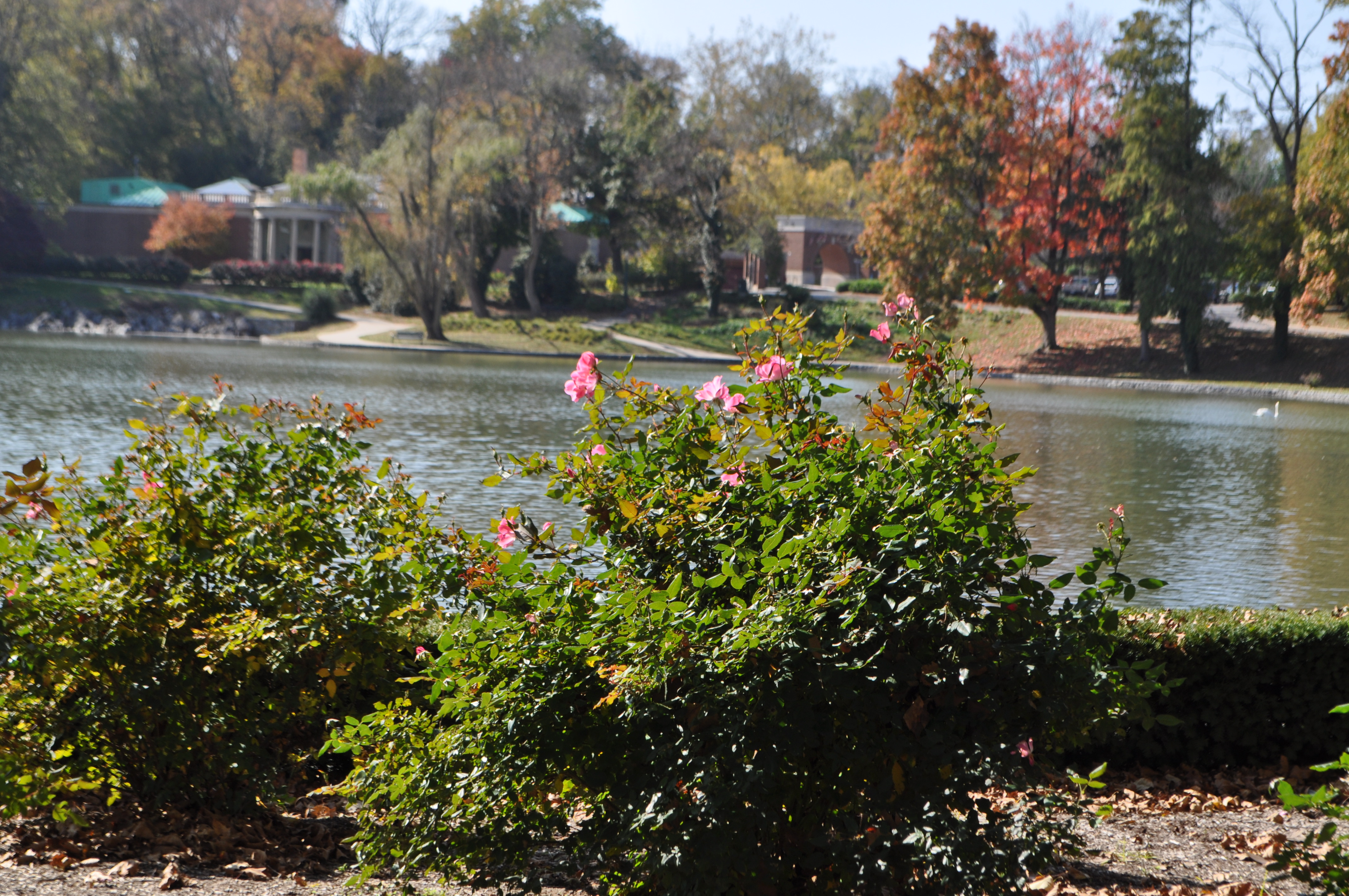
Ten miles north of Antietam/Sharpsburg is the city of Hagerstown. The Washington County Museum of Fine Arts currently features a one-year special display of items related to the Civil War, along with their regular displays of art, sculpture, etc. The museum is nestled in the beautiful City Park on the shore of a lake, near the location where Jonathan Hager first settled.
My Rotary Club this week had its luncheon and program in the atrium of the museum, affording our membership the opportunity to be briefed upon and view this special display entitled “In the Valley of the Shadow.”  Items speak especially to the variety of issues and circumstances of particular interest to our area – many having a connection to the local community – as well as the broader Civil War. The idea for this exhibit is to have the presentation run roughly for the period of time from the sesquicentennials of Antietam through Gettysburg.

Displays include combat and military life, Civil War medicine, African-American history, everyday life during the war, post-war commemorative objects, photographs, period publications, stereographic images, art, music and literature.
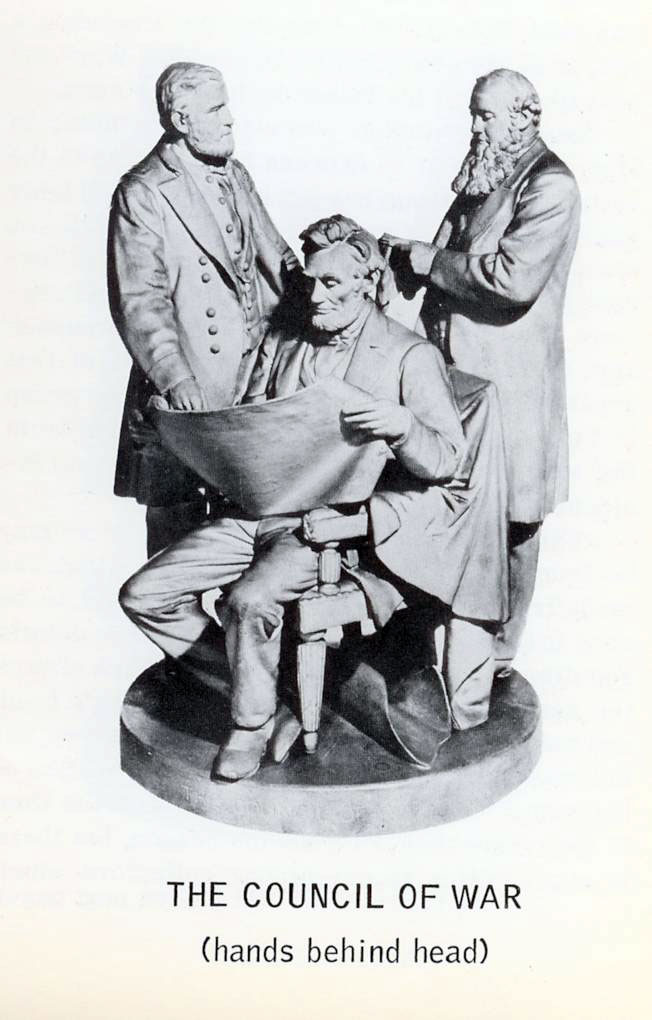
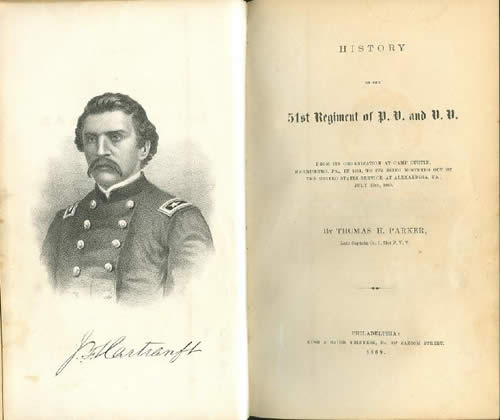
A copy of one of the items on display

Having recently in this blog quoted from the history of the 51st Pennsylvania Regiment, I was drawn especially to a portrait of this unit’s Colonel John F. Hartranft. It is loaned for this display from the nearby Pennsylvania school Mercersburg Academy (then called Marshall College), where Hartranft was once a student. Among other displays on loan are items from the Civil War Museum in Harrisburg, and pictures and cards from the collection of our own Battlefield Guides founder Steve Recker.

But the items I was especially interested in were a collection of four statues from the Rogers group. This piqued my interest due to my former book project research on the life of Abner Doubleday, who referenced these in some papers I found in the baseball Hall of Fame in Cooperstown, NY.  Though I am an “artsy” person in the area of music – having an undergraduate B.Mus. degree – I am NOT astute whatsoever in the area of visual arts and sculpture. So this reference of Doubleday sent me researching. The following text in blue is an excerpt from my first chapter on the life of Doubleday – writing this in an extended section on his spurious connection to the history of the sport of baseball.

One reference actually does exist of Abner Doubleday penning the word “baseball.” Near the end of his military career in 1871 he was stationed at Fort McKavett, Texas as the colonel in command of the 24th U.S. Infantry Regiment. This was one of four army units that were entirely African-American. To the Army’s Adjutant General in Washington he wrote:

“I have the honor to apply for permission to purchase for the Regimental library a few portraits of distinguished generals, Battle pictures, and some Rogers groups of Statuary, particularly those relative to the actions of the Colored population of the south. This being a colored regiment, ornaments of this kind seem very appropriate. I would also like to purchase baseball implements for the amusement of the men and a Magic Lantern for the same purpose. The fund is ample and I think these expenditures would add to the happiness of the men.”
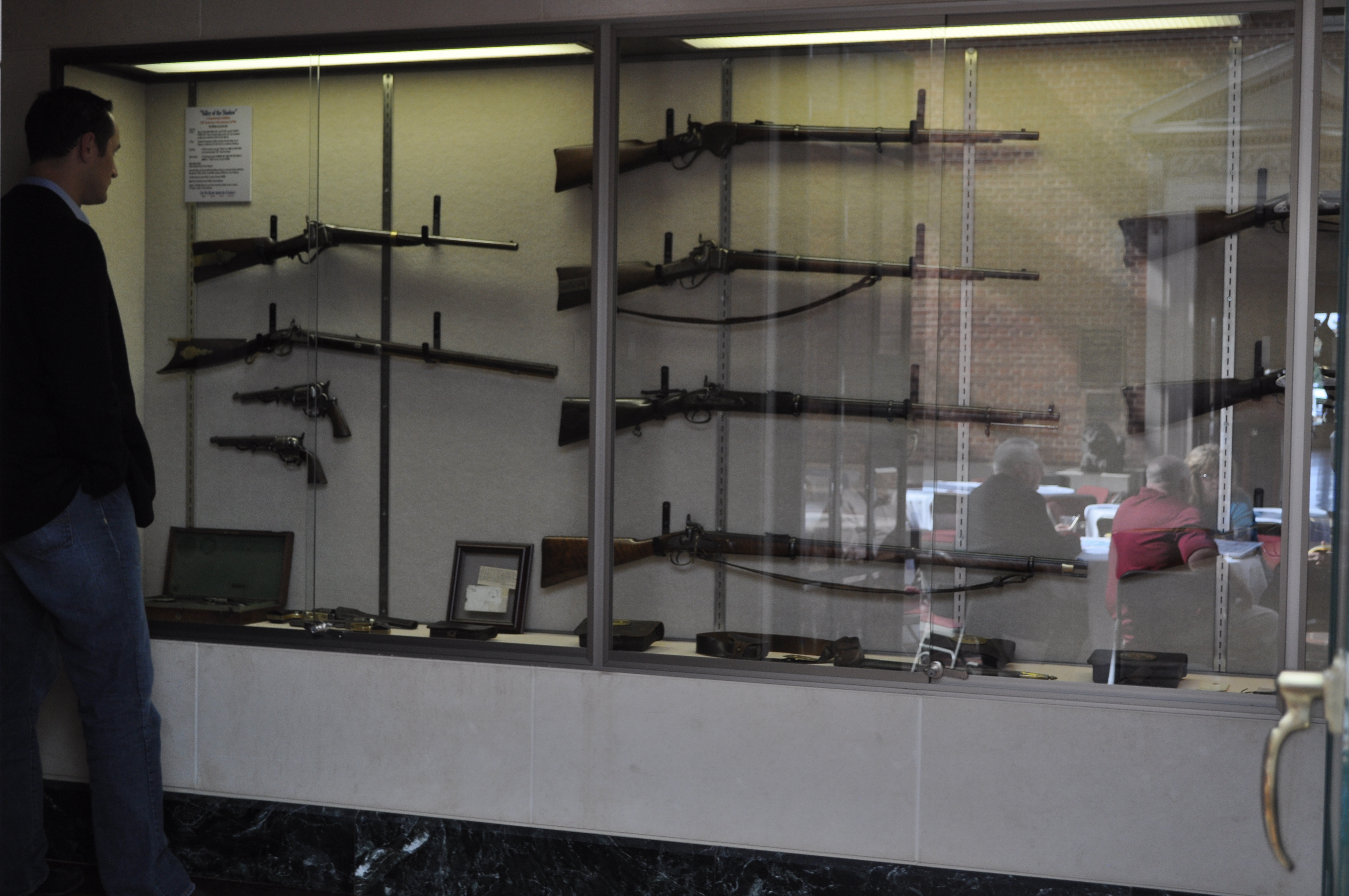
Referring to bats, balls and bases as “implements” hardly sounds like the vocabulary of the “alleged” inventor of the sport! The Rogers Groups of Statuary referenced a very popular form of durable plaster sculpture. The images pictured ordinary people performing ordinary deeds of life—depicting amusements, social customs, literary topics, historical figures, etc. The statues varied in size from eight inches to forty-six inches. Practically anyone of means in Victorian America possessed them, and the announcement of a new issue was cause for much publicity. The social interests and educational concerns of Doubleday may be seen in this request for the benefit of his regiment. The “Magic Lantern” was the name of an immensely popular 1870 invention that may be thought of as the ancestor to the modern slide projector.

The statues at the museum are really very cool, and I can see why they were popular. I suggested in conversation with Museum Director Rebecca Massie Lane that the collecting of these sculptures by folks in the 1800s was a sort of “lava lamp” of the day.  She had a better analogy – that it was similar to people who might collect the series of paintings of Thomas Kinkade.

This display runs through July 28, 2013. The Washington County Museum of Fine Arts may be found online at www.wcmfa.org and a listing of special speakers and events related to it may be found HERE.

This “slave auction” is also on display – presenting a compelling look at the faces of each character.
Antietam Aftermath – Part Five – Bloody Lane

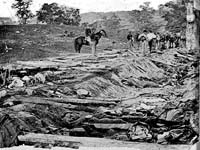
Scenes Along the Sunken Road (Bloody Lane)

Over a number of blog posts, I want to share with readers a series of descriptions of the scenes surrounding the Sharpsburg area in the days and weeks after the Battle of Antietam. Most of these will be through the eyes and pen of George F. Noyes – a lawyer from Maine who was a part of Abner Doubleday’s staff – and who wrote incredibly descriptive and moving prose in his 1863 book The Bivouac and the Battlefield.

This fifth post in this series continues the written account of Noyes’ early ride around the battlefield. His words will be in italics; my additional comments within <brackets like this>.  He wrote:

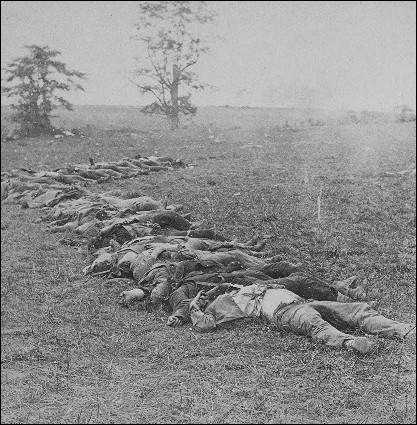
One more scene in this battle-picture must be seen, and with a visit to this our ride may end. It is a narrow country lane, hollowed out somewhat between the fields, partially shaded, and now literally crowded with rebel corpses. Here they stood in line of battle, and here, in the length of five hundred feet, I counted more than two hundred of their dead. In every attitude conceivable-some piled in groups of five or six; some grasping their muskets as if in the act of discharging them; some, evidently officers, killed while encouraging their men; some lying in the position of calm repose, all black and swollen, and ghastly with wounds, this battalion of the dead filled the lane with horror. As we rode beside it – we could not ride in it – I saw the field all about me black with corpses,

Perhaps that is Noyes on the horse on the north side of the lane? Not likely, but not impossible either!

and they told me that the cornfield beyond was equally crowded. <This description would indicate that he was riding on the Union side – the north side of the lane – for the cornfield along the sunken road was on the south side of the lane, and surely would have indeed contained more Confederate dead.>  It was a place to see once, to glance at, and then to ride hurriedly away, for, strong-hearted as was my then mood, I had gazed upon as much horror as I was able to bear. As we rode back, I noticed close by the lane several trenches already covered in, one with a strip of wood at its head marked with this inscription: “Colonel Garland and eighty dead rebels.” < I am simply unable to understand who Noyes is talking about here. One would think of Samuel Garland – the General killed three days earlier at Fox’s Gap, but it cannot be him (see my further remarks below). I conclude that Noyes is mistaken on this point as to the name he saw and reports.>  Details of our soldiers from the various regiments were collecting their comrades, bringing in the bodies on fence-rails, identifying them, and laying each in his own separate grave, with a head-piece inscribed with his name and regiment. Of course I cannot personally speak with positiveness as to the comparative numbers of the dead on each side, but from my own observation, and the opinions of old experienced officers, our late foes seemed to outnumber our own dead in the proportion of four to one. <Though this may have been true at certain places, overall, this is a great exaggeration of the numbers.>  Two days of laborious sepulchral will be necessary before they are hidden away in the bosom of our cherishing mother; during two days more of sunlight and darkness, of hot noontide and chilly midnight, must some of these poor mangled forms lie here untouched, untended, to be hurried by stranger hands at last into a common and nameless grave. <The following is an outstanding example of the writing skills of Noyes – that cause me to be drawn to his prose as a master of English language syntax and communication.>  Thank God that to the former occupants of these defaced bodies, now dwellers in far other mansions, the fate of these their former habitations is no longer of interest. Not for these poor shipwrecked forms, then, need we reserve our pity, but for the broken circles of which every man among these unburied thousands formed a part – for the homes throughout the South and the North made wretched this day with the first hints of their new sorrow – for the widow, the orphan, the lover! Oh war! war! war! Out of this sad presence silently we rode toward the setting sun, to find our head-quarter tents pitched on the edge of the battlefield, and to be soon seeking in sleep forgetfulness of war and all its horrors.

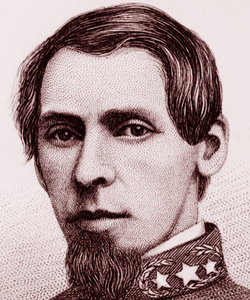
Regarding Samuel Garland – One might speculate that the troops of Garland’s Brigade – who fought at west end of Bloody Lane near the Hagerstown Turnpike – might have carried with them the body of their fallen leader from three days earlier …. And to speculate further that he was called “Colonel” because of his beloved association in that rank for the 11th Virginia… And to imagine he was temporarily buried there … yes, far-fetched, but there is to my knowledge no other Colonel Garland.

But this cannot be the case, according to this following excerpt from the 1996 issue of America’s Civil War:  Garland’s remains were escorted home to Lynchburg by his cousin and aide-de-camp Lieutenant Maurice Garland. By order of the City Council, his body was to lie in state in the Lynchburg Courthouse for a period of 24 hours. On Friday, September 19, 1862, Garland’s funeral was conducted at St. Paul’s Episcopal Church, with interment following at Lynchburg’s Presbyterian Cemetery. Garland was buried in the Meem family plot alongside his wife and young son. By resolution of the Lynchburg City Council, all business establishments were closed, all churches were ordered to toll their bells, and all soldiers then in the city were detailed to march in the procession. Almost the entire population of the city attended the ceremony for the much admired citizen who, in the words of The Lynchburg Virginian, ‘hated war, but excelled at it.’

Of this Confederate leader, D.H. Hill wrote in his after-action report: Brigadier-General Garland was killed at South Mountain–the most fearless man I ever knew, a Christian hero, a ripe scholar, and most accomplished gentleman.

Antietam Aftermath, part 4, from the 51st PA

As a part of my series of posts on the aftermath of the Battle of Antietam, here I offer an excerpt from the well-written history of the 51st PA Volunteer Infantry. Of course, all of those familiar with the details of the Battle know that this was one of the two regiments that successfully captured the stone crossing later to be known as the Burnside Bridge.

As throughout this series, the excerpt will be given in italics, whereas my remarks will be contained <in this fashion>.

October, 1862, was a month of peace and rest to the Union forces comprising McClellan’s army. Citizens began now to flock on the battlefields of South Mountain and Antietam from the North, hunting up the remains of their deceased relatives and friends, with the object of taking them home for Christian burial. <I reference the reader to connect to my friend’s great blog called “John Bank’s Civil War Blog” for story after story of this very thing.>

On Friday, October 3d, a grand review was got up in honor of the illustrious President of the United States, Abraham Lincoln, by the whole body of troops there encamped. President Lincoln reviewed the troops with evident satisfaction, passing in front of each regiment and returning the salutation with dignified grace, his appearance among them causing much enthusiasm. <This section of the history of the 51st really pictures the growing affection among the troops for Lincoln, as well as the growing disaffection for McClellan.>

While at this camp, a portion of the clothing that the men had left behind them at Fredericksburg arrived, adding something more to their comforts.  <Throughout the Union Army, the men had weeks before tossed much of their cold weather equipage to lighten the loads for long marches. So many of the writings from this time speak of wishes that now, with the changing season, they had not done so!>

Orders of the most stringent character against straggling were issued by McClellan, and were read off to each company separately, causing a more mutinous feeling in the army than all the previous orders combined could have done; in fact, the troops as a body had very little confidence in him as a leader, but they had the utmost confidence in his capacity as a promulgator of severe and useless orders; and whatever his prestige and glory might have been, his tyranny to his army had turned all kindly feelings into dislike; for man, partaking of the nature of a “hog,” can be coaxed, but not driven, if he once resolves to be stubborn, even in the army; and the warmest advocates for his military prowess began to designate him as “only a newspaper general,” meaning thereby that he was only made a great general through newspaper puffs.

<The text goes on to speak of a movement of their location from the area near Sharpsburg, to pass over a spur of South Mountain to the southeast to take them into Pleasant Valley. Here they again camped for an extended time, actually must closer to Harpers Ferry than to Sharpsburg. And then the writer picks up again on another straggling order from McClellan … >

On the 15th another order from McClellan was read against straggling, and was still more stringent than any of his former ones, for one section ordered the shooting down of the footsore, famishing, and diarrhea-stricken soldiers. Straggling on a march, as must be acknowledged, is one of the most pernicious vices that ever existed in the army, but it could have been greatly lessened by an ordinary amount of prudence and a little humanity on the part of the commanding officers. The causes for straggling are to be confined principally to the following reasons. First, men being poorly rationed will leave the column and wander off to any house from which they think they can buy, beg or steal food. Secondly, being hurried on the march, their strength fails from not having sufficient rest and food. Thirdly, from being compelled to wear shoes that have little or no shape to them, and (facetiously termed “gun boats” by the men,) are either too large or too small, consequently blistering the feet to such an extent that makes it impossible to keep up with the column when on a rapid march, for in drawing shoes they must take whatever they can get, whether they fit or not. Fourthly, the constant exposure to all kinds of weather while on the march—heat in the day and cold at night, rainy weather, perspiring freely, then lying down to sleep in the open air and becoming chilled, diarrhea and dysentery, chills and fever, and other ailments setting in—debilitates the soldier so that his weakness causes him to lag behind even when he is most anxious to keep up. Take the cases of straggling produced by the above four causes, aggregate them with all others, such as shirking, &c., and it will show a decrease of at least ninety percent. This is no imaginary calculation, but it is from actual observation, and the officers who would advocate the shooting down of all stragglers, have none to censure for the cause but themselves and their own inhumanity, for on all marches the commanding officers have horses to carry them, and it is very easy for those on horseback to say to a poor cripple who is staggering beneath a heavy knapsack, sixty to one hundred rounds of cartridges, a musket and his other accoutrements, “Get up here,” or “go to your regiment.”  <It certainly seems from the amount of time given to this topic in the text that it was a big issue to the men of the 51st and remained a lasting negative memory from their War experience.>

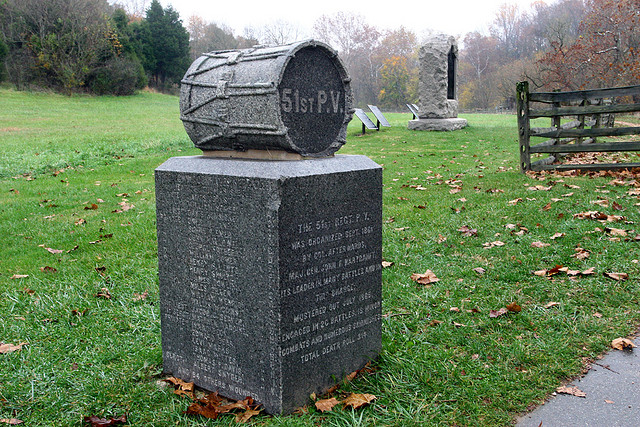
51st PA monument at Antietam

Congratulatory orders were received by the two 51sts from Gen. McClellan, complimenting the two regiments in most flattering terms for taking Antietam bridge, in which he said “the whole day’s fighting would have been lost if you had not succeeded in taking that most important point, the bridge.”

This order was accompanied by one of the same character from Gen. A. E. Burnside. …

On Sunday night, October 19th, the camp of the 51st P. V. was visited by a hurricane, accompanied by a heavy rain; the wind picking up the little shelters and carrying many of them to a great distance, leaving the inmates to receive the drenching rain that was pouring down. Whether the storm had carried away important bridges or not it is hard to say; but a detail was made of all the carpenters in the regiment to go to put up bridges over the Potomac, near Harper’s Ferry, which was two and a half miles distant. …

On Monday morning, October 27th, 1862, the 51st P. V. struck tents and left Pleasant Valley, Washington County, Md., on a march through Virginia, bringing up at Fredericksburg.  

<The following series of pages detail their varied marches and experiences that would take them to Fredericksburg for the mid-December battle at that location. I’ll include some more excerpts certainly at that time.>

Antietam Aftermath – Part Three

Sights around the Dunker Church

Over a number of blog posts, I want to share with readers a series of descriptions of the scenes surrounding the Sharpsburg area in the days and weeks after the Battle of Antietam. Most of these will be through the eyes and pen of George F. Noyes – a lawyer from Maine who was a part of Abner Doubleday’s staff – and who wrote incredibly descriptive and moving prose in his 1863 book The Bivouac and the Battlefield.

This third post in this series continues the writing of Noyes’ early ride around the battlefield. His words will be in italics; my additional comments within <brackets like this>.  He wrote:

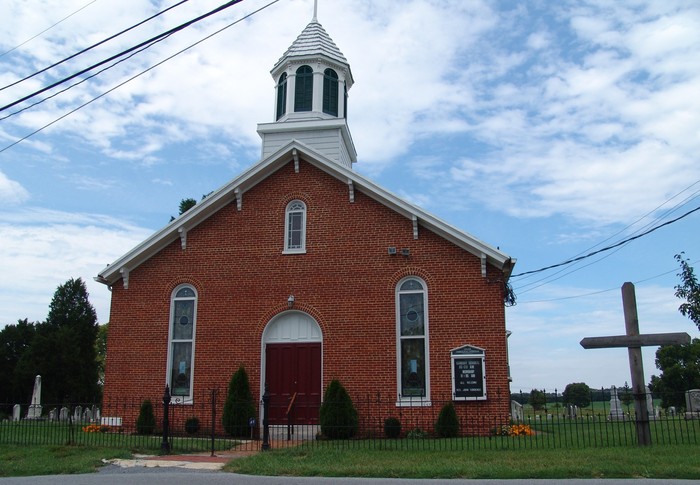
Over this graveyard of the unburied dead we reached a wood <referencing the West Woods>, every tree pierced with shot or cut with bullets, and came to the little brick church on the turnpike. This must have been a focal point in the battle, for a hundred round shot have pierced its walls, while bullets by thousands have scarred and battered it. <It is interesting how he states that it “must have been a focal point” … indicating how he was not within sight of it during the action. Probably by the time Noyes arrived on the field – probably about 8:00 – the fog of battle would have made it invisible to him in the area of the Miller farmhouse where he caught up to Doubleday. But before the battle at dawn of day, the white church stood out from a long distance to the north woods.> A little crowd of soldiers were standing about it, and within, a few severely wounded rebels were stretched on the benches, one of whom was raving in his agony. Surgical aid and proper attendance had already been furnished, and we did not join the throng of curious visitors within. Out in the grove behind the little church the dead had already been collected in groups ready for burial, some of them wearing our own uniform, but the large majority dressed in gray. No matter in what direction we turned, it was all the same shocking picture, awakening awe rather than pity, benumbing the senses rather than touching the heart, glazing the eye with horror rather than filling it with tears. I had, however, seen many a poor fellow during my ride, something in whose position or appearance had caused me to pause, and here, lying side by side with three others, I saw a young rebel officer, his face less discolored than the rest, whose features and expression called forth my earnest sympathy, not so much for him as for those who in his Southern home shall see him no more forever. No one knew his name among the burying-party, and before night he was laid in a trench with the rest, with no head-stone to mark his resting-place, one of the three thousand rebel dead who fill nameless graves upon this battlefield. So ends the brief madness which sent him hither to fight against a government he knew only by its blessings against his Northern brothers, who never desired to encroach upon a single right or institution of his who were willing that he should hug to his breast forever the Nessus shirt of slavery, <This refers to the account in Greek mythology about the poisoned shirt that killed Heracles. It has been an oft popular reference in literature, and is common in the mid-19th century Civil War writings.> asking only that he did not insist upon forcing its poison-folds over their shoulders also. So disappears the beloved of some sad hearts, another victim of that implacable Nemesis – who thus avenges upon the white man the wrongs of the black, and smiles with horrid satisfaction as this fearful game of war goes on.

Noyes was a passionate abolitionist, as were so many of the officers and staff gathered in Doubleday’s command.

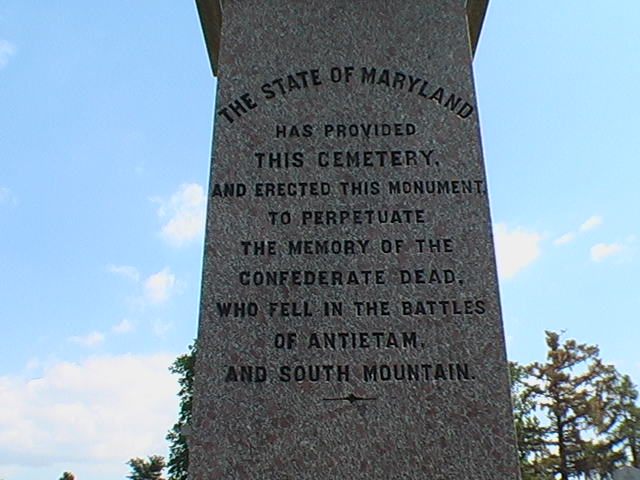
The Confederate dead would find their final resting place beyond Sharpsburg, the largest number of them being buried in the Rose Hill Cemetery in Hagerstown. This monument stands over the grassy field of the mass graves of these soldiers.

John Gibbon’s Recollections of the Weeks after Antietam

Antietam Aftermath – part 2

This is the 2nd in a series of posts on the scenes of devastation and army life after the Battle of Antietam – over a period of six weeks when the Army of the Potomac was in large part sitting still in Washington County, MD.

John Gibbon

The following is an excerpt from the writing of John Gibbon – from his book “Recollections of the Civil War.”  This was completed writing in 1885, though it was not published until 1928 by his daughter.

Gibbon, of course, was the commander of the famed Iron Brigade – the Black Hatters who fought so well in the cornfield and along the Hagerstown Pike west of that 30-arcre rectangle of death.

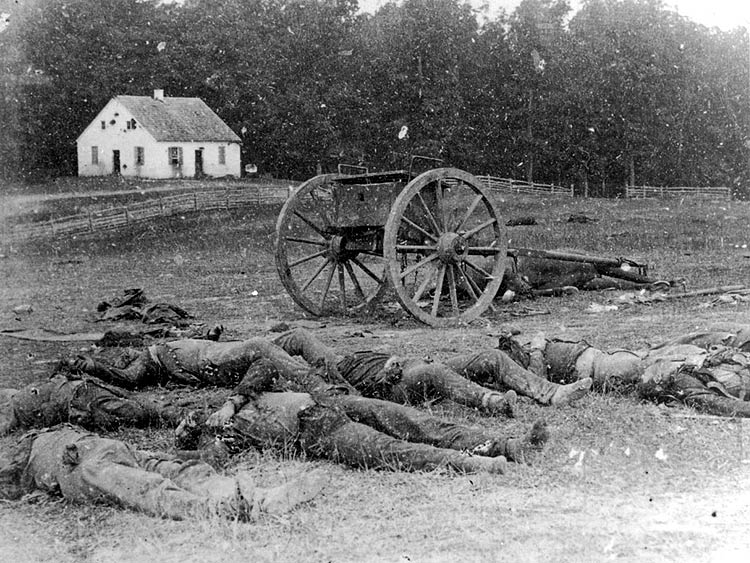
The battlefield as we marched through it demonstrated the severe conflict which had taken place, the ground in places being literally covered with dead bodies, they being especially numerous in the open field in front of Battery “B” along the fence bordering the turnpike. In the cornfield the bodies, in some cases, were piled on top of each other. Every house and barn in the vicinity was crowded with the wounded of both sides and the Sanitary Commission was kept busy distributing comforts and supplies of every kind to all. <This is of course describing the intense conflict in the southwest corner of the cornfield and to the west of it where Gibbon had placed his artillery – the 4thUS Artillery, Battery “B” from the regular army – called Campbell’s Battery at Antietam. An aggressive attack of Hood’s Texans resulted in a terrible carnage on both sides – particularly in the cornfield itself.>

A winter view looking west from the cornfield at the location of Battery “B” … with Nicodemus Heights clearly visible in the background

For weeks following the battle of Antietam, few movements were made while great quiet reigned along the line of the Potomac, varied by a visit from the President <October 2nd-4th> and a raid around the army by “Jeb” Stuart on the 10th of October which he made with little loss to himself, and a good deal of unfavorable comment, on our side, where it was not understood why all such raids should be confined to the “other side.”

I took advantage of the inaction to pay a short visit to my family in Baltimore, and after remaining there a few days, returned on the 14th by the “B.&O.” railroad to Point of Rocks with Sen. Ira Harris of New York on his way to visit the army. <Harris became a senator in 1861 – taking the place of William Seward who became Secretary of State. Harris’ daughter was the female guest of the Lincolns at the Ford Theatre on the night of the President’s assassination.> He, like everybody else I met on my trip seemed to be anxious to know “when the army was going to move.” The question was asked over and over again, “Why does not McClellan move?” So strong had become the feeling at the delay that I returned to the army impressed with the conviction that unless a move took place very soon, McClellan would be relieved from command, and so I expressed myself to a prominent member of his staff. The most important reason supposed to be for delay was the lack of supplies and it is certain when the army did at last move on the 26th of October the equipment of the men was not as complete as it should have been and might have been though Lee’s army must necessarily have been worse off than we were.

pp. 92-92 of Recollections of the Civil War

12 Years Ago Today

On this date in 2000, the terrorist explosion of the USS Cole took place, claiming the lives of 17 young men. Among the victims were two from Washington County, including one who was buried in the National Cemetery at Antietam – a location not far from his family home in Keedysville. Here is a picture of the grave of Patrick Roy that I took just this afternoon.

Grave of Patrick Roy on the 12th anniversary of his death on the USS Cole

Post-Antietam Descriptions – Part One

Over a number of blog posts, I want to share with readers a series of descriptions of the scenes surrounding the Sharpsburg area in the days and weeks after the Battle of Antietam. Most of these will be through the eyes and pen of George F. Noyes – a lawyer from Maine who was a part of Abner Doubleday’s staff – and who wrote incredibly descriptive and moving prose in his 1863 book The Bivouac and the Battlefield.

This first excerpt describes the scene along the Hagerstown Turnpike in the area of the famous Miller Cornfield. His words will be in italics; my additional comments within <brackets like this>.  He wrote:

Let us first turn off to the left of the Hagerstown Turnpike; but we must ride very slowly and carefully, for lying all through this cornfield are the victims of the hardest contest of our division <speaking of Doubleday’s Division of Hookers 1st Army Corps>.  Can it be that these are the bodies of our late antagonists? Their faces are so absolutely black that I said to myself at first, this must have been a negro regiment. Their eyes are protruding from the sockets; their heads, hands, and limbs are swollen to twice their natural size. Ah! there is little left to awaken our sympathy, for all those vestiges of our common humanity which touch the sympathetic chord are now quite blotted out. These defaced and broken caskets, emptied of all that made them manlike, human, are repulsive merely. Naught remains but to lay them away quietly, where what is now repulsive shall be resolved into its original elements, shall be for a time “Brother to the insensate clod Which the rude swain turns with his share, And treads upon,” and shall reappear in new forms of life hereafter. <The quote is a poetic reference to the decomposition of death from an 1817 poem by William Cullen Bryant called “Thanatopsis”.  In researching the reference, I found it also quoted in a couple of regimental histories… must have been well-known.>  Passing through this cornfield, with the dead lying all through its aisles, out into an uncultivated field beyond <he is moving south through the cornfield, and now describing the scene where today would be the parking area along the park road called “Cornfield Avenue”>, I saw bodies, attired mainly in rebel gray, lying in ranks so regular, that Death the Reaper must have mowed them down in swaths <Hooker’s report stated a very similar observation: “the slain lay in rows precisely as they stood in their ranks a few moments before.”>. Our burying-parties were already busily engaged, and had put away to rest many of our own men

Dead being buried to the west of the cornfield at Antietam

<generally speaking, the home team guys got buried first>; still, here as everywhere, I saw them scattered over the fields. The ground was strewn with muskets, knapsacks, cartridge-boxes, and articles of clothing, with the carcasses of horses, and with thousands of shot and shell. <He next begins to describe the scene to the northwest and west of the cornfield.> And so it was on the other side of the turnpike, nay, in the turnpike itself; ride where we may, through cornfield, wood, or ravine, and our ride will be among the dead until the heart grows sick and faint with horror. Here, close to the road, were the haystacks near which our general <this is how he references Abner Doubleday throughout the book> and staff paused for a while when the division was farthest advanced, and here, at the corner of the barn, lay one of our men, killed by a shell, which had well-nigh proved fatal to them also. <I don’t know if this is the same shell, but Doubleday wrote in his report after the battle that, “A shell exploded under my horse’s nose in the beginning of this action on the 17th. This caused him to run over some steep, sharp rocks. He fell, and I was very much bruised and unable to hold the reins in my hands for a long time.”>

Keep checking back for more posts of this sort – detailing the time after Antietam – 150 years ago this season of the year.

150 Years Ago: Battle of Perryville

The largest battle of the Civil War in Kentucky took place on October 8, 1862 in Perryville (a.k.a. Chaplin Hills, from the location west of Perryville).

The battle could be considered a tactical Confederate victory, yet also a strategic Union victory.

Braxton Bragg’s Army of Mississippi of about 16,000 engaged the single corps of Major General Don Carlos Buell’s Army of the Ohio (37,000). With total casualties of about 4,400 Union to 3,400 Confederates, the Rebels retreated to the Cumberland Gap into Tennessee, hauling off large amounts of grain and supplies stolen from Kentucky.

The Union retained the critical control of the border state of Kentucky for the rest of the War. However, for allowing Bragg’s force to slip away, Buell would be replaced by General William Rosecrans two weeks later.

Lincoln’s Final Day at Antietam

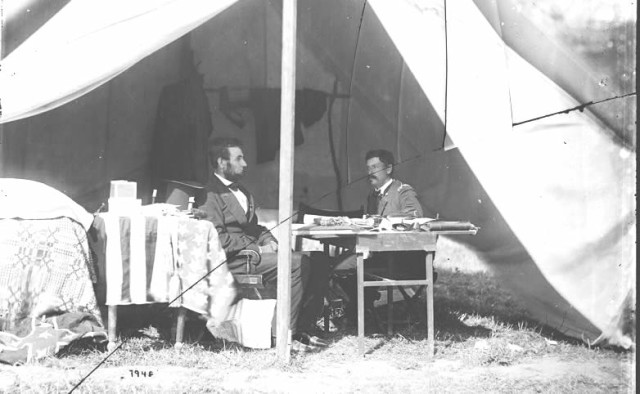
It was 150 years ago on the date of October 4, 1862 that Lincoln departed Antietam and headed back to Washington after his surprise visit of McClellan and the Army of the Potomac.

On the previous day – the 3rd – Lincoln reviewed troops of the 1st and 6th corps in the hamlet of Bakersville. This is the tiniest of villages about two miles north of the battlefield. It was comprised of a Lutheran church built in 1854, a single room schoolhouse, and but a few houses. The recent sesquicentennial reenactment was held on farm fields adjoining the church property. When I drive from my home to meet guests at Antietam, I pass through this village and past this school and church, and I always think of that day when Lincoln was there to greet the troops.

The New York Herald said of this event, “At the review of each corps the people collected in large numbers, and manifested the greatest enthusiasm in meeting the President and ‘Little Mac.’”  For what it is worth, neither of the primary sources that I often quote about my particular interest in the 1st Corps mention this event (the History of the 76th NY / Noyes book – The Bivouac and the Battlefield).

The final stop for Lincoln on the 4th of October as he departed the area of Sharpsburg was to visit in the Pry House. This 1844 home was the location of McClellan’s Headquarters during the battle. At this time, with McClellan having moved elsewhere, it was used for hospital purposes – specifically for General Israel Richardson. The divisional commander under Bull Sumner in the 2nd Corps was wounded severely near the location of the present day tower at the high end of Bloody Lane. He would die in the upstairs bedroom of the Pry House six weeks after the battle. On this 4th day of October, he was to be granted a special visit by President Lincoln.

The home is a beautiful site to this day. For those who visit Antietam during the tourist season, it is open to see an excellent presentation of many objects related to Civil War medicine (this is under other auspices than the Antietam National Battlefield). But any time of year, it is a worthy stop for the guest to walk around the house – especially to step upon the observation deck that affords the same beautiful view of the battlefield as McClellan was able to see, along with his headquarters staff of officers.

150 Years Ago Today: Lincoln Visits Antietam

On this date of October 2nd in 1862, President Lincoln arrived in the Sharpsburg area from Harpers Ferry in a trip to visit the Army of the Potomac and General McClellan largely unannounced. Along with a genuine heart for the soldiers and expressing his appreciation for them, he hoped as well to goad McClellan after the Rebels in an effort to strike them while bruised and shaken. The President would continue his stay through the morning of the 4th.

During this time, the President and his General viewed portions of the battlefields of Antietam and South Mountain, along with a variety of meetings and discussions. Little is recorded of them, though perhaps the best glance behind the tent flaps comes from a Lincoln letter to McClellan from a week after the visit – after McClellan was still in place and requisitioning supplies. He wrote, “You remember me speaking to you of what I called your over-cautiousness. Are you not over-cautious when you assume that you cannot do what the enemy is constantly doing? Should you not claim to be at least his equal in prowess, and act upon the claim?”

An oft-told story of this visit is of a conversation between Lincoln and his confidante and Illinois friend Osias Hatch. From a hillside overview of the vast Union forces, Lincoln asked, “Do you know what this is?”  Hatch simply replied that “It is the Army of the Potomac.”  Lincoln’s response was, “So it is called, but that is a mistake; it is only McClellan’s bodyguard.”

Within days of the visit, a peremptory order came to McClellan through Halleck – commanding him to move to strike a blow to the enemy. Halleck declared that “Your army must move now while the roads are good.”  But it would be another three weeks before the Army departed to the south.

Oliver Wendell Holmes at Antietam and After

One of the great human interest stories is that of Oliver Wendell Holmes, Jr… wounded at Antietam in the West Woods, ultimately to recover and live into his 90s as the Chief Justice of the US Supreme Court.

Holmes was a Captain in the 20th Massachusetts regiment. They were a part of Sedgwick’s advance into and through the West Woods – even to a cornfield beyond. At the height of the Confederate counter-attack (an “enfilading lines” attack!), Holmes was shot through the neck and presumed to be a goner. In fact, a surgeon examined him and declared, “I’ve no time to waste on dead men.” A friend insisted he be helped and carried from the field. He received care at a local home, then at a house in Keedysville, and eventually by a staunch Unionist family in Hagerstown named the Kennedys.

Eventually he was well enough to travel home to Boston. His famous literary father had come looking for him – without success – though ultimately finding him on a train departing Hagerstown. They travelled together home to Boston, where the younger Holmes would convalesce from his wound.

I have a very old copy of a book on the life of Holmes, entitled “Yankee from Olympus: Justice Holmes and His Family,” by Catherine Drinker Bowen, 1944. The description of Holmes back in Boston during this time essentially presents a man suffering from a condition we moderns know as Post-Traumatic Stress Disorder. He was aloof, depressed, confused … not at all the young man that family and friends remembered.

Here is an excerpt:

To Wendell it seemed incredible that people would ask for stories of the battlefield as for tales of a circus, or of a boat race on the river Charles. He had forgotten his own eager garrulousness after Ball’s Bluff – a battle in which he had not seen ten minutes of fighting before being carried unconscious from the field. What he knew now of battlefields was better forgotten, but Wendell could not forget. Dead men sprawled among the corn, naked, stripped of trousers and boots, eyes staring, limbs flung out in awful abandon. For those boots and trousers the Rebels had fought like tigers. If the North fought for “victory,” for “Union,” “freedom,” the South fought for shoes to put on its bleeding feet, pants for its legs, and fought no less bravely. Here on the streets they called the Rebels cowards. They were not cowards.

Cowardice, gallantry, chivalry – how wearily a soldier, returned from the field, met such words? At home they thought of battle as if it were fought on Boston Common. As if a man came down the steps of his house pulling on his gloves, smoking a cigar – then got on his horse and charged a battery up Beacon Street while the ladies waved handkerchiefs from a balcony. What really happened was that you spent the night on the wet ground with your bowels open and fought on a breakfast of salt meat and dirty water.