Battle of Fredericksburg – 150 Years Ago

December 11-15, 1862 – Fredericksburg, VA

The huge Civil War Battle of Fredericksburg deserves so much more attention than I will be able to give it in this blog. As an Antietam guide, when I read and research about Fredericksburg, I am reminded of the immensity of it all on both occasions – how the more one learns, the more one knows he actually knows little relative to all that could be recorded.

BurnsideBriefly reviewed, upon replacing George McClellan, General Burnside’s plan was to move the Army of the Potomac quickly to Fredericksburg and then on to Richmond before Lee could successfully stop this action. It would be necessary to cross the Rappahannock River at Fredericksburg, and to do that would require the engineering feat of the construction of pontoon bridges. These were truly an ingenious system and very capable for the task.  But administrative foul-ups and delays, along with very poor weather, delayed the arrival of the pontoons. Enough time was lost that Lee was able to post his considerable forces on the high ground above Fredericksburg on the south side of the river.

An overview of the dates of the battle:

Pontoon Boats

Pontoon Boats

11th and 12th – construction of the pontoon bridges and crossing of the river by the Union Army – along with urban fighting in the city of Fredericksburg.

13th – the actual date of the battle, featuring waves of Union attacks upon Marye’s Heights upon the Rebel left flank, and the planned giant attack of Franklin’s Grand Division of 60,000 men against Stonewall Jackson on the Confederate Right.

14th and 15th – while still in place, the armies starred at each other and collected the wounded, and Burnside was talked out of any further action – with the Union retreating from the field on the 15th.

Significant Facts about Fredericksburg:

  • The first opposed river crossing in American military history occurred.
  • The first urban fighting of the Civil War occurred – as Barksdale’s Mississippi troops engaged the Federals in severe combat in the ruined streets of the city.
  • Fredericksburg was the largest battle of the War in terms of total numbers of combatants gathered at one location – in the range of 200,000.
  • The Union lost over 13,000 casualties – 2/3 of which piled up in front of Marye’s Heights. Confederate losses were a more modest 4,500.
  • While viewing this scene, General Lee spoke the famous quote, “It is well that war is so terrible, or we should grow too fond of it.”
  • A despondent Abraham Lincoln wrote, “If there is a worse place than hell, I am in it.”

I am going to include several personal accounts of the Battle of Fredericksburg over the coming days – tomorrow featuring a letter written by Clara Barton, and on the 13th giving the account of Frederick Hitchcock of the 132nd PA – which is quite a story.

fredericksburg pontoon bridges

Pontoon Bridges at Fredericksburg

Another Description of the Fredericksburg Pontoon Crossing

Following up on yesterday’s posts about the pontoon bridges that were such a part of the crossing of the Rappahannock River at Fredericksburg, here is an additional account on the same – this being written by Doubleday’s staffer named George Noyes in his book “The Bivouac and the Battlefield.” Published in 1863, it contains some strikingly similar remarks to the work of Smith in the history of the 132nd PA. I have noticed this before, and am beginning to wonder if Smith did not borrow ideas at times from the work of Noyes.

Writing about the events of December 11th, Noyes said: “Our entire army was now filling the woods and fields skirting the Rappahannock, and stood grimly face to face with the enemy. But the river must be crossed before the desperate storming of the Fredericksburg Heights was possible, and the laying the pontoon bridges was the first thing in order. … Here early in the day the pontoons were brought down to the river’s brink, and while our leading brigades looked on with almost breathless suspense, and the long line of our gunners on the heights overlooking the river stood ready to open fire at the least hostile demonstration, the laying of the two bridges was at once commenced—the one by the 15th New York Engineers, and the other by the United States Engineers.

[Here is where this is such a similarity to Smith’s remarks that I included in a post yesterday – where each render almost identical editorial opinions in their writing … though I suppose it could be that such was a very commonly held thought of infantrymen about the labors of bridge engineers.]  The work is simple enough, but I can conceive of no duty demanding more true courage. In the charge even of a forlorn hope, every man, as he grasps his musket, is fired by the common enthusiasm, lifted on the wave of a common excitement, feels to the tips of his finger-ends the martial inspiration; but this duty had in itself no warlike incitement—none of the fervid intoxication of a desperate charge; these men were for the nonce [this word means “for the present time or occasion”] not warriors, but bridge-builders, grasping not the musket, but the hammer; not borne forward in a rush of excited valor, but penned up in narrow boats, from which neither advance nor retreat was possible. Every plank they laid brought them, living targets, closer and closer to the rebel sharpshooters, now coolly sighting each his man from the rifle-pits on the other side. [This really must have been a very, very interesting sight – as literally thousands of men are watching this scene unfold!]

fredericksburg pontoon bridgesBut there was no hesitation. The boats were floated out into the stream; each in turn was brought into place; coolly and systematically the engineers united it to the rest with girders, upon which, one by one, they laid down the plank. Nearer and nearer to the opposite bank grow the floating causeways; already they are more than half way across; the anxious thousands watching so eagerly the operation are already beginning to breathe more freely; the silence and suspense are awful, when suddenly a line of fire fringes the rebel rifle-pits, and volley after volley from the rebel sharpshooters is poured upon the courageous workmen. Some are wounded; all fall at once into the bottom of their pontoons, where they are partially protected; and now our artillery posted on the heights sweeps the opposite plain with grape and canister. These terrific discharges soon make every rifle-pit too hot for its occupants, and finally drive every rebel out of his hiding-place. Once more the heroic workmen resume their task of peril, the last boat is floated to its place, the last girder spans from boat to shore; and as the foremost engineer leaps upon the bank, one long, loud, enthusiastic cheer relieves the pent-up excitement of ten thousand spectators, and renders to these brave men the homage of their applauding comrades.

Farther up the river, and just opposite the city, the point at which General Sumner’s right grand division was to cross—our engineers were not so fortunate … suddenly, at the report of a single rebel cannon … the rebel sharpshooters swept the unfinished bridge with their rifles, and three officers and twenty men fell killed and wounded before their murderous fire. To continue the work in the face of this continuous storm of bullets became simply impossible. … It had become evident that the rebel riflemen could not be dislodged from their hiding-places by artillery, and men were now needed who would cross in the pontoons and drive them out at the point of the bayonet. The call is for volunteers. Hundreds at once step to the front, men of Michigan and Massachusetts … With desperate strength the boats are speeding on their dangerous errand. In vain the rebel sharpshooters seek to check their progress; the shore is gained; with loud cheers our heroes rush up the bank, charge with the cold steel upon houses and rifle-pits, capture fifty prisoners, and put the whole rebel gang hors de combat, [Noyes is a lawyer, and writes here a French legal phase that literally means “outside of the combat”]  with wounds more or less severe, or send them flying toward the rear. Five minutes of this bloody work does the business, and they are soon re-crossing with their captives, having met with small loss, to be received by wild and tumultuous cheers and congratulations.

Hardly have these cheers died away before the bridge is finished, and at double-quick our impatient volunteers are crossing to secure and hold it. Nearly at the same period, by a sudden and gallant dash, the 87th Pennsylvania threw another pontoon bridge across a little below this, and now four floating ways span the Rappahannock, and afford free passage to the rebel lair. 

Pontoon Bridges – Simply Ingenious

We are approaching the sesquicentennial of the Battle of Fredericksburg (and a series of Enfilading Lines posts about it!). And whenever I think of this battle, my mind takes me to a consideration of what I view as fascinating pieces of engineering – the pontoon bridge.

Bridge at Appotommax

Example of a Pontoon Bridge – at Appotommax

Perhaps the most famous of these are the bridges built over the Rappahannock River at Fredericksburg. This was done under the sniping fire of Barksdale’s Confederates … who were themselves under fire from Union artillery. It was a difficult enough job to build a bridge floating on the water current, let alone to do it under fire. This is the first such encounter in American military history.

Pontoon boats were anchored parallel to each other with beams connecting them across the gunwales … followed by planks at a 90-degree angle to the beams. For a great article that describes not only the construction of pontoon bridges (and specifically those at Fredericksburg), but also gives a history of such engineering, click HERE.

Regarding the construction of the pontoon bridges at Fredericksburg, here is an account from his “Personal Recollections of the Civil War” by John Gibbon:

Early on the morning of the 11th our Corps (1st) started. A dense fog covered the whole face of the country and for a time concealed our movements but as it became lighter the sound of a cannon boomed out and the conflict began. As we neared the river, the sharp rattle of musketry could be heard up at the town where attempts were being made to throw bridges across. Down below where we were to cross, the opposition was but slight and only from skirmishers, the main line of the enemy being back on the hills beyond the broad flat which extended from the hills to the river. The skirmishers were driven away and the work of building our bridges and occupying the other bank of the river went on.

A.P. Smith, the author of The History of the 76th New York shares another account:

Early on the morning of the eleventh, the pontoons were brought down to the river’s brink and laid, one bridge by the Fifteenth New York Engineers, and the other by the United States Engineers, while the cannon stood, heavily shotted, upon commanding eminences, threatening destruction to the enemy in case he attempted to interfere with the workmen.

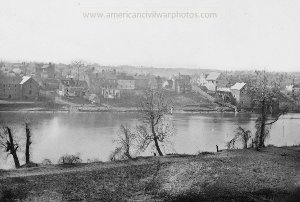
City of Fredericksburg

City of Fredericksburg

No duty requires more real courage than the laying of bridges, in the face of the foe. The excitements of the field prepare the soldier for the severest charge; but the engineers, without the stimulus of excitement, must march down to the stream, though the rebel pickets and sharpshooters threaten on the other shore. The bridges were, however, laid, and today crossed in the face of the enemy.

The seventy-sixth was ordered to guard the bridge to prevent any retreat of stragglers or others, even at the point of the bayonet, as the General said, because this Regiment could be depended upon in any emergency.

After the experience of the past few months, the glory of being shot at was not very highly prized. The men rather considered it good fortune when obedience to orders required their presence at a point not particularly exposed; and though in all the record of the Seventy-sixth, no instance can be found where, as a regiment, it sought to avoid the performance of its whole duty, yet the truth impels us to do justice to that common instinct which there, as elsewhere, preferred safety to danger.

Early in the morning, December thirteenth, firing commenced all along the lines, and it soon became apparent that a severe engagement was about to take place. The Seventy-sixth was congratulating itself upon its good fortune in escaping a participation in the dangers of the fight, when, about nine o’clock, orders were received to join the Division moving to the front.

The general he is talking about is Abner Doubleday – the 76th being part of his division. They occupied the extreme left of the Union line.

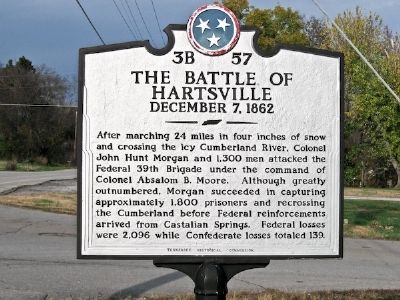
Battle of Hartsville, TN

Battle of Hartsville, TN

A very interesting (though often little known) conflict of some substance took place on this date of December 7, 1862 – 150 years ago today in Hartsville, Tennessee.  And like an infamous event on this calendar date 79 years later in Hawaii, it was accomplished with an early morning surprise attack!

battle of hartsvilleThe end of this month and calendar turnover into 2013 will mark the 150th anniversary of the Battle of Stones River (Murfreesboro) – a huge event with the highest percentage of loss on both sides of any major battle of the Civil War. The event of today’s topic is a part of the campaign and movements leading toward that eventual cataclysmic occurrence.

General Braxton Bragg and his Army of the Tennessee had retreated southeast from Nashville after his loss at the Battle of Perryville in early October. Union General William S. Rosecrans was moving his Army of the Cumberland also to the southeast toward Murfreesboro.

Hartsville was a crossing point on the Cumberland River about 40 miles upstream from Nashville, north of Murfreesboro. Guarding the river crossing at Hartsville was a 2,400-man brigade consisting of the 106th and 108th Ohio Infantry, 104th Illinois Infantry, and 2nd Indiana Cavalry commanded by Colonel Absalom B. Moore.

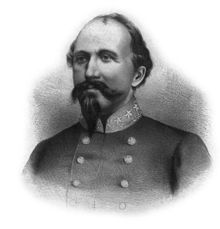
John Hunt Morgan

John Hunt Morgan

Bragg ordered the 1,300-man force of General John Hunt Morgan on a raid to the north to harass the supply lines of the advancing Union men. In severe winter weather that included a river crossing Hunt’s group of largely Kentuckians inflicted a dawn attack that completely surprised Moore’s men. By 8:30, totally surrounded, they surrendered. The Confederates lost about 135 casualties in the quick conflict, but came away with a huge stash of supplies and 1,844 prisoners! General Joseph E. Johnston called this a “brilliant feat” and recommended that Morgan be appointed brigadier general – accomplished almost immediately, as Jefferson Davis happened to be in the vicinity at Murfreesboro and promoted Morgan in person when he arrived.

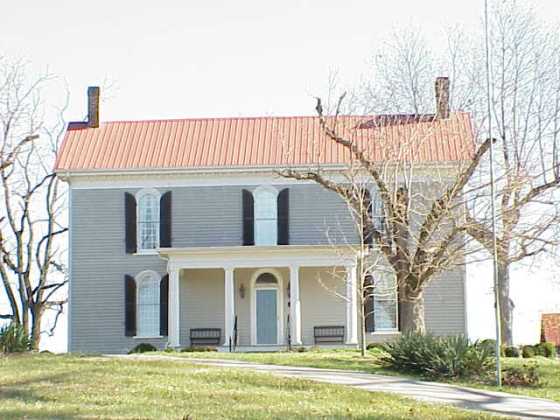
Herod House on the Hartsville Battlefield. Bloodstains on the floor indicate that the wounded were treated here.

Herod House on the Hartsville Battlefield. Bloodstains on the floor indicate that the wounded were treated here.

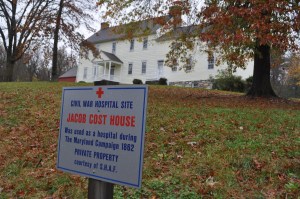
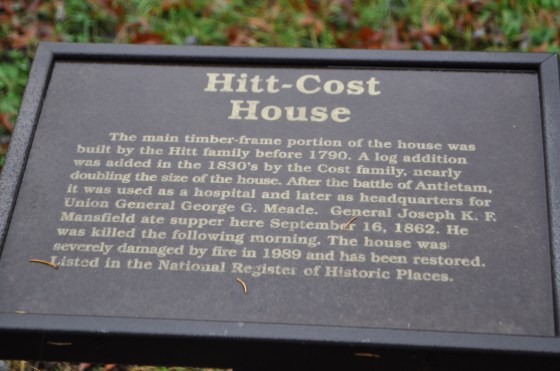
Antietam Aftermath – The Cost Hospital

On occasions when hosting guests at Antietam, if there is extra time, or if weather or circumstances around the visitor’s center preclude an ability for an orientation talk there, I will take guests on a more circuitous route that includes the town of Keedysville. I continue to believe it is best for guests to have the first 30-40 minutes from the vantage point of the visitor’s center, yet it is also nice to be able to show people a few extra sights not generally seen by the public on the battlefield itself.

DSC_0002When I take this more circuitous route, I return guests to the battlefield on back roads that cross the Upper Bridge over the Antietam – a sight worth seeing (HERE is what it looked like during Superstorm Sandy).

On the east bank of the Antietam at this location is the Cost Hospital. It was a very significant hospital location – very close in fact to the Pry Mill.

The following excerpt is from “A History of Washington County, Maryland, from the Earliest Settlements to the Present Time, Including a History of Hagerstown” by Thomas John Chew Williams – published in 1906.

At nine o’clock on the morning of September 17, 1862 while the battle of Antietam was raging around him, Dr. Wilcox, of New York, established an emergency hospital on his premises, in which over 500 wounded soldiers were cared for, occupying his barn and out buildings; 25 of them being accommodated in his parlor. Twenty-two died there and were buried on Mr. Cost’s farm, but were afterward removed to the National Cemetery, Sharpsburg. At the end of seventeen days the hospital was removed from his place to Smoketown. In every way possible Mr. Cost gave his aid to the Union forces. General Meade had his headquarters in his home for some time.

The writing also says about Jacob Cost that He has always been noted among his neighbors and acquaintances for his integrity and uprightness of character. He is a man whose chief aim in life has not been personal aggrandizement, but rather the promotion of the well-being of all the people. He has not sought to become wealthy at the expense of the rights of others, but has steadily amassed a comfortable fortune by honest industry. He has been a staunch adherent of the Republican Party, and a friend to the cause of education and everything tending to promote the general good.

DSC_0003

Texas Brigade Reminiscences of Judge Stevens – Part 5

Before I soon begin writing about the Battle of Fredericksburg, I am posting five parts of a new War reminiscences collection – one that I’ll likely also use from time to time moving forward through the next couple years. These will be from “Reminiscences of the Civil War: by Judge John W. Stevens, a Soldier in Hood’s Texas Brigade, Army of Northern Virginia.”  Stevens served in the 5th Texas Infantry. This final portion describes his departure from Maryland as a wounded soldier. As always when I do these sorts of posts, the italicized text is Stevens’ writing, whereas my remarks will be in regular type, enclosed within [brackets].

Before writing briefly of his experience of leaving the battlefield, Sharpsburg, and Maryland to cross the Potomac into Shepherdstown, Virginia (at that time not yet WV), Stevens’ pen flowed with tributes to the bravery and losses of his gallant comrades:

Richard Snowden Andrews

In after years when rosy spring time comes with fragrant flowers, the fair maidens of Maryland will assemble on the banks of the clear sparkling waters of the Antietam and shroud the graves of the soldier dead, with garlands of nature’s most, loving offerings. Their fair hands will bedeck the little mounds with the gorgeous rose, the queenly tulip, the sweet scented pink, the beautiful purple tinted heliotrope and the fair, majestic lily. The orator of the day will tell in thrilling language how Hood with his two brigades held the gap and drove the enemy in front until McLaws came to Johnson’s aid (Bushrod Johnson.) [This is beautiful writing, and Bushrod Johnson is an interesting Confederate General to say the least, but he was not at Antietam. McLaws’ Division did come to the aid of the Confederates as a major part of the tremendous ENFILADING LINES action in the West Woods. And since the cemetery at Antietam contains only the Union dead, I’m not sure the fair daughters of Maryland are singing the tributes to the Confederate dead nor the orator especially praising General Hood, but it made for great prose.]  The chorus of lovely daughters of old Maryland—a state which through all time had been an asylum for religious liberty and has sent brave men to battle by sea and by land—will make the woods melodious with that ever memorable song “Stonewall Jackson is on Your Shore, My Maryland, My Maryland.” The old Maryland battery, once commanded by the brave Snowden Andrews, will be brought out, manned and planted in position and will make the hills resound with its thundering salutes in honor of the distinguished dead. [Again, Snowden Andrews was not at Antietam, nor was the Maryland Battery – was likely at Harpers Ferry, or en route. Andrews was from Baltimore, and he was an architect who designed Government House – the residence of the Governor in Maryland. Andrews suffered a severe intestinal wound at the 8/9/62 Battle of Cedar Mountain, VA. The surgeon remarked that Andrews had but a 1 in 100 chance of surviving, to which is said, “Well, I am going to hold on to my one chance.” He survived, though was not back to service by the time of Antietam. No doubt Stevens knew these men, but is here speaking broadly in flowery language.]

Government House – Annapolis

I suppose it was about 8 o’clock in the morning when I reached the field hospital. Dr. Breckenridge, our regimental surgeon, after examining my wound, said to me if I was able to walk to try to cross the Potomac river, three miles distant, at Shepherdstown. So, on I moved, weak and faint from loss of blood and the pain I was suffering. Just at sundown that evening I got into the town, on the south side of the river. There I met Major Littlefield, who gave me three army biscuits—more than I had had to eat in three days previously. I thought it was the sweetest morsel of bread I had ever tasted. A bed was provided for me and there I remained until the morning of the 19th, when I was sent to the hospital at Winchester, some thirty miles away.

[One would presume this must refer to George Washington Littlefield – though he was not a Major at the time of Antietam. He was promoted to that as he lay unconscious on the battlefield of Mossy Creek (TN) in December of 1863. He was the quintessential self-made Texas cattleman and banker. But again, I have to wonder about this identification, as Littlefield was associated with the 8th Texas Cavalry – not connected with Antietam. There was a J.H. Littlefield in the 5th Texas, though he was not of the rank of Major. Details, details.]

Texas Brigade Reminiscences of Judge Stevens – Part 4

Here is the fourth of five posts from “Reminiscences of the Civil War: by Judge John W. Stevens, a Soldier in Hood’s Texas Brigade, Army of Northern Virginia.”  Stevens served in the 5th Texas Infantry and, as we’ll read today, was wounded at Antietam. The italicized text is Stevens’ writing, whereas my remarks will be in regular type, enclosed within [brackets].

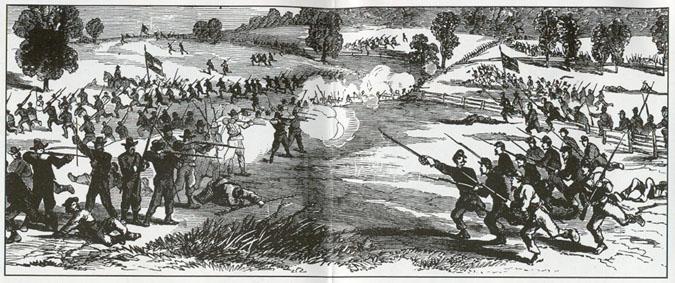
Just before daylight on the morning of the 17th we had some meat and flour issued to us with orders to cook it at once. No such order was necessary, as we had been practically without rations for three days; hence the starting of the fires and wetting up of the flour in any way we could was started at once. Some of us used an old scrap of oil cloth or one corner of our blankets as bread, trays. We all understood that we must work in a hurry or go into battle with very empty craws. But daylight came too soon, the smoke of our fires proving a good mark to indicate to the Federals where our lines were. They began to shell us with their canister shot and at the same time to advance their lines. The falling shot raked our bread pans, skillets and fires right and left, putting a complete check to all preparations for the much needed breakfast. Simultaneously with this our commanders came dashing down the line ordering us to fall in, load and prepare for action, and in less time than it takes to pen these lines we were in line and moving out in battle array to play our part in what is said to be the hardest fought battle of the war. It is about 600 yards across an open field to the point at which we had been relieved the night before by a command of Georgia troops.

They are now hotly engaged and we are moving on to support them. The enemy is pressing them back and at the same time raining a terrible shower of shell and shrapnel on us as we advance. We are suffering terribly and our men are falling all along the line. The Georgians are being cut to pieces badly by overpowering numbers who are pressing them back. We advance at double-quick and cheer the Georgians. More than half their number lie stretched upon the ground. As they close up their ranks to the left an opening is made which admits our brigade; we cheer our friends and raise the rebel yell as we take positions in line, now in sixty or seventy yards of the enemies line. We charge them with a yell, and not only check their advance but push them back some 400 or 500 yards, but at a most terrible cost.

At this point this writer received a painful wound that left him flat on his back on the ground, where in a few minutes he received a second wound that for some time left him unconscious on the field. Upon recovering consciousness, to his horror, our lines were falling back. The idea of falling into the hands of the enemy was too horrible to be considered, so, making an effort to stand up, I found that I was not disabled so badly that I could not walk. Therefore I determined to make my exit to the field hospital, some 700 yards to the rear in an old barn.

[The movement being described here is that of the 5th Texas essentially coming out of the West Woods very near the Dunker Church, and then moving to the northeast along the Smoketown Road. This would have them passing over the ground where today is the Maryland Monument, and moving across the Mumma Farm Lane – passing the 4th and 44th Georgia regiments of Ripley’s Brigade. Beyond that they would have entered the extreme southeast sections of the East Woods. Here they would have been engaged with driving back elements of Rickett’s Division of the 1st Corps, then later being driven by Crawford’s Division of Mansfield’s 12th Corps.]

Of the battle of the 5th Texas, Ike Turner wrote in his report:  “About 8 o’clock at night we were relieved, and retired to the [West] woods in rear of the [Dunker] church. Slept until about day, when firing commenced in front. We were called to attention; thrown around the hill in line of battle to protect us from grape and shell. We had not occupied this position more than half an hour before we were ordered out as support for the Third Brigade. We caught up with said brigade where our first line had been fighting. Here the Fifth was ordered to halt by Major [Captain] Sellers, and allow the regiments on the right of the Third to advance. While lying here, General Hood rode up, ordering me to incline to the right, press forward, and drive the enemy out of the woods, which we did. The enemy twice tried to regain their position in the woods by advancing a force through the lower edge of the corn-field, which we repulsed. From a point of timber about 400 yards to our front and left, I discovered strong reinforcements marching out by the left flank down a hollow, which protected them from our fire. Allowing them to get within 75 yards of us with lines unbroken, I saw we would soon be hard pressed. Sent four times to Major [Captain] Sellers for support, determined to hold my position as long as possible. My men, were out of ammunition, the enemy not more than 100 yards in my front, no support, no ammunition; all our troops had fallen back on my left; I deemed it prudent to fall back also.

The casualties of the regiment were 5 killed and 81 wounded total, 86. Of the wounded, 3 were mortally, and have died; 16 were not removed from the field, and 2 were left on the Maryland side in hospital for want of transportation.

Texas Brigade Reminiscences of Judge Stevens – Part 3

Skirmishes large and small on September 15 and 16

This is the third of five posts from “Reminiscences of the Civil War: by Judge John W. Stevens, a Soldier in Hood’s Texas Brigade, Army of Northern Virginia.”  Stevens served in the 5th Texas Infantry. This segment will talk much about skirmishing action on September 16th – the eve of the great Battle of Antietam.

Most folks know that Antietam is considered the bloodiest single day in American history. However, I don’t believe many people realize how much skirmishing action took place the day and evening before the battle, as the contending armies took place on the field of conflict. This account is a riveting little story of one such encounter. As always when I do these sorts of posts, the italicized text is Stevens’ writing, whereas my remarks will be in regular type, enclosed within [brackets].

[Talking about the 15th] All day we were in line. The Federals pursue us and form their line on the north side of the river [actually meaning the east side of the Antietam]; both armies are now arranging for what promises to be another severe battle.

Our sharp-shooters are all along the river on the river bank, disputing every inch of ground. The rattling of musketry is at times very interesting, now and then the booming of artillery and the whizzing of shell remind us that the terrible conflict is coming. From some cause we have no rations; why? I cannot at this late date tell, but I know we had none. I remember breaking into a deserted dwelling, but found nothing but some pickles and apple butter. I thought the apple butter the best thing I ever tasted. About noon Gen. Lee had the news read to us that Jackson had just captured Harper’s ferry with 11,000 men, 20,000 stand of small arms and 70 pieces of artillery. We yelled, but still we were hungry; thus passed away the 15th. [Why did they have no food? Well, marching and fighting and marching and fighting… it was all too much to provision. It is interesting that Stevens writes about hearing the recent capture of Harpers Ferry. Indeed, it was but about 3-4 hours before he reports this news reaching the men. I have read of accounts of the contending sides being so close that when the Confederates cheered the news, the Federals were able to yell over and ask what the ruckus was about! But the good news of the fall of Harpers Ferry, received at the good ground for a battle on the west side of the Antietam, worked toward Lee making what he hoped would be a good decision – to make a stand on the ridge outside Sharpsburg, Maryland.]

[As a Greek linguistics scholar by training, this next paragraph is interesting to me – to see how Stevens vacillates between the present and past tenses. In Classical or Koine Greek, this is called an aoristic present… the idea being that the writer is talking of the past in such a vivid context that he slips into the present as if it was happening while being written.] Next day was merely a repetition of the 15th, except that each army had their lines more definitely formed and our friends in blue had effected a crossing of a good part of their army to the south side of the Antietam river. [Actually, it was only about 20%.]  There was more or less skirmishing all day the 16th. Jackson has been moving to join us ever since Harpers Ferry fell on the 15th. He reached us tonight, and all night he is engaged in forming his line. As dark on the 16th closes down upon us, the two lines where this writer was were about 400 yards apart. About 9 p.m. our regimental commander, Capt. Ike Turner, concluded that the enemy was trying to advance their lines under cover of darkness—starlight only. [Most veterans I’ve read who talk about the night before the battle talk about the rain – though maybe it started later than this time, or maybe it is yet another figure of speech.] This writer was detailed to call for one volunteer from each company, ten men, and to take them and go forward for the purpose of ascertaining the truth of this apprehension. Now, you must remember that was the first time since I left old Concord church, in Liberty County, that I had commanded anything except one gun. So, of course, for the time I felt that to some extent the success of the South rested upon my shoulders. So away we went, eleven of us, to feel for McClellan’s army. We felt of it, and it felt of us, too. We advanced carefully along for about 300 yards through some open woods—no underbrush—and the first thing we knew we were right up at the Yankee pickets. They thought we were their own men until we were right on them. Then the ball opened and I recall there was about the hottest fight of the war for about fifteen minutes, considering the number engaged. We all got mixed up until we hardly knew each other apart in the darkness. The blaze from their guns was blinding to us, yet we kept pegging away. This lasted I suppose for a full fifteen minutes, when all at once, as if by magic, the enemy ceased firing and vanished. Where they went to or what became of them we could not tell, only they were gone except about half a dozen dead ones, and we had lost five of our boys, all killed. In the melee we lost our bearings; as we were consulting about this, our commander sent for us to return. When we got back he complimented us for what we had done and said we had fully accomplished his purpose in sending us out. [This firefight would have been in the East Woods – the same place the 5th would fight the next day.]

About 10 o’clock that night we were relieved and ordered back about 600 yards to rest, and draw rations, which we did not get until about daylight next morning, and then too late to get the benefit of them, as you will understand we were ordered into battle before sunrise on the 17th, the hungriest set of rebels that ever fought a battle.

Referring to the little fight above mentioned, I can only recall the names now of two of the men who were with me: Hardy Allen, of Co. “E,” and House, of Co. “H.”

Allen was killed dead—shot through the breast. He was standing close to my side. I heard the death missile as it hit him, making a sound as though he had slapped his hands together. House was killed in a moment after just to my right.

Such a fight as that during the Spanish-American war would have filled the columns of the daily papers for two or three weeks, and every survivor would have been dubbed a hero, and possibly promoted. And yet I doubt if half the men in our regiment knew anything of it, and nobody thought of it 24 hours.
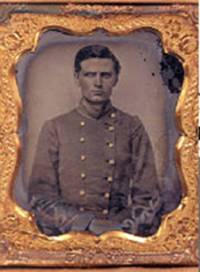
Isaac Newton Moreland Turner

[Concerning this fight, the report of Captain Turner – written a week after the battle – says that “Late in the evening of the 16th instant our brigade was moved by the left flank from the position we had been occupying during the day to a field in front of a church. We had not occupied our new position long before a brisk fire commenced between our skirmishers and those of the enemy. The Fifth Texas Regiment was ordered to the edge of the [East?] woods as a support for our skirmishers. On arriving at the position assigned our skirmishers, being hard pressed, fell back and passed to my right. I ordered the regiment to commence firing, which checked the advance of the enemy.”]

Isaac Newton Moreland Turner is an interesting character. From a plantation background in Georgia and Texas, and only age 22 at the time of Antietam, he was a dashing leader with a bit of a flair for being a dare-devil. He was mortally wounded in April of 1863 and expressed at the end his desire to be taken back to Texas. However, it was only possible to get him back to the old plantation in Georgia to be buried. In 1994, a Confederate Sons group made possible the dying wish for his remains to return to the homestead in Texas.

Texas Brigade Reminiscences of Judge Stevens – Part 2

This is the second of five posts from “Reminiscences of the Civil War: by Judge John W. Stevens, a Soldier in Hood’s Texas Brigade, Army of Northern Virginia.”  Stevens served in the 5th Texas Infantry. He was wounded at Antietam and captured on the second day at Gettysburg. He was later a Judge in Hill County, Texas. This publication was from 1902.

This segment will talk about a very unique experience on South Mountain. And as always when I do these sorts of posts, the italicized text is Stevens’ writing, whereas my remarks will be in regular type, enclosed within [brackets].

The 5th Texas found themselves late in the day at the Battle of South Mountain (September 14th – three days before Antietam) near Fox’s Gap. They were to the north side of the gap (facing south), essentially between Fox’s and Turner’s Gaps.

Our brigade was maneuvered and moved from one point to another on the mountain up and down, all the evening under fire from both artillery and small arms, sometimes in very close proximity to the enemy, sometimes in full view of the charges and counter-charges made at different parts along the line of battle; but as my memory now reaches back, I am inclined to think that so far as results to either side it was not much of a battle. True, there was a constant roar of both small arms and artillery, but when night put a quietus to operations both armies seemed not to have accomplished anything further than to kill and wound a few of each other. [This is a rather scant view of the action at South Mountain. It was clearly a loss for the Confederates, though they held the gaps as darkness fell … and more than “a few of each other were killed or wounded. With just over 5,000 casualties (more than 1st Bull Run), it ranks about 33rd in terms of total casualties – it simply tends to get overlooked in the shadows of Antietam.]

Really, it was not a place to fight a battle and I suppose all Gen. Lee wished to do was to put a temporary check on McClellan, who was now in chief command of the federal troops once more, the great Bombastes – Furioso Pope having been bound up in red tape and decently laid away for the remainder of the war. [John Pope, who had commanded Federal forces at 2nd Bull Run just three weeks before Antietam, was an especially hated figure by the South. Having made many grandiloquent statements about what he would do to the Rebels, and verbalizing and promoting a concept of “hard war” affecting civilian populations, even the kindly Robert E. Lee called him a “miscreant.” The reference to him as the great Bombastes Furioso referred to an immensely popular 19th century comic opera that ridiculed the grandiose style of operas that was much in vogue at that time.]

Col B F Carter – 4th TX

Just after dark that night and when everything was as quiet as a graveyard, Col. B. F. Carter, of the Fourth Texas regiment, came to our regiment and called for two men, for what purpose I did not understand. This writer and another man were detailed and ordered to follow him. He carried us down the mountain some 300 or 400 yards from where we lay in line, through a thick brush to a fence on the side of the mountain. We were halted at the fence, beyond which was open ground, and about 100 yards beyond the fence was a line of Federals. Some were standing up, with the line officers on horseback, but the most of them were lying down. Myself and comrade were placed in the corner of the fence with our guns pointing through the cracks between the rails. When we were thus posted Col. Carter ordered us to remain there and watch the movements of the enemy, to keep very quiet, and if they should advance to wait until their line was within twenty feet of the fence and then fire and fall back in all possible haste to our command. [Col. Carter was mortally wounded at Gettysburg, dying in Virginia in September of 1863.]

We sat there I suppose for an hour, or possibly two hours, conversing in a whisper and calculating the chances of escape should they advance upon us and should we wait until they were within twenty feet of us before we fell back. Now, I want to say right here that I got the biggest scare of the war right there. It seemed to me that I got as large as an ox and it appeared to me that the enemy knew we were in that fence corner looking at them and that if they moved up there we were sure to be killed. A kind of nervous demoralization seemed to take complete control of me, but I was very careful to keep it concealed from my comrade.

I talked to him as though I wanted them to come so I could get to take deliberate aim at one and know I had killed him. (I found out a month later that my comrade was as bad, or worse scared than I was.) Did you ever walk through or near a graveyard when a boy and whistle to keep up your courage?

Finally the Yankee officer called in a low tone, “Attention!'” and they were all on their feet at once. ”Guide center; forward, march!” We thought they were coming toward us. Every hair on my head stood up like a porcupine’s quills. We could not tell for the life of us whether they were moving toward us or away from us until they had gone some twenty-five or thirty steps. Greatly to our relief, we found they were moving in an opposite direction. I never felt so happy in my life, and in a few minutes my scare went off and I felt like I could whip a whole line of Yanks, especially when they were out of my reach. We were soon called back to our command and about midnight we began what I suppose you might call a retreat. We moved toward Sharpsburg, crossing the Antietam river about sun up, and a little way after crossing it we formed a line of battle, between the town and river, about three miles from the Potomac. [Indeed the entire Confederate force fell off the mountain overnight. To call the Antietam a “river” is rather generous! Anyone who has driven through Fox’s Gap and knows the lay of the land in the region of which the author writes, can certainly picture and imagine this scene.]

Texas Brigade Reminiscences of Judge Stevens – Part 1

Before I begin some writing about the Fredericksburg conflict in December, I’m going to post five parts of a new (to me) War reminiscences collection – one that I’ll likely also use from time to time moving forward through the next couple years. I’ve needed to add more Confederate reading to my list and references, and I’ve enjoyed the following as that of a fellow who writes well. To write well – that is something I really respect about anyone of any generation, and I believe that reading the incredibly descriptive prose of so many Civil War writers is something I enjoy essentially as much as the content of their accounts.

Judge Stevens

These posts will be from “Reminiscences of the Civil War: by Judge John W. Stevens, a Soldier in Hood’s Texas Brigade, Army of Northern Virginia.”  Stevens served in the 5th Texas Infantry. He was wounded at Antietam and captured on the second day at Gettysburg. He was later a Judge in Hill County, Texas. He was also a Methodist Preacher (the preacher part accounting for his descriptive abilities – at least that’s my belief, and I’m sticking to it!).

This publication was from 1902. Sensing that some folks might believe his memory was poor or that he embellished or fabricated his stories, the foreword of the book references a number of veterans who affirm they have read his manuscript and can validate the accuracy of his remarks.

I am going to include four excerpts that talk about South Mountain, skirmishing on the 16th, the Battle of Antietam, and the departure from Maryland, but first I’m going to share the preface to the book. As always when I do these sorts of posts, the italicized text is Stevens’ writing, whereas my remarks will be in regular type, enclosed within [brackets].

Preface

It is not without some misgivings, that I have given out to the public, in book form, these sketches. Some five or six years ago I began writing them, for the entertainment of the young folks, and run them through the “Picayune,” a little Daily published in this city by Mr. Preston Ivy. [The city he is talking about in Hillsboro, TX.  He later references also writing up these sketches in better, more corrected form for a publication called the “Hillsboro Mirror, and comments that the demand for printing them in book form has been so flattering, that I have yielded, and here it is.]

At the beginning I had no thought of their reaching beyond half a dozen chapters; but as my pen moved over the paper, the matter grew upon me, and I continued to write, and as I wrote, the matter continued to grow; the great conflict passed before me in panoramic view. The city of Richmond, the great lines of breast work, the army in camp, the fields, the mountains, the valleys of Old Virginia, the grand old James as she moved along to the sea, the broad Shenandoah whose banks were stained with the blood of patriots, the majestic Potomac, the sanguinary fields of conflict all over this grand old state, also the bloody “Lane” at Sharpsburg. The placid waters of the Antietam, red with the South’s best blood, the rugged heights of Gettysburg, down whose rocky faces, rivers of our most sacred blood run in torrents. All these scenes passed before my vision as vividly, and as fresh as if it were now taking place… until I was completely lost in reverie. Arousing myself from this mental slumber, I see two vast armies in martial array. The colors are fluttering in the breeze. Drums are beating; fifes are blowing, all to the tune of Dixie. The very air is redolent with martial music. For miles in every direction vast lines of men are moving into position in quick step.

I look again; I see the world’s greatest military leader mounted on old “Traveler” calmly riding to the front, surrounded by his official staff. Majesty sits enthroned upon his noble brow, his countenance is as serene and quiet as a babe in his mother’s arms—with one sweep of his field glass he takes in the situation—he orders in a calm tone the attack, like a lightning flash, his aids-de-camp move with his orders to A. P. Hill, to Longstreet, to Jackson, to Ewell. Two vast lines of men rush together in titanic conflict—the small arms are deafening, the thunderous roar of a hundred batteries is jarring the very heavens. The prostrate forms of thousands of dead and dying cover the ground. Hampton and Stewart, with Pelham’s horse artillery are on the flank—they are not idle. All this passes swiftly before my mind, as though it were now transpiring. You ask me how it is I can remember so much—my reply is how could I ever forget it?

I could have written a hundred chapters just as well as what I have written, and then, the half would not be told.

That is beautiful writing!  (And yes, at Antietam, on Nicodemus Heights, was J.E.B. Stewart with Pelham’s horse artillery.) Truly, the grand spectacle of participation in the Civil War forged indelible stamps upon the minds and souls of its participants. I do not doubt at all that their memories, even 40 years or more later when many of them at long last wrote their reminiscences, were fairly sharp and reliable. In that the War has such capacity to engage our imaginations here some 150 years later, what are but four decades to an eyewitness participant of the national drama?